
404 · Launch Video Breakdown: Hook, Pacing & Motion Design
404 introduces a 3JS game generator: point an agent at the repo, describe a game, and it produces a playable scene with generated assets.
Scene-by-scene timeline & spoken transcript
The Hook
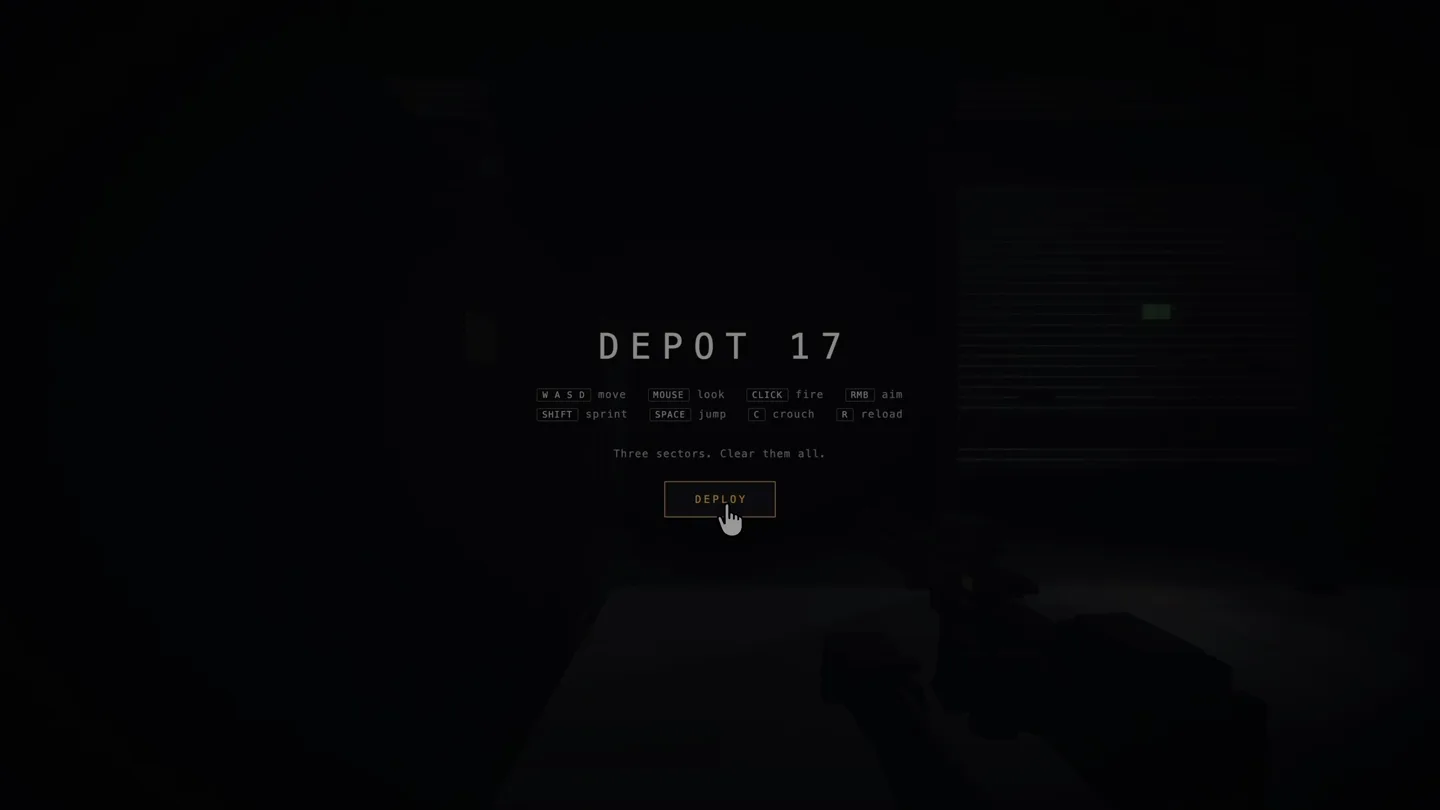
Game Intro & High-Energy Drop
“(No spoken dialogue — Driving electronic beat with 808s, sub-bass, pizzicato synth, high-energy riser at 0:02, percussive drop, and sub-bass impact at 0:04.)”
- On screen
- DEPOT 17 NIGHT OPERATION building depot OBJECTIVE CLEAR LOADING DOCK 10 HOSTILES SECTOR 1/3 SECTOR 1 - LOADING DOCK 30 / 210 9MM CARBINE 45 fps 140.000 100% tick med
- Camera
- Initial static text screen, then first-person perspective (FPS) game camera, panning slightly and moving forward through a dark industrial environment.
- Motion
- Rapid scene cuts, text reveal with subtle underline animation, quick camera movements simulating gameplay, dynamic lighting changes from dark to illuminated.
Problem Agitation
Intense Combat & Low Vitals
“You can't eat money, oh no.”
- On screen
- OBJECTIVE CLEAR LOADING DOCK 8 HOSTILES SECTOR 1/3 +100 7 / 210 9MM CARBINE 5 / 210 9MM CARBINE 30 / 185 9MM CARBINE 22 / 185 9MM CARBINE 19 / 185 9MM CARBINE 18 / 185 9MM CARBINE 16 / 185 9MM CARBINE 8 / 185 9MM CARBINE LOW VITALS 30 / 163 9MM CARBINE
- Camera
- First-person perspective, rapid strafing, aiming, and shooting movements. Quick cuts between different angles of the same combat scenario.
- Motion
- Fast-paced action montage, screen shake on impacts, red vignette indicating damage, score pop-ups (+100), weapon recoil animation, enemy target acquisition.
Product Reveal
Transition to Main Floor & Brand Logo
“You can't eat money, oh no.”
- On screen
- OBJECTIVE CLEAR MAIN FLOOR 32 HOSTILES SECTOR 2/3 SECTOR 2 - MAIN FLOOR 13 / 153 9MM CARBINE 8 HOSTILES SECTOR 2/3 HEADSHOT +150 23 / 188 9MM CARBINE 21 / 188 9MM CARBINE 18 / 188 9MM CARBINE 404
- Camera
- Continued first-person gameplay, moving through a new section of the warehouse. Ends with a quick zoom into the '404' logo.
- Motion
- Seamless transition between game sectors, more combat, score pop-ups, and a sudden, impactful reveal of the '404' brand logo with a distinct, stylized font.
Feature Teaser
Agent Interaction & Game Generation
“You can't eat money, oh no.”
- On screen
- (No on-screen text)
- Camera
- Abstract camera movements, focusing on UI elements and code snippets, then transitioning to a 3D environment build-up.
- Motion
- Rapid text animation, code snippets appearing and disappearing, 3D model generation, procedural environment creation, and dynamic camera moves showcasing the generated game world.
Call to Action
Final Impact & Outro
“(No spoken dialogue — Final impactful sub-bass hit at 0:40, followed by a sustained synth pad and a subtle, ethereal outro.)”
- On screen
- (No on-screen text)
- Camera
- Slow, deliberate camera pan over a generated 3D scene, then fades to black.
- Motion
- Subtle camera drift, atmospheric lighting, and a gradual fade to black, leaving a lasting impression of the generated world.
Motion design primitives
Synthesizable in Remotion · key components of the fps-combat-fast-cut-generator template.
FPSCombatMontage
Simulates first-person shooter gameplay with rapid cuts, weapon movements, enemy encounters, and on-screen HUD elements like health, ammo, and score pop-ups. Includes screen shake and damage indicators.
+ Code construction recipe
Utilize `Sequence` for rapid scene cuts. Implement `spring` animations for weapon recoil and screen shake. Overlay `AbsoluteFill` with `LinearGradient` for damage vignettes. Use `interpolate` for HUD element opacity and position changes.
ProceduralSceneBuild
Displays a 3D environment being constructed piece by piece, with assets appearing and assembling dynamically. This includes terrain, structures, and interactive elements, often accompanied by code or UI overlays.
+ Code construction recipe
Leverage `ThreeCanvas` for 3D rendering. Use `Sequence` and `delay` to animate individual 3D models appearing and scaling into place. Implement `Shader` components for procedural textures or effects during generation. Animate camera paths with `interpolate`.
GlitchTextReveal
Text appears with a digital glitch effect, often involving color shifts, pixelation, or rapid character displacement, before settling into a clean, legible state. Can be used for titles or key information.
+ Code construction recipe
Apply `Text` component with custom `CSS` filters for glitch effects (e.g., `filter: hue-rotate()`, `transform: translateX()`). Use `interpolate` with `steps()` or `easeOutCubic` for abrupt, digital-like transitions. Combine with `delay` for staggered character reveals.
Style DNA & aesthetic system
Visual aesthetic
Typography
Motion
Special effects
Pacing & rhythm
Conceptual story rhythm
- 1
The Immersion
Purpose. Immediately pulls the viewer into the product's core experience (gameplay) to demonstrate its output.
Execution. Opens with a quick text intro, then plunges directly into intense, first-person shooter gameplay footage with dynamic camera work and sound design.
- 2
The Challenge
Purpose. Highlights the difficulty or complexity of the problem the product solves (creating games).
Execution. Continues with high-stakes combat, showing 'low vitals' and multiple enemies, implying the effort involved in game creation, even if automated.
- 3
The Solution Reveal
Purpose. Introduces the product (404) as the innovative answer to the challenge.
Execution. A sudden cut from gameplay to the '404' logo, followed by abstract UI and code snippets, then a visual demonstration of a 3D game scene being procedurally generated.
- 4
The Empowerment
Purpose. Showcases the ease and power of the product, enabling users to achieve complex results simply.
Execution. The generated 3D scene is fully realized, demonstrating the product's capability to produce playable environments and assets, ending with a sustained, atmospheric shot.
Remix in Animatiq Studio
Master remix prompt · agent-ready
Sample remix
Objective
A new AI-powered architectural design tool that generates building blueprints and 3D models from natural language descriptions.How the recipe adapts
The FPSCombatMontage would be adapted to a 'BlueprintGenerationMontage,' showing rapid cuts of architectural elements snapping into place, floor plans being drawn, and 3D models assembling. The GlitchTextReveal would introduce design parameters like 'Sustainable Materials' or 'High-Rise Residential.' The ProceduralSceneBuild would demonstrate a full building exterior and interior being generated from a text prompt, with the camera smoothly orbiting the evolving structure. The dark, industrial aesthetic would translate to a sleek, modern architectural visualization, with technical UI overlays.Remix blueprint · fps-combat-fast-cut-generator
Scene durations (5 scenes, 43.8s)
Key Remotion components
Related Developer Tools Product Launches
Explore all Developer Tools launches →
xAI opens voice cloning on its API: build a custom voice in about two minutes or pick from 80+ voices in 28 languages.

Agentic CLI for coding, building apps, and automating workflows.

Sakana AI launches Fugu, a multi-agent orchestration system served through a single model API, led by its Fugu Ultra model.