
Ara · Launch Video Breakdown: Hook, Pacing & Motion Design
Ara, the self-driving IDE, ships a new look for even faster coding.
Scene-by-scene timeline & spoken transcript
The Hook
AI-Powered Chat Interface for Coding
“(No spoken dialogue — Driving electronic beat with sub-bass, pizzicato synths, atmospheric pads, and percussive elements.)”
- On screen
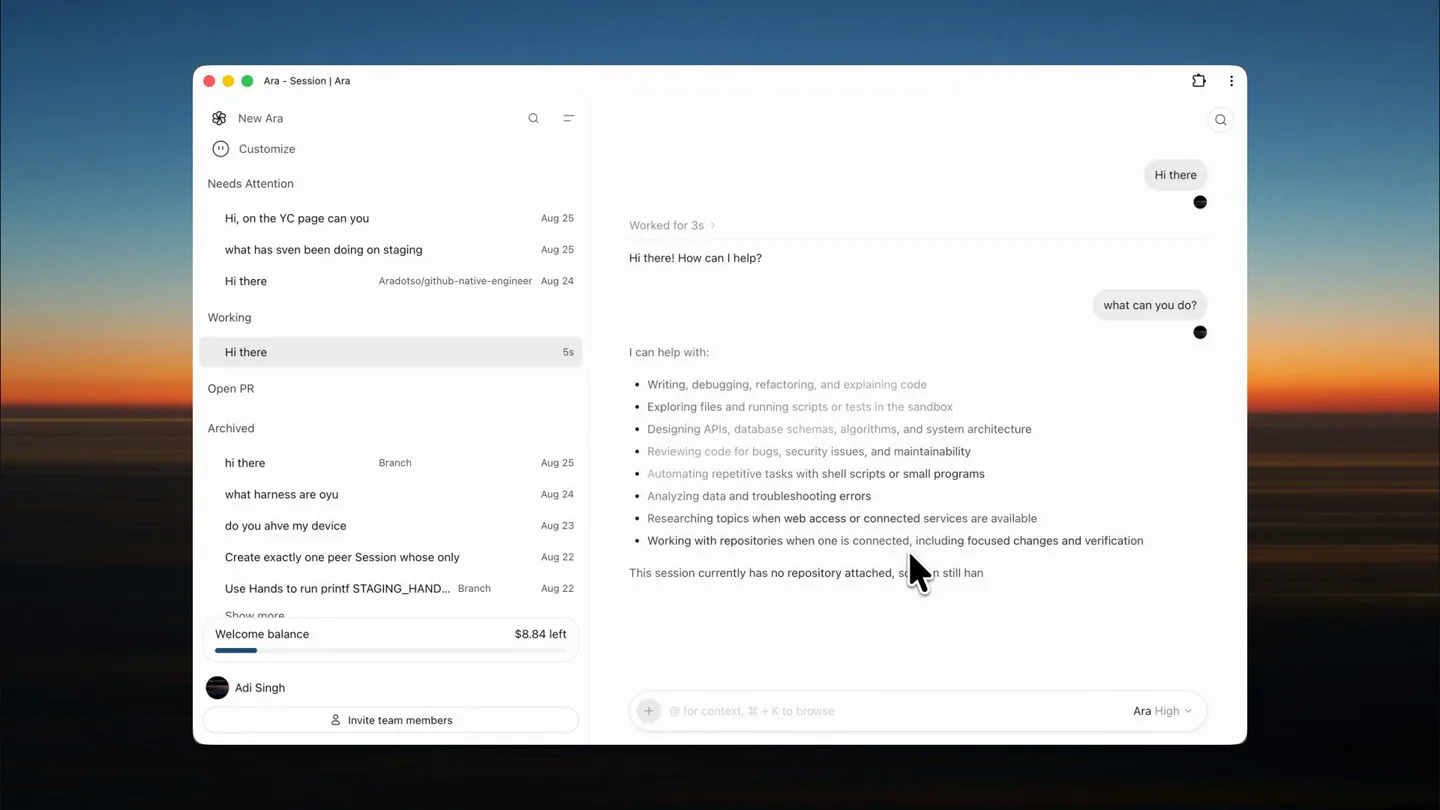
- Hi there Hi, on the YC page can you what has sven been doing on staging Hi there Working Open PR Archived hi there what harness are oyu do you ahve my device create exactly one peer Session whose only Use Hands to run printf STAGING_HAND... Show more Welcome balance Adi Singh Invite team members Ara - Session | Ara New Ara Customize Needs Attention 6:22 AM Aug 25 Aug 25 Aug 24 Aug 23 Aug 22 Aug 22 $8.84 left Branch Hi there! How can I help? 6:22 AM what can you do? Working I can help with: Writing, debugging, refactoring, and explaining code Exploring files and running scripts or tests in the sandbox Designing APIs, database schemas, algorithms, and system architecture Reviewing code for bugs, security issues, and maintainability Automating repetitive tasks with shell scripts or small programs Analyzing data and troubleshooting errors Researching topics when web access or connected services are available Working with repositories when one is connected, including focused changes and verification This session currently has no repository attached, so I can still handle general coding, exploration, scripting, and one-off tasks in the ephemeral workspace. 6:24 AM for content, K + K to browse Ara High
- Camera
- Static, slightly zoomed-in desktop screen capture, focusing on a chat interface.
- Motion
- Real-time UI interaction simulation with cursor movement and text input/output, simulating a user interacting with an AI coding assistant.
Product Reveal
Introducing Ara: The Cloud Coding Agent
“(No spoken dialogue — High-energy audio riser at 0:08, leading into a sub-bass drop/impact at 0:09.)”
- On screen
- Introducing a new Ara The cloud coding agent.
- Camera
- Static, centered text on a white background.
- Motion
- Text reveal animation: 'Ara' fades in, followed by a subtle icon animation, then 'The cloud coding agent.' fades in. Simple, clean typography animation.
Feature Teaser
Customizable UI and Workflow
“(No spoken dialogue — Driving electronic beat continues with pizzicato synths and percussive elements.)”
- On screen
- Email adi@ara.so Appearance Theme Follow System Aug 25 Aug 24 Aug 23 Aug 22 Aug 22 Language English Session UI Choose Codex or Claude Code, then its layout. Codex Claude Code Sidepanel 1 page Tools open in the tabbed Tools replace chat in the sidepanel active pane Ara subscription Ara Hobby Connected $8.84 left A custom UI like Claude Code and Codex. Plugins UI Code Settings History Profile Adi Show on your runs and across the workspace Change Remove Email adi@ara.so Appearance Theme Follow System Language English Session UI Choose Codex or Claude Code, then its layout. Codex Claude Code Sidepanel 1 page Tools open in the tabbed Tools replace chat in the sidepanel active pane Ara subscription Ara Hobby Connected Providers + Connect Worked for 8s Hi, on the YC page ... Session 3 7 Simplify/remove the oversized subtitle text. Change the title to "Twenty $5000 for YC founders." Place the fade-in white-text scroll section directly beneath the title and subtitle. Keep the three feature cards beneath it. Verify the result and push the change to main. 25k and the repo is GitHub native engineer Worked for 18s for content, K + K to browse Ara High Hi there Session 3 7 Let me know if you would like to attach to this session or on a specific repository! Worked for 15m 40s Result Here are the repositories currently connected to your environment: Azadotso/github- native-engineer Azadotso/github-natts 'ngineer-sandbox Azadotso/some- monorepo Azadotso/ara-rcp Azadotso/i-a Acme-Ara/nemcode-demo Acme- Ara/GeneralTeto Azadotso/ara-cua Azadotso/cliafarming Let me know if you would like to attach one to this session or work on a specific repository! for content, K + K to browse Ara High
- Camera
- Panning and zooming across different sections of the Ara UI, simulating user interaction and demonstrating features.
- Motion
- Dynamic UI navigation with smooth camera pans and zooms. Text reveals and highlights emphasize key features like UI customization and repository management. A high-energy audio riser occurs at 0:17.
Call to Action
Your Models, Your Subscription, Code at Agent Speed
“(No spoken dialogue — Powerful sub-bass drop/impact at 0:18. Driving electronic beat continues to the end.)”
- On screen
- Your models. Your subscription. Code at the speed of agents. Ara - Skills | Ara Providers + Connect Search providers Subscription AI Anthropic GitHub Copilot Kimi For Coding OpenAI Codex OpenRouter Radius xAI API Ara Switch workspace Change Workspace name The name shown across Ara and in notifications adi's Workspace 5.6 Luna High 5.6 Luna High 5.6 Luna High 5.6 Luna High Google Vertex AI Groq Hugging Face Kimi For Coding MiniMax MiniMax CN Mistral Moonshot AI Moonshot AI CN Qwen Token Plan CN Qwen Token Plan Individual Radius Together Vercel AI Gateway xAI Xiaomi Xiaomi Token Plan AMS Xiaomi Token Plan CN
- Camera
- Alternating between static text on a white background and dynamic UI interaction showcasing provider integration.
- Motion
- Text reveal animation for 'Your models. Your subscription.' and 'Code at the speed of agents.' UI interaction shows scrolling through a list of AI providers, emphasizing flexibility and integration. The video ends with a final text statement.
Motion design primitives
Synthesizable in Remotion · key components of the ara-fast-cut-ui-launch template.
TypingCursorReveal
Simulates real-time typing in a chat interface, with a blinking cursor and text appearing character by character, followed by an AI response appearing instantly.
+ Code construction recipe
Use `Sequence` and `spring` for character-by-character text reveal. Implement a blinking cursor with `interpolate` and `loop` for opacity. AI responses can use a `FadeIn` component with a slight delay.
DynamicUIPanZoom
Smooth, controlled camera pans and zooms across a software interface, highlighting specific elements or sections as if a user is navigating the application.
+ Code construction recipe
Utilize `AbsoluteFill` for the UI content. Animate `transform` properties (scale, translateX, translateY) of the UI container using `spring` or `interpolate` with `ease-in-out` curves for smooth transitions between focal points.
TextFadeIconPop
A primary text element fades in, followed by a related icon appearing with a subtle 'pop' or scale-up animation, then a secondary text element fades in.
+ Code construction recipe
Combine `FadeIn` for text elements. For the icon, use `spring` to animate `scale` from 0 to 1, possibly with a slight overshoot, synchronized with the text fade-in.
Style DNA & aesthetic system
Visual aesthetic
Typography
Motion
Special effects
Pacing & rhythm
Conceptual story rhythm
- 1
Interactive Introduction
Purpose. Immediately immerse the viewer in the product's core interaction loop, demonstrating its intelligence and responsiveness.
Execution. Opening with a simulated chat interaction, showing an AI coding assistant responding to user queries in real-time.
- 2
Core Value Proposition
Purpose. Clearly state what the product is and its primary benefit.
Execution. A clean title card introducing 'Ara, the cloud coding agent' with a subtle logo animation.
- 3
Feature Deep Dive
Purpose. Showcase key functionalities and customization options, highlighting user control and flexibility.
Execution. Dynamic UI pans and zooms demonstrating UI layout options, repository management, and integration with various AI providers.
- 4
Empowerment & Call to Action
Purpose. Reinforce user benefits and encourage adoption by emphasizing speed and control.
Execution. Impactful text cards like 'Your models. Your subscription.' and 'Code at the speed of agents.', interspersed with UI showing extensive provider integration.
Remix in Animatiq Studio
Master remix prompt · agent-ready
Sample remix
Objective
Launch a new AI-powered code refactoring tool called 'RefactorFlow'.How the recipe adapts
The video would open with a simulated IDE showing RefactorFlow suggesting and applying complex code refactors in real-time. The title card would introduce 'RefactorFlow: Intelligent Code Transformation'. Feature demonstrations would involve dynamic pans across the IDE showing different refactoring options, custom rule sets, and integration with various version control systems. The final text cards would emphasize 'Effortless Refactoring. Seamless Integration.' and 'Code Smarter, Not Harder.'.Remix blueprint · ara-fast-cut-ui-launch
Scene durations (4 scenes, 26s)
Key Remotion components
Related Developer Tools Product Launches
Explore all Developer Tools launches →
xAI opens voice cloning on its API: build a custom voice in about two minutes or pick from 80+ voices in 28 languages.

Agentic CLI for coding, building apps, and automating workflows.
Sakana AI launches Fugu, a multi-agent orchestration system served through a single model API, led by its Fugu Ultra model.