
Cap · Launch Video Breakdown: Hook, Pacing & Motion Design
A 100× performance speedup shipped to Cap, the open-source screen recorder.
Scene-by-scene timeline & spoken transcript
The Hook
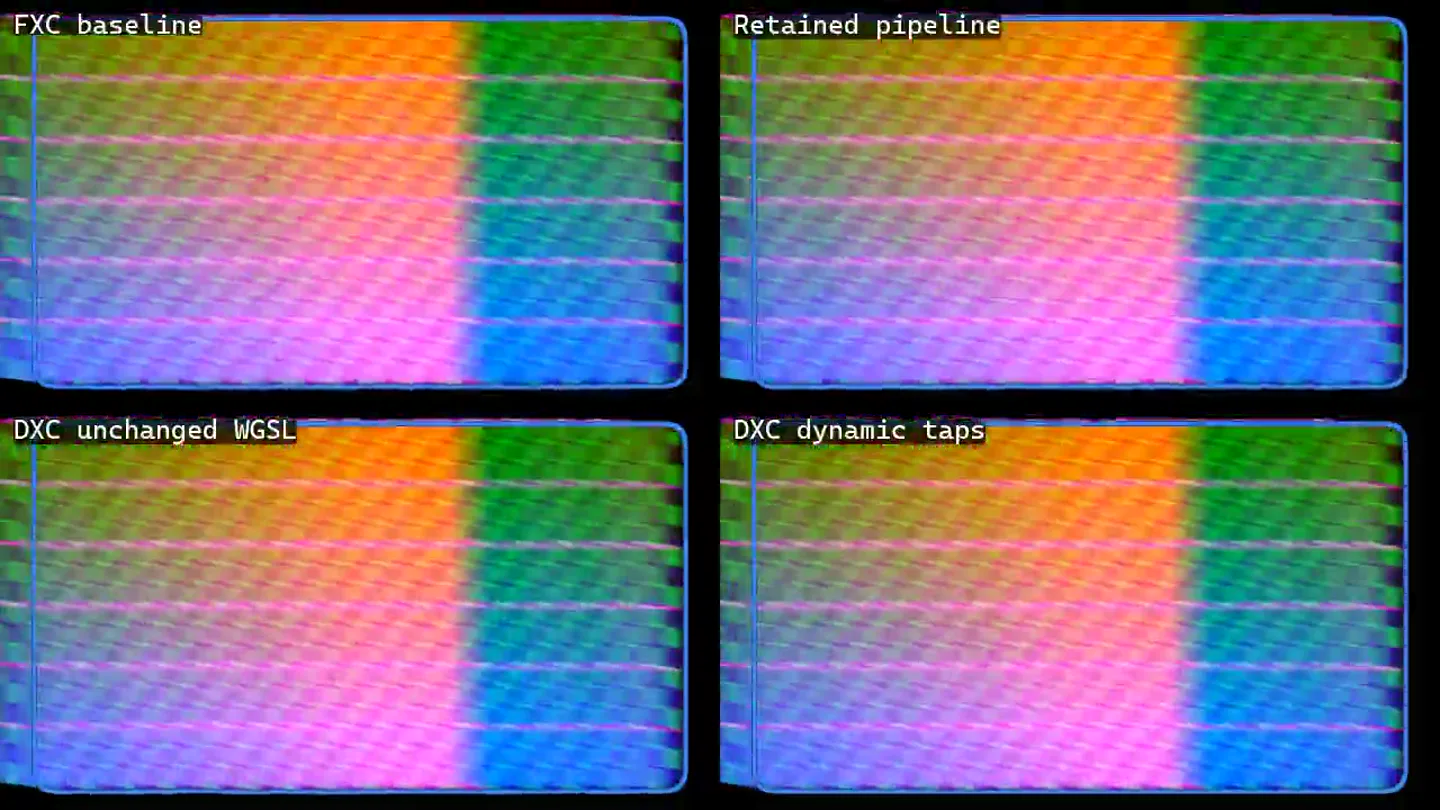
Shader Performance Comparison Grid
“(No spoken dialogue — ambient visual with a subtle, rhythmic pulse implied by the visual changes.)”
- On screen
- FXC baseline Retained pipeline DXC unchanged WGSL DXC dynamic taps
- Camera
- Static, wide shot of a four-panel grid, each panel displaying a shader output.
- Motion
- Subtle, continuous texture animation within each panel, demonstrating real-time shader performance differences.
Problem Agitation
Visualizing Performance Bottlenecks
“(No spoken dialogue — ambient visual with a subtle, rhythmic pulse implied by the visual changes.)”
- On screen
- FXC baseline Retained pipeline DXC unchanged WGSL DXC dynamic taps
- Camera
- Static, wide shot of the four-panel grid.
- Motion
- The texture within each panel shifts and morphs, highlighting the varying visual fidelity and processing patterns across the different shader implementations.
Product Reveal
Dynamic Shader Optimization in Action
“(No spoken dialogue — ambient visual with a subtle, rhythmic pulse implied by the visual changes.)”
- On screen
- FXC baseline Retained pipeline DXC unchanged WGSL DXC dynamic taps
- Camera
- Static, wide shot of the four-panel grid.
- Motion
- The visual patterns within the 'DXC dynamic taps' panel begin to show more intricate and responsive changes, subtly indicating superior performance compared to the others.
Feature Teaser
The Power of Dynamic Taps
“(No spoken dialogue — ambient visual with a subtle, rhythmic pulse implied by the visual changes.)”
- On screen
- FXC baseline Retained pipeline DXC unchanged WGSL DXC dynamic taps
- Camera
- Static, wide shot of the four-panel grid.
- Motion
- The 'DXC dynamic taps' panel continues to display the most complex and fluid animation, visually reinforcing the '100x performance speedup' claim through direct comparison.
Motion design primitives
Synthesizable in Remotion · key components of the quad-panel-shader-comparison template.
QuadPanelShaderGrid
A 2x2 grid layout where each cell displays a distinct, continuously animating shader output. The content within each panel evolves independently or in synchronized patterns.
+ Code construction recipe
Utilize Remotion's <AbsoluteFill> for the main container. Create four child <AbsoluteFill> components, each positioned and sized to form a quadrant. Inside each quadrant, render a custom WebGL shader component, passing different uniform values or shader programs to each to achieve distinct visual effects. Animate uniform values over time using `interpolate()` or `spring()` for continuous motion.
ShaderPatternMorph
A single shader output that continuously transforms its internal patterns, colors, and textures over time, creating a fluid, organic, or geometric evolution.
+ Code construction recipe
Implement a Remotion component that renders a WebGL shader. Animate key shader uniform variables (e.g., time, frequency, amplitude, color shifts) using `useCurrentFrame()` and `interpolate()` to drive the continuous morphing effect. Consider using noise functions or complex mathematical patterns within the shader itself for rich visual transformations.
PerformanceHighlightPulse
A subtle, rhythmic visual pulse or intensification within one specific panel of a grid, drawing attention to its superior performance or visual quality.
+ Code construction recipe
Apply a subtle scaling, glow, or color saturation animation to the target panel's container or directly within its shader. Use `spring()` with a low damping ratio for a gentle, continuous pulse, or `sequence()` with `interpolate()` for a more distinct, repeating emphasis. Ensure the effect is noticeable but not distracting from the core shader animation.
Style DNA & aesthetic system
Visual aesthetic
Typography
Motion
Special effects
Pacing & rhythm
Conceptual story rhythm
- 1
Initial State Comparison
Purpose. Establish the baseline and current state of performance across different shader implementations.
Execution. Four distinct shader outputs are displayed simultaneously, each with a unique visual pattern representing its performance characteristics.
- 2
Problematic Performance Visualized
Purpose. Visually agitate the problem by showing the limitations or less optimal performance of existing methods.
Execution. The 'baseline' and 'retained pipeline' panels show less dynamic or less visually appealing patterns compared to the 'DXC dynamic taps' panel, which hints at superior capability.
- 3
Solution Introduction
Purpose. Introduce the new technology ('DXC dynamic taps') as the superior solution.
Execution. The 'DXC dynamic taps' panel begins to exhibit more complex, fluid, and visually 'better' patterns, subtly outperforming the others.
- 4
Performance Breakthrough Demonstration
Purpose. Conclusively demonstrate the significant performance improvement offered by the new solution.
Execution. The 'DXC dynamic taps' panel consistently displays the most intricate and responsive visual effects, serving as a continuous, compelling demonstration of the '100x speedup'.
Remix in Animatiq Studio
Master remix prompt · agent-ready
Sample remix
Objective
Demonstrate the real-time data processing speed of a new AI inference engine compared to older versions.How the recipe adapts
The 2x2 grid will show four different AI inference engines. Each panel will visualize data throughput as a continuously evolving particle system or a dynamic graph. The 'New AI Engine' panel will display a significantly denser, faster-moving, and more complex particle flow or graph animation, visually representing its superior processing speed and efficiency compared to 'Legacy Engine 1', 'Legacy Engine 2', and 'Optimized Previous Version'.Remix blueprint · quad-panel-shader-comparison
Scene durations (4 scenes, 6s)
Key Remotion components
Related Developer Tools Product Launches
Explore all Developer Tools launches →
xAI opens voice cloning on its API: build a custom voice in about two minutes or pick from 80+ voices in 28 languages.

Agentic CLI for coding, building apps, and automating workflows.
Sakana AI launches Fugu, a multi-agent orchestration system served through a single model API, led by its Fugu Ultra model.