
Scene-by-scene timeline & spoken transcript
The Hook
Introduction to Advanced Research Capabilities
“(No spoken dialogue — A driving, rhythmic synth arpeggio with evolving pads and sub-bass establishes an energetic, futuristic mood.)”
- On screen
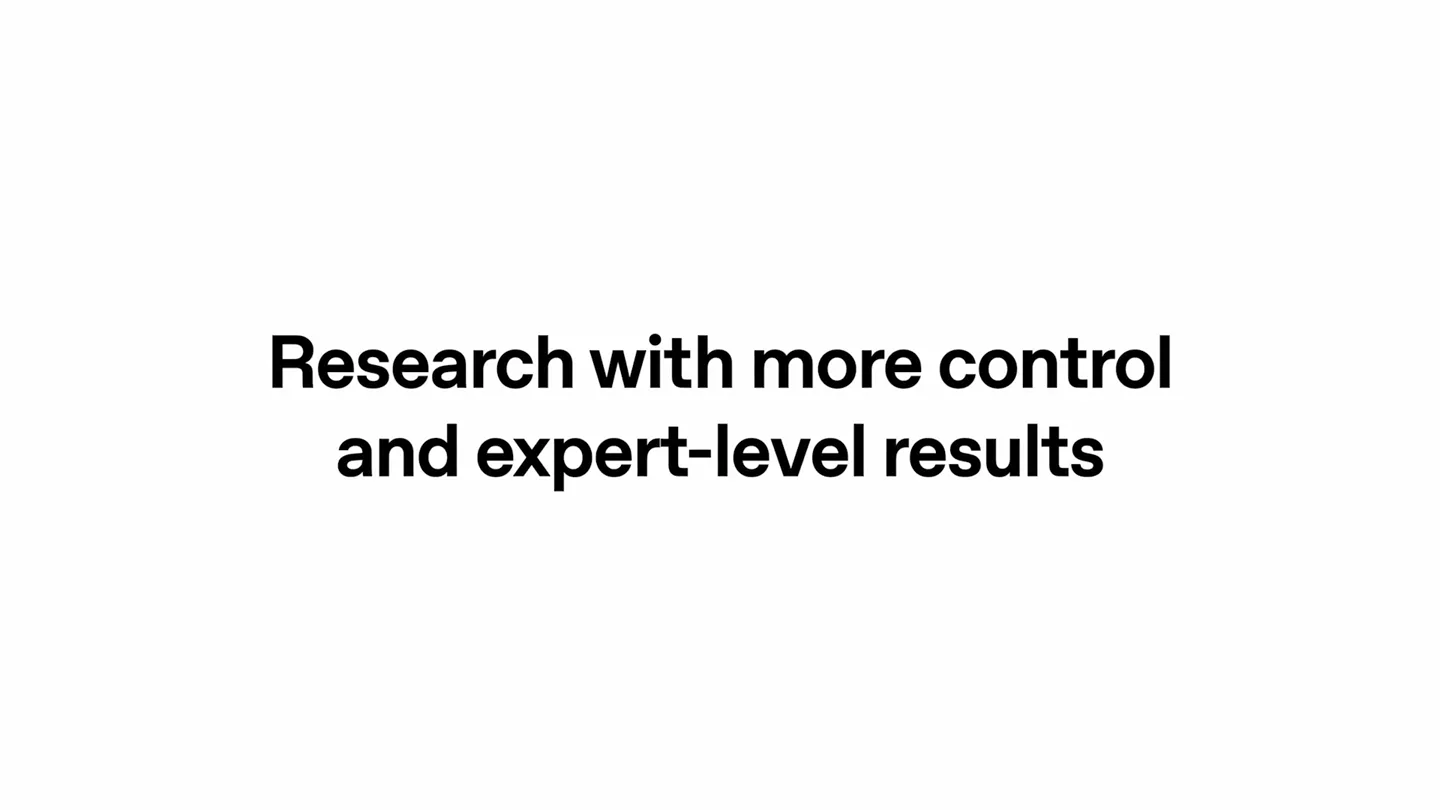
- Research with more control and expert-level results
- Camera
- Static shot, centered text on a white background.
- Motion
- Text fade-in with subtle scale animation.
Product Reveal
Interactive Deep Research Workflow
“(No spoken dialogue — The synth arpeggio continues, maintaining energy. Sound effects accompany UI interactions like clicks and typing.)”
- On screen
- ChatGPT 5.2 What's on your mind today? Ask anything Company knowledge Deep research Apps Sites Ready when you are. Ask a complex question. Get a full report, with sources. Compare US consumer spending in 2010 and 2020 relative to populatio Canva Dropbox Figma Google Drive LSEG Spotify Connect more Search specific sites Choose which sites to focus on during research. Prioritize these sites, but allow full-web search bea.gov census.gov fred.stlouisfed.org Add Website, https://example.com Done US consumer spending vs population growth Retrieve 2010 and 2020 consumer spending and population data from BEA and Census. Use the LSEG connector and then consult bea.gov, census.gov, and stlouisfed.org. Calculate per-capita consumer spending changes between 2010 and 2020. Analyze real versus nominal spending using BEA price deflators from BEA only. Summarize findings with charts and cite only the restricted websites. Apps LSEG Sites Researching... Downloading and displaying data for charts... Citing data sources properly... "US consumer spending vs population growth" Follow up with any questions or clarifications Include a summary of US retail sector performance during that same per
- Camera
- Close-up on the ChatGPT UI, with dynamic zooms and pans to highlight specific interactive elements and text input.
- Motion
- UI element reveals, text typing animation, modal pop-ups with subtle bounce, progress bar fills, and smooth camera pushes/pulls.
Feature Teaser
Comprehensive Report Generation
“(No spoken dialogue — The electronic score builds with synth risers and sweeps, culminating in a sub-bass drop/impact as the report loads.)”
- On screen
- View comprehensive reports right in ChatGPT 5.2 Stopped talking to connector I am updating the research plan to include a summary of US retail sector performance from 2010 to 2020, with analyst commentary, in addition to the consumer spending versus population growth analysis. Research completed in 14m 15 citations 41 searches U.S. Consumer Spending and Population Growth, 2010 to 2020 Scope and definition of consumer spending This report compares U.S. consumer spending in 2010 vs 2020, explicitly benchmarking spending growth against population growth over the same decade and calculating per-capita consumer spending for each year. In the Bureau of Economic Analysis (BEA) framework, "consumer spending" at the national level is Personal Consumption Expenditures (PCE)—the value of goods and services purchased by, or on behalf of, U.S. residents. To separate nominal (current-dollar) from real (inflation-adjusted) spending, the analysis uses BEA's official chain-type framework (real chained-dollar series and corresponding deflators/price indexes). Get a detailed report Deep research Sites (3) TABLE OF CONTENTS U.S. Consumer Spending and Population Growth, 2010 to 2020 Scope and definition of consumer spending Data sources and methodology Official sources used and why they match the request Nominal vs real, and the role of BEA deflators Population concept used for per-capita calculations Total consumer spending in 2010 and 2020 Population and per-capita consumer spending Population in 2010 and 2020 Per-capita consumer spending in 2010 and 2020 Growth rates and inflation decomposition Spending growth vs population growth over the decade From 2010 to 2020 Nominal PCE increase 38.70% (CAGR 3.33%) while real PCE increased 19.95% (CAGR 1.84%). Population increased 7.10% (CAGR 0.69%). Real PCE per capita increased 11.89% (CAGR 1.14%/yr), indicating real consumption growth outpaced population. Inflation adjustment using BEA deflators The BEA PCE implicit price deflator rose from 90.514 (2010) to 104.660 (2020) (index 2010=100), an increase of 15.64% over the decade (CAGR 1.47%/yr). Using BEA's identity for implicit price deflators (current-dollar = chained-dollar) x 100 — nominal growth can be interpreted as a combination of real growth and price growth. A useful way to summarize this decade is: Nominal PCE growth factor (2010-2020): 1.387 Real PCE growth factor (2010-2020): 1.199 PCE deflator growth factor (2010-2020): 1.156 The product of real and price factors (1.199 x 1.156) closely matches nominal growth, consistent with BEA's real/nominal/deflator framework (small differences can arise from chain-indexing mechanisms). Growth-rate summary table Metric 2010 2020 Total change (2010->2020) CAGR Sources - 56 Activity - 14m bea.gov https://www.bea.gov/data/consume... https://www.bea.gov/faq/513 https://fred.stlouisfed.org https://fred.stlouisfed.org/data/PCE... https://fred.stlouisfed.org/data/DP... https://fred.stlouisfed.org/data/PCE... https://fred.stlouisfed.org/data/B23... https://fred.stlouisfed.org/data/PCE... https://fred.stlouisfed.org/series/EC... https://fred.stlouisfed.org/data/gdp... Copy contents Export to Markdown Export to Word Export to PDF
- Camera
- Smooth zoom into the generated report, followed by a pan to highlight specific sections like the table of contents and citations. A final close-up on export options.
- Motion
- Seamless UI transitions, content scrolling, and a subtle highlight animation on interactive elements. The camera movement is fluid and purposeful, guiding the viewer's eye.
Call to Action
OpenAI Logo Reveal
“(No spoken dialogue — The electronic score reaches its peak with a final impactful sub-bass drop and a sustained synth pad, creating a sense of resolution and power.)”
- On screen
- (No on-screen text)
- Camera
- Rapid zoom out from the UI to a full-screen view of the OpenAI logo, which then subtly pulses.
- Motion
- Fast-cut transition, logo reveal with a subtle glow and scale animation, followed by a gentle, continuous pulse effect.
Motion design primitives
Synthesizable in Remotion · key components of the ai-agent-deep-research-showcase template.
UIDynamicTypewriter
Text appears as if being typed in real-time within UI input fields, often accompanied by a blinking cursor. This primitive simulates user interaction and input.
+ Code construction recipe
Utilize `interpolate` for character opacity and position, combined with `spring` for cursor blink animation. Implement a `Sequence` component to control the timing of character reveals.
ModalSlideFade
New UI modals or dropdowns slide in from a specific direction (e.g., bottom or side) while simultaneously fading into view. This creates a smooth, non-jarring reveal of new content.
+ Code construction recipe
Combine `interpolate` for `translateY` (or `translateX`) and `opacity`. Use an `Easing.out(Easing.cubic)` curve for a natural deceleration. Ensure z-index management for overlay.
ContentZoomPan
The camera smoothly zooms into specific areas of the UI or content, then pans across to highlight different sections, mimicking a guided tour or detailed inspection.
+ Code construction recipe
Employ `interpolate` on `scale` and `translateX`/`translateY` properties of a parent container. Use `spring` for smooth, organic camera stops and starts. Consider `clamp` for boundary control.
Style DNA & aesthetic system
Visual aesthetic
Typography
Motion
Special effects
Pacing & rhythm
Conceptual story rhythm
- 1
The Promise
Purpose. Establish the core benefit of the product: enhanced research capabilities.
Execution. Bold, centered text on a clean background, setting a clear and direct message.
- 2
The Demonstration
Purpose. Showcase the product's features through a step-by-step interactive workflow.
Execution. Detailed UI walkthrough with dynamic camera movements, typing animations, and modal reveals, highlighting user interaction.
- 3
The Result
Purpose. Illustrate the comprehensive output and value delivered by the product.
Execution. Zoom into a generated report, showcasing its structure, content, and export options, emphasizing depth and utility.
- 4
The Brand
Purpose. Reinforce brand identity and leave a lasting impression.
Execution. A clean, impactful reveal of the company logo with subtle animation, concluding the narrative.
Remix in Animatiq Studio
Master remix prompt · agent-ready
Sample remix
Objective
Launch a new collaborative design tool called 'CanvasFlow'.How the recipe adapts
The CanvasFlow launch video would feature a clean, white UI with subtle pastel gradients in the background. The UIDynamicTypewriter primitive would show users inputting design prompts. ModalSlideFade would introduce new collaboration features like shared artboards. ContentZoomPan would highlight specific design elements and real-time edits within the CanvasFlow interface. The video would maintain the deliberate pacing and energetic electronic score, concluding with the CanvasFlow logo reveal, subtly pulsing.Remix blueprint · ai-agent-deep-research-showcase
Scene durations (4 scenes, 79s)
Key Remotion components
Related AI Agents Product Launches
Explore all AI Agents launches →
To ensure that artificial general intelligence benefits all of humanity
Gopuff introduces Go, an AI shopping assistant built with SpaceXAI: say what you need and the order is placed.

Iliad (Troy) trailer made by Grok Imagine 1.5, which was just released