
Arik Chakma · Launch Video Breakdown: Hook, Pacing & Motion Design
gpu-time is a small browser-based model that converts natural language to JavaScript date and time. It runs on WebGPU.
Scene-by-scene timeline & spoken transcript
The Hook
Tokenization and Contextual Understanding
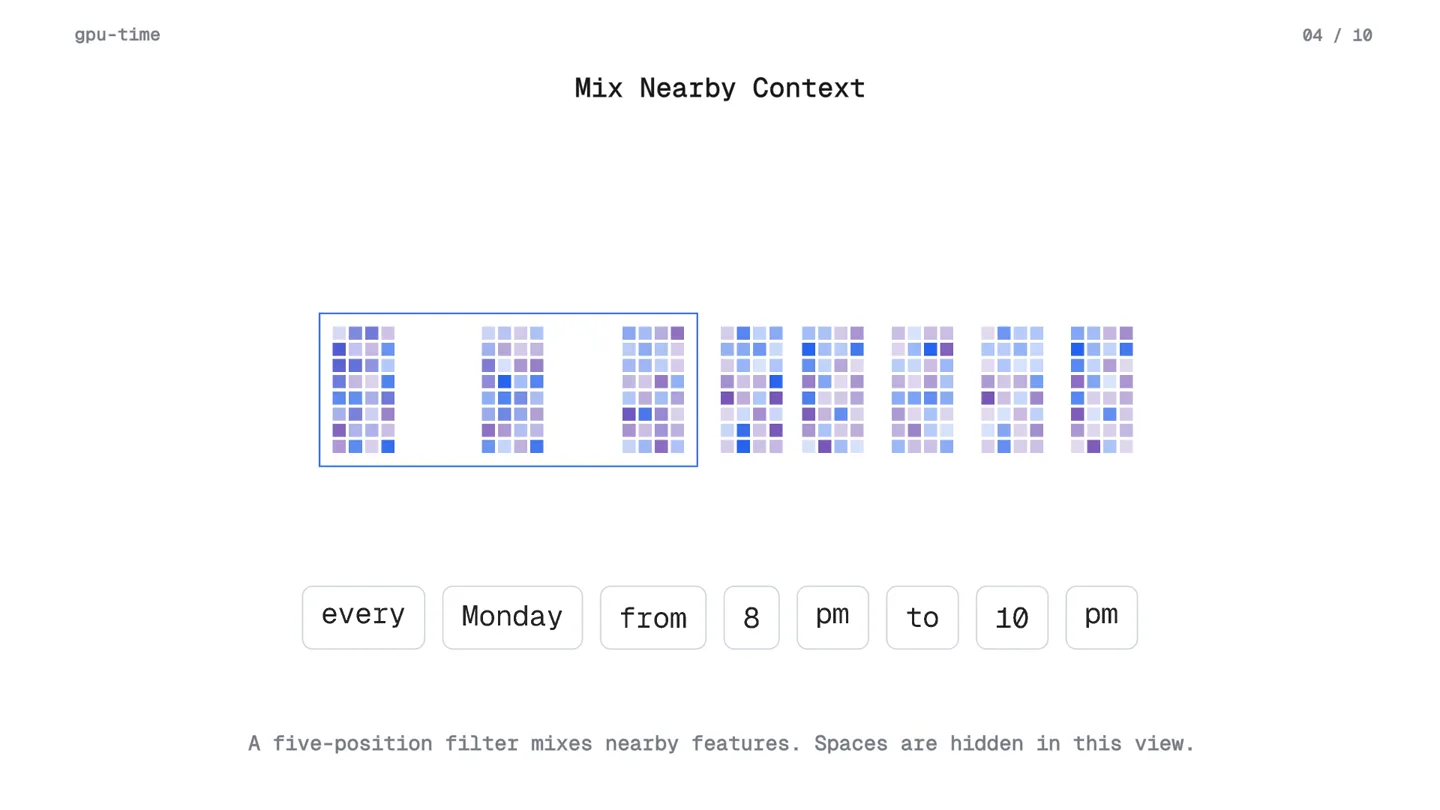
“So we start with a sentence. We split it into tokens. We keep each token's position. Words, numbers, and AM/PM split apart. Spaces retained internally. Each grid holds 32 learned values, summed from token-feature embeddings. A five-position filter mixes nearby features. Spaces are hidden in this view. Each token's 32 state values update as context arrives from either direction.”
- On screen
- gpu-time 01 / 10 Start with a Sentence every Monday from 8pm to 10 A recurring window, written in plain English. gpu-time 02 / 10 Keep Each Token's Position every Monday from 8 pm to 10 pm Words, numbers and AM/PM split apart. Spaces retained internally. gpu-time 02 / 10 Keep Each Token's Position every Monday from 8 pm to 10 pm 0:5 6:12 13:17 18:19 19:21 22:24 25:27 27:29 Words, numbers and AM/PM split apart. Spaces retained internally. gpu-time 03 / 10 Learned Token Vectors every Monday from 8 pm to 10 pm Each grid holds 32 learned values, summed from token-feature embeddings. gpu-time 03 / 10 Learned Token Vectors every Monday from 8 pm to 10 pm Each grid holds 32 learned values, summed from token-feature embeddings. gpu-time 04 / 10 Mix Nearby Context every Monday from 8 pm to 10 pm A five-position filter mixes nearby features. Spaces are hidden in this view. gpu-time 04 / 10 Mix Nearby Context every Monday from 8 pm to 10 pm A five-position filter mixes nearby features. Spaces are hidden in this view. gpu-time 05 / 10 Context from Both Sides forward → ← backward every Monday from 8 pm to 10 pm Each token's 32 state values update as context arrives from either direction. gpu-time 05 / 10 Context from Both Sides forward → ← backward every Monday from 8 pm to 10 pm Each token's 32 state values update as context arrives from either direction.
- Camera
- Static, centered framing on the UI elements. No camera movement.
- Motion
- Text fades in, individual words highlight, then expand into token boxes. Grids of colored squares animate to represent token vectors, with subtle pulsing and highlighting. Lines and dots animate to show context flow.
Problem Agitation
Role Scoring and Schedule Resolution
“From context, we generate scores. Token context plus pooled sentence context. Actual activations, nodes, links sampled. 40 role scores, 10 named roles shown. 5 reserved slots omitted; boundary is separate. Separate boundary score. No new clause. The model identifies roles. It does not calculate dates. Internal calendar normalization. The public API returns dates and rules directly.”
- On screen
- gpu-time 06 / 10 From Context to Scores 32 + 32 16 gates 64 hidden 40 + 1 Monday every Monday from 8 pm to 10 pm Token context + pooled sentence context. Actual activations; nodes / links sampled. gpu-time 06 / 10 From Context to Scores 32 + 32 16 gates 64 hidden 40 + 1 WebGPU 32 lanes CPU too Monday every Monday from 8 pm to 10 pm Token context + pooled sentence context. Actual activations; nodes / links sampled. gpu-time 07 / 10 Role Scores WEEKDAY TIME_NAMED GLUE JOIN SECOND RANGE_START YEAR EDGE MONTH BOUND_START +5.978 -0.228 -0.243 -0.252 -0.280 -0.313 -0.313 -0.361 -0.374 -0.400 0 Monday 40 role scores 10 named roles shown every Monday from 8 pm to 10 pm 10 highest named-role scores shown. 5 reserved slots omitted; boundary is separate. gpu-time 07 / 10 Role Scores WEEKDAY TIME_NAMED GLUE JOIN SECOND RANGE_START YEAR EDGE MONTH BOUND_START +5.978 -0.228 -0.243 -0.252 -0.280 -0.313 -0.313 -0.361 -0.374 -0.400 0 Monday 40 role scores 10 named roles shown separate boundary score: -12.598 < 1.75 → no new clause every Monday from 8 pm to 10 pm 10 highest named-role scores shown. 5 reserved slots omitted; boundary is separate. gpu-time 07 / 10 Give Each Token a Role RECUR WEEKDAY RANGE_START HOUR MERIDIEM RANGE_END HOUR MERIDIEM every Monday from 8 pm to 10 pm The model identifies roles. It does not calculate dates. gpu-time 08 / 10 Resolve the Schedule RECUR WEEKDAY RANGE_START HOUR MERIDIEM RANGE_END HOUR MERIDIEM every Monday from 8 pm to 10 pm Internal calendar normalization. The public API returns dates and rules directly.
- Camera
- Static, centered framing on the UI elements. No camera movement.
- Motion
- Nodes and connecting lines animate to visualize a neural network. Bar charts grow to represent scores. Token boxes change color and display new labels, indicating role assignment. A tree diagram expands to show schedule breakdown.
Product Reveal
Time Zone Handling and Output
“We keep the local time. Daylight saving ends November 1. The local schedule stays at 8pm. Calendar property fragments, generated from the same schedule.”
- On screen
- gpu-time 08 / 10 Resolve the Schedule recurring schedule WEEKLY frequency MO day 20:00-22:00 time window caller: reference date + America/New_York Internal calendar normalization. The public API returns dates and rules directly. gpu-time 09 / 10 Keep the Local Time MONDAY LOCAL WINDOW UTC NEXT DAY 2026-10-26 20:00 → 22:00 00:00Z America/New_York Daylight saving ends November 1. The local schedule stays at 8pm. gpu-time 09 / 10 Keep the Local Time MONDAY LOCAL WINDOW UTC NEXT DAY 2026-10-26 20:00 → 22:00 00:00Z 2026-11-02 20:00 → 22:00 01:00Z 2026-11-09 20:00 → 22:00 01:00Z America/New_York Daylight saving ends November 1. The local schedule stays at 8pm. gpu-time 10 / 10 Return Dates and Rules DTSTART;TZID=America/New_York:20261026T200000 DTEND;TZID=America/New_York:20261026T220000 RRULE:FREQ=WEEKLY;INTERVAL=1;BYDAY=MO Calendar property fragments, generated from the same schedule.
- Camera
- Static, centered framing on the UI elements. No camera movement.
- Motion
- Table rows animate in, highlighting changes in UTC time. Text lines appear to show the final output in a code-like format.
Call to Action
Product Summary and Call to Action
“(No spoken dialogue — The music features a consistent, low-energy ambient electronic score with a prominent, sustained sub-bass drone throughout. It incorporates subtle, ethereal synth pads and occasional, very soft, high-frequency synth arpeggios that add a sense of movement without increasing the tempo. There are no high-energy audio transitions, risers, sweeps, or sub-bass drops/impacts; the sound design maintains a calm, steady, and slightly mysterious atmosphere.)”
- On screen
- gpu-time Plain English. Precise Schedules. Runs locally WebGPU + CPU 24,761 parameters Experimental English time parser
- Camera
- Static, centered framing on the UI elements. No camera movement.
- Motion
- The product logo and tagline fade in, followed by key features and a descriptive subtitle. Underline animation beneath the logo.
Motion design primitives
Synthesizable in Remotion · key components of the technical-process-explainer template.
TokenHighlightAndExpand
Individual words in a sentence are highlighted, then smoothly transition into distinct, rounded rectangular 'token' boxes, often revealing additional metadata or visual representations beneath them.
+ Code construction recipe
Use `spring` for position and scale transitions. Implement `map` over words to render individual `TokenBox` components. Use `interpolate` for background color and border radius changes. Conditional rendering for metadata elements.
ContextualFlowVisualizer
Abstract grids of colored squares (representing data vectors) animate with subtle pulsing and color shifts. Lines and dots dynamically appear and connect, illustrating data flow and contextual mixing between these visual 'tokens'.
+ Code construction recipe
Render a grid of `Square` components, each with a `backgroundColor` interpolated based on data values. Use `SVG` paths for connecting lines, animating `strokeDashoffset` and `strokeColor`. `Sequence` and `delay` for staggered dot animations.
DynamicDataBarChart
Vertical bar charts grow from a baseline to represent numerical scores, with the highest-scoring bar often highlighted. Associated text labels appear alongside the bars.
+ Code construction recipe
Use `AbsoluteFill` for the chart container. Render `Rect` components for bars, animating `height` and `y` position with `spring`. `Text` components for labels and values, fading in with `interpolateOpacityByFrame`.
Style DNA & aesthetic system
Visual aesthetic
Typography
Motion
Special effects
Pacing & rhythm
Conceptual story rhythm
- 1
Input & Tokenization
Purpose. Introduce the problem of parsing natural language and demonstrate the initial step of breaking down input.
Execution. A plain English sentence appears, then individual words are highlighted and transformed into distinct 'tokens' with visual representations of their underlying data.
- 2
Contextual Processing
Purpose. Explain how the system understands the meaning and relationships between tokens.
Execution. Abstract grids of data points animate, showing how information flows and mixes between tokens, illustrating the 'learning' process.
- 3
Role Assignment & Resolution
Purpose. Show how the system assigns semantic roles to tokens and resolves the overall schedule.
Execution. Bar charts visualize 'role scores', tokens are re-labeled with their assigned roles, and a tree diagram breaks down the final schedule structure.
- 4
Output & Product Summary
Purpose. Demonstrate the final, precise output and summarize the product's core value proposition.
Execution. A table illustrates time zone adjustments, followed by a code-like output. The video concludes with the product logo, tagline, and key features.
Remix in Animatiq Studio
Master remix prompt · agent-ready
Sample remix
Objective
Launch a new AI-powered code refactoring tool that understands code context.How the recipe adapts
The 'TokenHighlightAndExpand' primitive would be adapted to highlight code snippets and transform them into 'code tokens'. The 'ContextualFlowVisualizer' would show how the AI analyzes dependencies and suggests refactors, with data grids representing code embeddings. 'DynamicDataBarChart' could visualize code complexity scores or refactoring impact. The overall minimalist aesthetic and slow, explanatory pacing would be retained to detail the tool's internal workings.Remix blueprint · technical-process-explainer
Scene durations (4 scenes, 91s)
Key Remotion components
Related Developer Tools Product Launches
Explore all Developer Tools launches →
Agentic CLI for coding, building apps, and automating workflows.

AI is already smart enough. Real-world tasks are still slow, expensive and unreliable, because we hand AI a computer built for humans, then wrap it in a heavy harness. AI doesn’t need to get smarter

Big day 🔥 🚀 Introducing Dolphin AI - an agentic AI studio for complete video production. The story of Dolphin is very interesting. It didn’t start as a product. It started as an internal tool. W