
ちずもかおやん · Launch Video Breakdown: Hook, Pacing & Motion Design
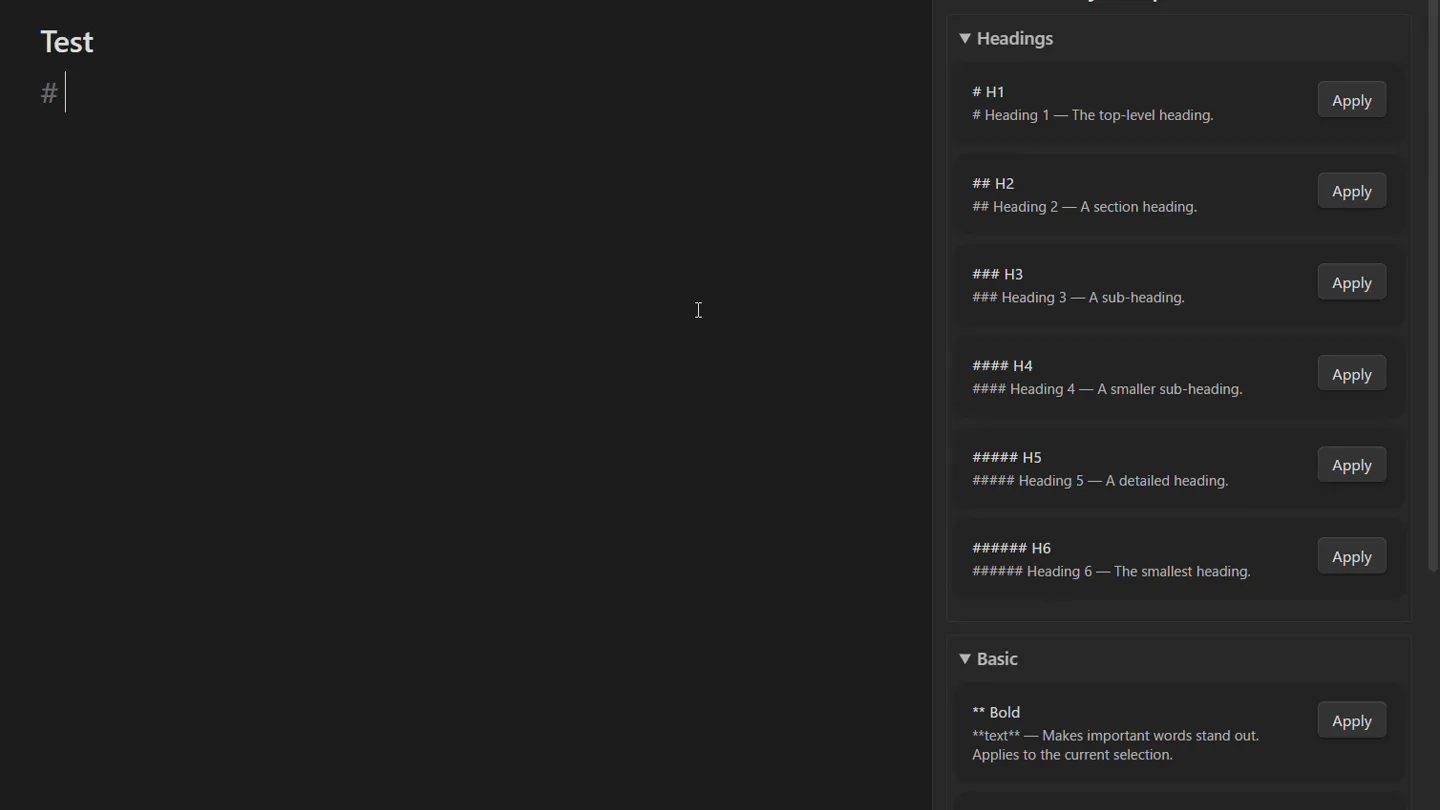
An Obsidian sidebar toolbar that inserts common Markdown with one click, so you don't leave live preview for headings, tables, or checkboxes.
Scene-by-scene timeline & spoken transcript
The Hook
Effortless Markdown Formatting
“(No spoken dialogue — The track begins with a sustained, evolving pad sound, creating an atmospheric and slightly mysterious mood. At [00:09], a subtle high-frequency riser begins, building tension.)”
- On screen
- Test # 1 ## 2 **** > aaaaaaa
- Camera
- Static, full-screen capture of the Obsidian interface with the 'Markdown syntax palette' sidebar open.
- Motion
- Cursor interaction with UI elements, demonstrating rapid application of Markdown syntax (headings, bold, quote).
Product Reveal
Expanding Markdown Capabilities
“(No spoken dialogue — This culminates in a significant sub-bass drop/impact at [00:10], followed by a rhythmic, pulsing synth bass line and a driving, almost industrial-sounding percussion loop.)”
- On screen
- Test # 1 ## 2 **** > aaaaaaa [ ] To-do
- Camera
- Static, full-screen capture. The sidebar content dynamically expands and collapses.
- Motion
- UI element expansion/collapse (accordion effect) and cursor interaction to apply more complex Markdown elements like checklists and tables.
Feature Teaser
Advanced Callout Integration
“(No spoken dialogue — Another high-energy riser starts at [00:20], leading to a more pronounced sub-bass drop/impact at [00:21]. The rhythmic elements intensify, with additional percussive layers and a more prominent, arpeggiated synth melody emerging.)”
- On screen
- Test # 1 ## 2 **** > aaaaaaa [ ] To-do > [!note] Title > Body text here > [!danger] Title > Body text here > [!success] Title > Body text here
- Camera
- Static, full-screen capture. The sidebar scrolls to reveal new categories.
- Motion
- Rapid cursor interaction and application of various 'callout' styles, demonstrating the visual output of the Markdown in live preview.
Call to Action
Seamless Live Preview Workflow
“(No spoken dialogue — A final, extended riser begins at [00:31], building to a powerful sub-bass drop/impact at [00:32], which then transitions into a more open, expansive synth pad with a sustained, deep bass tone, gradually fading out.)”
- On screen
- Test 1 2 1111 | aaaaaaa [ ] To-do Title Body text here Title Body text here Title Body text here
- Camera
- Static, full-screen capture. The sidebar is toggled off, revealing the full live preview.
- Motion
- A single, impactful toggle animation of the sidebar, transitioning from Markdown input view to a clean, rendered live preview.
Motion design primitives
Synthesizable in Remotion · key components of the developer-tool-sidebar-workflow template.
SidebarAccordionToggle
UI sidebar sections expand and collapse with a smooth, vertical slide animation, revealing or hiding content categories. This is often accompanied by a subtle change in the caret icon (e.g., right-pointing to down-pointing).
+ Code construction recipe
Use `interpolate` for `height` and `opacity` properties, tied to a shared value for the accordion state. Implement a `spring` animation for a natural, bouncy feel on the height transition. SVG path morphing for the caret icon.
CursorClickHighlight
A visual highlight or ripple effect emanates from the cursor upon clicking an 'Apply' button, indicating user interaction and immediate feedback.
+ Code construction recipe
Employ a `canvas` or `SVG` overlay that renders a radial gradient expanding from the click coordinates. Animate `scale` and `opacity` with a fast `tween` or `spring` to create a quick, dissipating pulse.
LivePreviewRender
A dramatic, single-frame transition where the raw Markdown input instantly transforms into its styled, rendered output, often triggered by a UI toggle.
+ Code construction recipe
This is primarily a scene cut, but if animated, it would involve a `crossFade` or `wipe` transition between two pre-rendered states (raw Markdown vs. styled output). For a more complex effect, individual elements could `scale` and `fade` into their new positions.
Style DNA & aesthetic system
Visual aesthetic
Typography
Motion
Special effects
Pacing & rhythm
Conceptual story rhythm
- 1
The Problem of Manual Markdown
Purpose. Establish the tediousness of manually typing Markdown syntax, especially for common elements.
Execution. Rapid, repetitive typing of Markdown characters, showing the friction in the current workflow.
- 2
Introducing the Sidebar Solution
Purpose. Present the product as the direct answer to the problem, showcasing its intuitive interface.
Execution. Cursor interacting with the sidebar, applying Markdown elements with single clicks, demonstrating speed and ease.
- 3
Showcasing Feature Depth
Purpose. Highlight the breadth of Markdown elements supported, from basic to advanced callouts.
Execution. Scrolling through sidebar categories, expanding sections, and applying diverse Markdown types, showing the live preview updates.
- 4
The Seamless Workflow
Purpose. Conclude by demonstrating the integrated, distraction-free writing experience.
Execution. Toggling off the sidebar to reveal a clean, fully rendered document, emphasizing the final output and improved focus.
Remix in Animatiq Studio
Master remix prompt · agent-ready
Sample remix
Objective
A new VS Code extension that automates boilerplate code generation for React components.How the recipe adapts
The video would open with a developer manually typing repetitive React component structure in VS Code. The sidebar would then appear, showing options for component templates. Cursor interactions would demonstrate one-click generation of complex components, with accordion-style expansions for configuration options. The video would culminate in a single, dramatic toggle of the sidebar, revealing a clean, fully generated component file, ready for development.Remix blueprint · developer-tool-sidebar-workflow
Scene durations (4 scenes, 48.4s)
Key Remotion components
Related Developer Tools Product Launches
Explore all Developer Tools launches →
xAI opens voice cloning on its API: build a custom voice in about two minutes or pick from 80+ voices in 28 languages.

Agentic CLI for coding, building apps, and automating workflows.
Sakana AI launches Fugu, a multi-agent orchestration system served through a single model API, led by its Fugu Ultra model.