
AI at Meta · Launch Video Breakdown: Hook, Pacing & Motion Design
Today we're introducing TRIBE v2 (Trimodal Brain Encoder), a foundation model trained to predict how the human brain responds to almost any sight or sound. Building on our Algonauts 2025 award-winn…
Scene-by-scene timeline & spoken transcript
The Hook
Introducing TRIBE v2: Brain Encoder
“(No spoken dialogue — Pizzicato synths and sub-bass introduce a high-energy audio transition with a riser and sweep.)”
- On screen
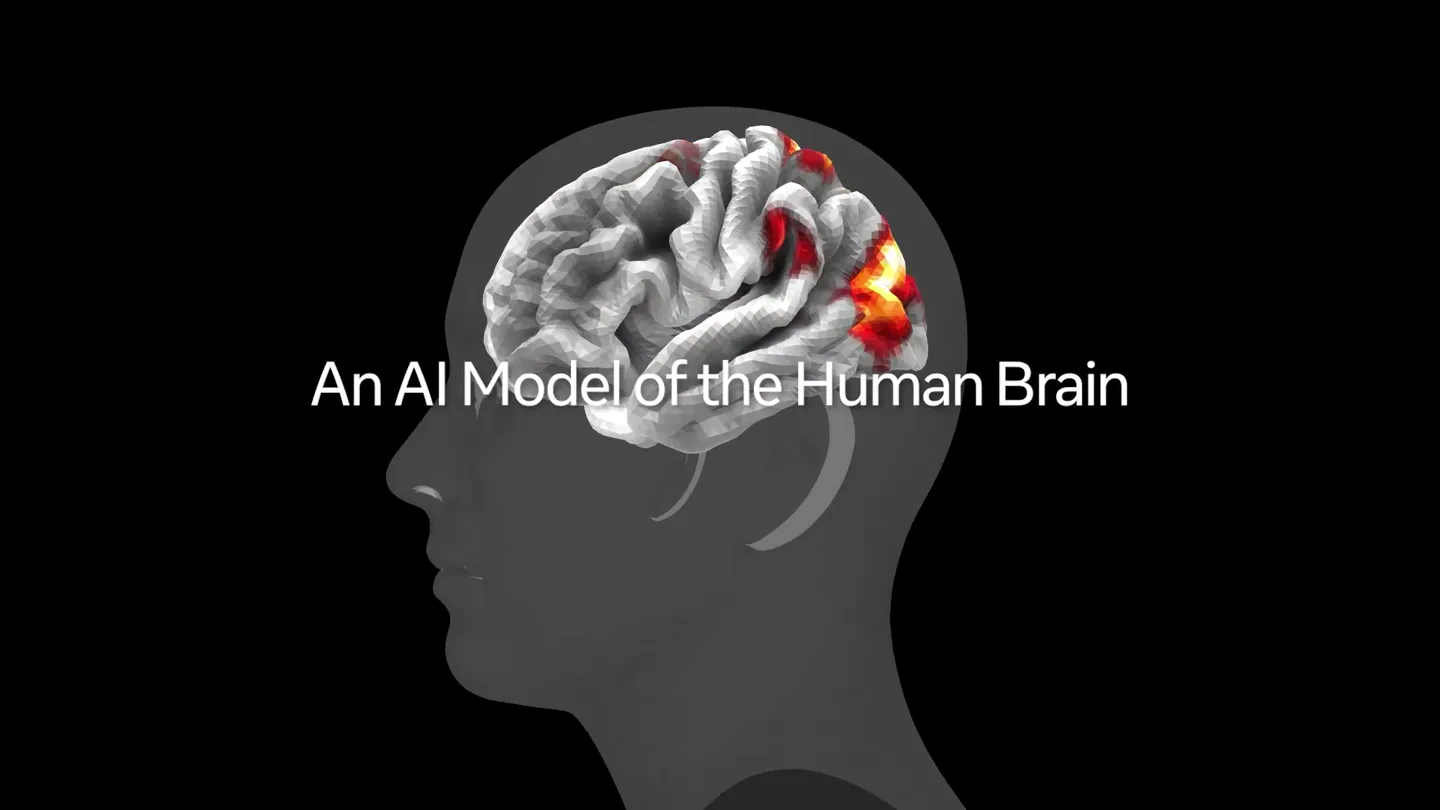
- An AI Model of the Human Brain Predicting Neural Responses to Sight, Sound and Language
- Camera
- Slow, deliberate 3D rotation of a translucent human head model with an animated brain, revealing different angles.
- Motion
- 3D model animation, text reveal with subtle fade-in and scale, dynamic heat-map overlay on brain.
Product Reveal
TRIBE v2: Stimulus to Prediction
“the truth”
- On screen
- STIMULUS MODEL PREDICTION MUSIC LANGUAGE VISUAL
- Camera
- Static, wide shot of a split-screen layout, presenting 'Stimulus' on the left and 'Model Prediction' on the right.
- Motion
- Split-screen comparison, dynamic data visualization with animated arrows, real-world video clips as stimuli, and synchronized brain activity heat-maps.
Feature Teaser
Actual vs. Predicted Brain Responses
“this is so good”
- On screen
- ACTUAL RESPONSE MODEL PREDICTION
- Camera
- Static, wide shot of a grid layout comparing 'Actual Response' and 'Model Prediction' side-by-side.
- Motion
- Grid comparison, synchronized heat-map animations across multiple brain models, demonstrating prediction accuracy.
Call to Action
Explore TRIBE v2 Resources
“good afternoon”
- On screen
- Find the paper, codebase, model and interactive demo here: aidemos.atmeta.com/tribev2
- Camera
- Static, centered text display with a subtle background gradient.
- Motion
- Text fade-in, subtle background light leak animation, clear and concise call to action.
Motion design primitives
Synthesizable in Remotion · key components of the ai-meta-tribe-v2-remix template.
BrainActivityHeatmap
A 3D human brain model with specific regions highlighted by a pulsating, evolving heat-map of red and yellow, indicating neural activity. The heat-map dynamically spreads and recedes across the brain's surface.
+ Code construction recipe
Utilize Remotion's 3D capabilities with a GLSL shader for the brain surface. Implement a noise texture or perlin noise function to drive the heat-map's intensity and spread, interpolating color values (red to yellow) based on activity data. Use `spring` for pulsating effects.
StimulusPredictionFlow
A split-screen layout where a 'Stimulus' video clip on the left is connected by an animated arrow to a 'Model Prediction' brain activity visualization on the right. New stimulus-prediction pairs animate in from the bottom.
+ Code construction recipe
Employ Remotion's layout components for grid and flexbox. Use `Sequence` for staggered entry of new stimulus-prediction rows. Animate arrows with `interpolate` for path drawing and `spring` for a subtle bounce on completion. Video clips can be rendered directly.
ComparativeGridReveal
A grid of brain models comparing 'Actual Response' and 'Model Prediction' side-by-side. Each pair of brains animates its heat-map activity in sync, showcasing the model's accuracy.
+ Code construction recipe
Construct a responsive grid using CSS Grid or Flexbox within Remotion. Each cell contains a `BrainActivityHeatmap` component. Synchronize the `interpolate` or `spring` animations for the heat-map data across corresponding 'Actual' and 'Prediction' brains using shared animation drivers.
Style DNA & aesthetic system
Visual aesthetic
Typography
Motion
Special effects
Pacing & rhythm
Conceptual story rhythm
- 1
The Scientific Introduction
Purpose. To establish the core technological breakthrough and its scope.
Execution. A rotating 3D brain model with text revealing the model's capabilities, setting a high-tech, scientific tone.
- 2
Demonstrating Functionality
Purpose. To visually explain how the AI model processes different types of stimuli.
Execution. Split-screen comparisons showing real-world stimuli (music, language, visual) mapping to predicted brain activity.
- 3
Validating Accuracy
Purpose. To build trust and showcase the model's precision by comparing actual vs. predicted responses.
Execution. A grid of side-by-side brain models illustrating the close correlation between actual and predicted neural responses.
- 4
Engagement & Next Steps
Purpose. To guide viewers to further resources and encourage deeper engagement.
Execution. A clear call to action with a URL, presented against a clean, minimalist background.
Remix in Animatiq Studio
Master remix prompt · agent-ready
Sample remix
Objective
Launch an AI model that predicts user sentiment from social media text.How the recipe adapts
The BrainActivityHeatmap primitive would be adapted to visualize 'sentiment activation' on a stylized social media icon or a text bubble. The StimulusPredictionFlow would show social media posts as 'Stimulus' leading to 'Sentiment Prediction' visualizations. The ComparativeGridReveal would compare 'Actual User Sentiment' with 'Predicted Sentiment' across various posts. The color palette would shift to reflect sentiment (e.g., green for positive, red for negative). Typography and pacing would remain consistent for brand recognition.Remix blueprint · ai-meta-tribe-v2-remix
Scene durations (4 scenes, 29s)
Key Remotion components
Related AI Agents Product Launches
Explore all AI Agents launches →
To ensure that artificial general intelligence benefits all of humanity
Gopuff introduces Go, an AI shopping assistant built with SpaceXAI: say what you need and the order is placed.

Iliad (Troy) trailer made by Grok Imagine 1.5, which was just released