
Mirasim · Launch Video Breakdown: Hook, Pacing & Motion Design
Mirasim lets builders use every model and every harness, then hand off mid-task in the same session so they stay in flow.
Scene-by-scene timeline & spoken transcript
The Hook
Mirasim: All Agents, One Place
“(No spoken dialogue — Ambient electronic score with pizzicato synths and sub-bass intro, building energy.)”
- On screen
- Mirasim From Build to Eval All Agents. In one place.
- Camera
- Static wide shot, centered text and logo.
- Motion
- Text reveal with subtle scale and opacity, logo animation with expanding lines, background texture with subtle pixel-like animation.
Problem Agitation
The Build-Evaluate-Results Loop
“(No spoken dialogue — Driving tech-house beat establishes rhythm, with subtle electronic sweeps.)”
- On screen
- ONE IDE Agents that drive real software the efficient way </> Build Coding agents write and ship the software Evaluate Simulated users try it on a real browser, phone, shell Results Scores, evidence, next tasks hand off → run & observe → feeds next build tasks – closes the loop
- Camera
- Static overhead shot, presenting a diagram.
- Motion
- Sequential text reveals, line drawing animations to connect concepts, and a curved arrow animation to illustrate the feedback loop.
Product Reveal
Mirasim in Action: Build & Evaluate
“(No spoken dialogue — Beat intensifies with high-energy risers and sub-bass impacts during transitions, maintaining a modern, energetic feel.)”
- On screen
- Choose your model Deepseek V4 Pro Tell the agent what to build. Mirasim v Build an e-commerce s| + Claude / opus-5 v high v Sessions run in parallel. RUNNING Mirasim v 0.8.143 1 Default 2 + RUNNING Mirasim Build an e-commerce site, a standard DTC et... Claude Code opus-5 v high I'll start by looking at what's in the working directory to see if there's an existing project to build on. Inspect driftwell project Found an existing driftwell project - a coffee DTC storefront with a mini- game arcade bolted into the homepage. Let me inspect its structure before deciding whether to extend it or build fresh. Read art.js 1m25s 5.0% 48.8k awaiting model relay Type a message... Claude / opus-5 v high v RUNNING Mirasim / Look at this image. Where's room for improve... + MAKE IT HIT. Type a message... Claude / opus-5 v high v RUNNING Mirasim v 0.8.143 1 Default 2 + RUNNING Mirasim Build DTC e-com... RUNNING Mirasim Research DTC storefronts for TikTok macaro... Claude Code v 2.1.223 Welcome back! Tips for getting started Run /init to ... What's new Added owner M... Added a warml... Added a /rel... /release-note... Tackle your toughest work with Opus 5. Switch anytime with /model. A recent customer gave us feedback saying the product quality is less than ideal. How should we address the concerns. Effecting... >> bypass permissions on (shift+tab to cycle) - esc to interrupt Claude Code opus-5 v high Review image for improvements. + Look at this image. Where's room for improvement? Looking at this as a hero for a creative studio site. The palette and type choices Type a message... Claude / opus-5 v high v Agents read the page as structure - not a screenshot screenshot 2,944 tokens/turn 56 tokens/turn screenshot 53,000 tokens/turn structure 1,000 tokens/turn Send the build to five simulated users. Type a prompt - paste or drop files too /users/admin/desktop/mirasim.ai home Open TUI Open Terminal /eval Global Enabled only when the user explicitly invokes eval ('$eval', '/eval', 'use eval'). Brings in mutually isolated outside-user pers /content-evaluator Global Strict quality review of what the creator Agent produces at every stage. Triggers automatically when the pipeline switches sta /full-output-enforcement Global Overrides default LLM truncation behavior. Enforces complete code generation, bans placeholder patterns, and handles toke /high-end-visual-design Global Teaches the AI to design like a high-end agency. Defines the exact font, spacing, shadows, card structures, and animations mirasim.ai home v satln v worktree /eval create 5 target user personas and run an evaluation of the local project in headed mode. I wanna see the browser interactions it goes| + Claude / opus-5 v high v
- Camera
- Dynamic camera movements, panning and zooming across UI elements, simulating user interaction.
- Motion
- UI element reveals, text typing animations, data visualization with animated bars and numbers, smooth transitions between different UI states, and a 'magic reveal' effect for the structure vs. screenshot comparison.
Call to Action
Evaluation & Ship What Wins
“(No spoken dialogue — The electronic score builds to a climax, with powerful sub-bass impacts and a final energetic flourish.)”
- On screen
- Mirasim v 0.8.143 1 Default + mirasim.ai home v New Session + /eval create 5 target user personas and run an evaluation of the local project in headed mode. I want t... Luo Jiayin: what she needed exists, but it sits on a layer she can't reach Shao Yan: the landing page kept him, the Guide convinced him - and what convinced him isn't what t Meng Xu: one minute, forwarded it - and what made him willing to forward was the site admitting w Wei Cheng: the site closed him, but he assembled the last step himself Tan Shu: three sourced answers - and the most persuasive thing was a hole the vendor pointed at itsel The four findings that matter 1. The Guide is the conversion engine; the landing page shuts one class of visitor out of it. D and E each got their deciding evidence from Guide chapters, and none stumbled into it - all three reflexively bypass landing pages and go find docs. A has no such habit, so she spent her whole session on the demo canvas. The answer she needed is at /guide/evaluation, and no live path takes her there. 2. Three routes into the report's method layer are dead. She clicked. What. They actually did - only the left highlight moved. Tried. How it was run - same, then stopped her rule: no progress, hands off. Verified in source. Jump in. Eval/book.txt:282.1 feeds a highlight class to nothing else. /evaluation view vetted - A is /appear at :1996, and the component has zero -ve brevity. What strings is that the same canvas had taught her clicking works - step D3 really does know the breakup, which is where her single best piece of evidence came from. The expectation is so first, then broken. 3. The landing page calls simulated users "real users". The/top.tsx:282.1 lab. is he tab. Send a build to real users. :28K reads A simulated person works through the tab. :0B She flapped it on the screen. "These two words are not the same thing to me." Every other place on the site gets it right, so it's an outlier. Type a message... Claude / opus-5 v ultra v Mirasim site: five unexplored entry motives (headed) review - web finished 5/5 ca 266806-2100-mirasim-site-en target http://localhost:4981/ @ git:6789911c41 claude-opus-5[1m] created 08-06 14:26 What this round asked What happened to each of them Luo Jiayin: what she needed exists, but it sits on a layer she can't reach Shao Yan: the landing page kept him, the Guide convinced him - and what convinced him isn't what t Meng Xu: one minute, forwarded it - and what made him willing to forward was the site admitting w Wei Cheng: the site closed him, but he assembled the last step himself Tan Shu: three sourced answers - and the most persuasive thing was a hole the vendor pointed at itsel Runtime actions and observations are the evidence - reading the source is not treated as user evidence. #1 Shao Yan Succeeded EVALUATION REPORT 266806-2100-mirasim-site-en 5 0 succeeded EVALUATION REPORT 266806-2100-mirasim-site-en 5 2 succeeded User researcher Sarah Mitchell 9 yrs non-eng Windows Succeeded Staff engineer James Carter 13 yrs platform lead existing stack Succeeded Co-founder Priya Nair CTO fragmented time 60s / mobile Pending Founder-eng Michael Brooks retail SaaS macOS traveling Pending Architect Yuki Tanaka 14 yrs healthcare data-ownership Pending 5/5 personas completed the evaluation. Build it. Meet your users.Ship Build it. Meet your users. Ship what wins. Mirasim
- Camera
- Zooming into specific data points, panning across evaluation reports, and a final wide shot with the brand logo.
- Motion
- Highlighting specific text, progress bar animations, card reveals with subtle bounce, and a final text reveal with a strong brand presence.
Motion design primitives
Synthesizable in Remotion · key components of the mirasim-developer-flow template.
CodeTerminalTypewriter
Simulates text being typed into a terminal or chat interface, often with a blinking cursor, followed by a response or output. This is frequently accompanied by a subtle 'scroll' effect as new lines appear.
+ Code construction recipe
Utilize Remotion's `Sequence` and `spring` for character-by-character text reveals. Implement a `useCurrentFrame` to control cursor visibility and text content. For scrolling, use `interpolate` on `translateY` based on the number of lines, potentially with a `measureText` utility for dynamic line height.
DataPointHighlight
Highlights specific numbers or metrics within a larger UI, often with a quick zoom, color change, or a bounding box animation to draw attention to key data points.
+ Code construction recipe
Employ `spring` for scale and opacity changes on the highlighted element. Use `AbsoluteFill` with `z-index` to bring the element forward. For bounding boxes, animate `stroke-dasharray` or `scale` on an SVG rectangle, synchronized with the data reveal.
PersonaCardReveal
Individual cards representing user personas or evaluation statuses appear sequentially or in a grid, often with a slight delay and a subtle bounce or spring-like entry animation.
+ Code construction recipe
Use `Sequence` with `delay` for staggered entry. Each card component can use `spring` for `translateY` and `opacity` to create a soft bounce-in effect. `map` over an array of persona data to render multiple cards efficiently.
Style DNA & aesthetic system
Visual aesthetic
Typography
Motion
Special effects
Pacing & rhythm
Conceptual story rhythm
- 1
The Vision
Purpose. Introduce the core value proposition and brand identity.
Execution. Brand logo and tagline reveal with subtle background animation and elegant typography.
- 2
The Workflow
Purpose. Explain the problem Mirasim solves and its integrated solution.
Execution. Animated diagram illustrating the 'Build-Evaluate-Results' loop with clear labels and connecting lines.
- 3
The Deep Dive
Purpose. Demonstrate key product features and technical advantages.
Execution. Dynamic UI walkthroughs, text typing animations, data visualizations, and side-by-side comparisons highlighting efficiency.
- 4
The Impact
Purpose. Showcase the results and benefits of using Mirasim.
Execution. Evaluation reports, persona progress updates, and a strong concluding statement reinforcing the product's value.
Remix in Animatiq Studio
Master remix prompt · agent-ready
Sample remix
Objective
Launch a new AI-powered design tool, CanvasFlow, that automates repetitive design tasks and provides real-time feedback.How the recipe adapts
The 'CodeTerminalTypewriter' primitive adapts to 'DesignPromptTypewriter' for users inputting design requests. 'DataPointHighlight' becomes 'EfficiencyMetricHighlight', showcasing time saved or iterations reduced. 'PersonaCardReveal' transforms into 'DesignReviewCardReveal', showing feedback from different stakeholders. The overall aesthetic maintains the clean UI and grid background, but with design-specific iconography and a color palette shifted to reflect creativity and precision.Remix blueprint · mirasim-developer-flow
Scene durations (4 scenes, 72s)
Key Remotion components
Related Developer Tools Product Launches
Explore all Developer Tools launches →
Agentic CLI for coding, building apps, and automating workflows.
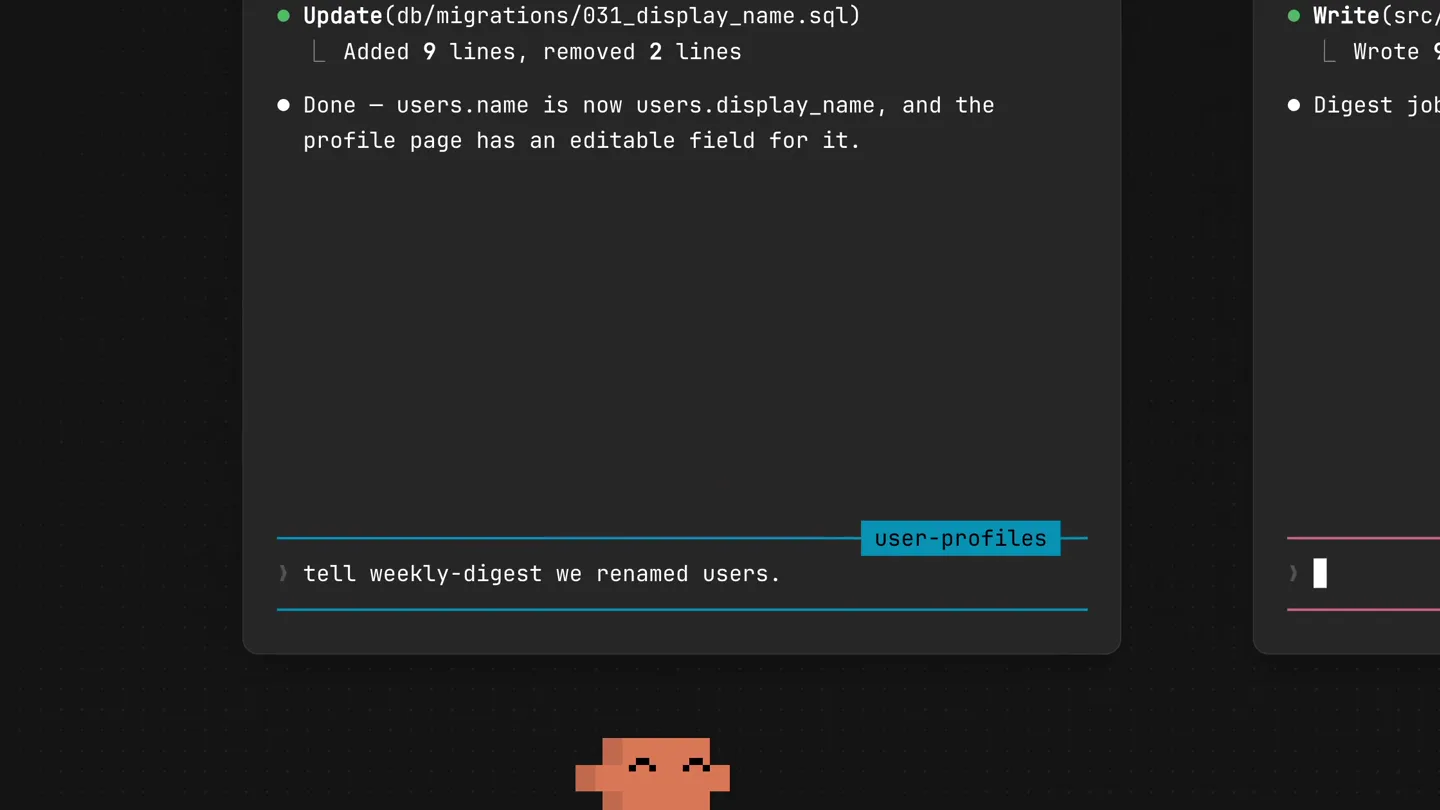
New in Claude Code: your sessions can now message each other. Tell Claude to send a summary (not your history or files), and the other session picks it up mid-task.

Meet Qwen3.8-Max: A New Bar for Coding and Cowork. https://t.co/mJaA8vr6xT