
Notion · Launch Video Breakdown: Hook, Pacing & Motion Design
Ship OS runs the product development cycle in Notion from customer feedback to a merged PR. Agents handle triaging, routing, and summarizing while the team handles judgment calls.
Scene-by-scene timeline & spoken transcript
The Hook
Introducing Ship OS: The Product Development Cycle in Notion
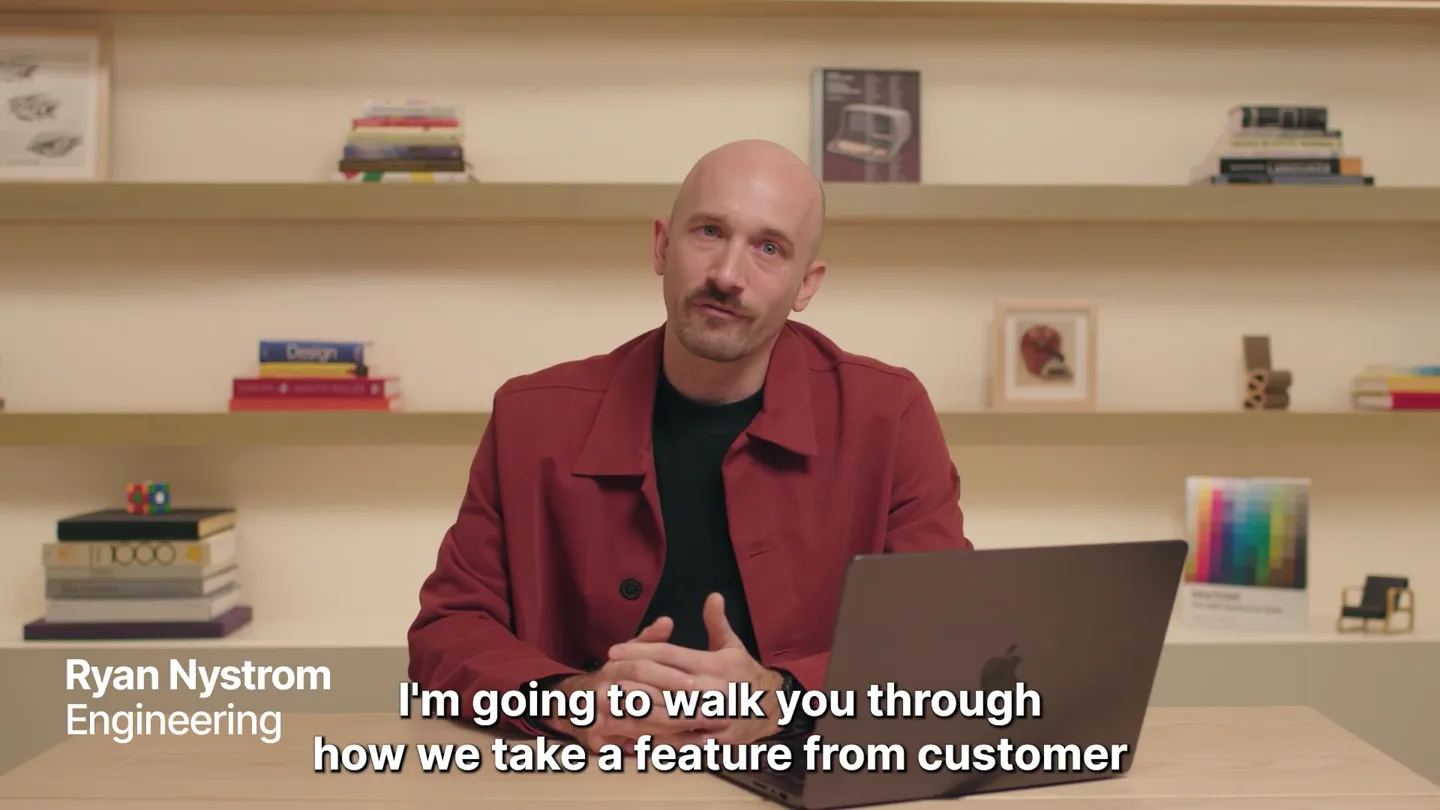
“I'm going to walk you through how we take a feature from customer feedback to a shipped product, all inside Notion. First up is triage. Agents capture feedback and tasks from any source, then enrich, organize, and coordinate it all automatically.”
- On screen
- Ryan Nystrom Engineering Triage Pla Inbox 0 User feedback Lumi Labs Home Meetings No upcoming events New AI meeting note View all Teams Company OS Product Engineering Product Backlog Docs Tasks Meetings Status Updates Launch Dashboard People Executive More Agents Weekly Eng Status Reporter Product Feedback Triager Ship Ops Agent IT Triage New chat Product Backlog By Status By Team Timeline Dashboard 4 more... Triage Webhooks reliability September 8, 2025 → October 3, 2025 P1 Rhona He Product Feedback Triager Enterprise search March 16, 2026 → June 28, 2026 P1 Product Feedback Triager + New project Plan Inline AI Assistant November 17, 2025 → February 4, 2026 P1 Product Feedback Triager Audit log export December 1, 2025 → December 31, 2025 25.00% P2 Ryan Nystrom Add number charts May 1, 2026 P1 Product Feedback Triager Build Data Security Enhancement November 17, 2025 → February 4, 2026 57.14% P1 Rhona He In-app notification center November 13, 2024 → December 7, 2025 60.00% P3 Ryan Nystrom Review Subscription upgrade/downgr March 27, 2026 → April 3 100.00% PO Product Feedback Triager Mobile App Launch October 29, 2024 → November 3, 2024 100.00% P3 Product Feedback Triager + New project Ship New Filter Sort Properties
- Camera
- The video opens with a medium shot of the presenter, Ryan Nystrom, seated at a desk with a laptop. It then cuts to a close-up on a Notion UI element, followed by a wider shot of the Notion 'Product Backlog' page, showcasing various tasks and statuses.
- Motion
- The initial cut from presenter to UI is a hard cut. UI elements animate in with subtle fades and slides, highlighting specific sections like 'Triage' and 'Inbox 0'. The 'Product Backlog' view uses a smooth zoom-in and pan to reveal details.
Product Reveal
Planning and Building with Collaborative Docs and AI Agents
“From there, planning. Agents draft PRDs, do research and pull it together with collaborative docs and AI meeting notes, all connected. Then it's time to build. Teams turn tasks and docs into specs, hand them off to coding agents and track in-progress work in one place.”
- On screen
- Triage Plan Build Review Ship Lumi Labs Home Meetings No upcoming events New AI meeting note View all Teams Company OS Product Engineering Product Backlog Docs Tasks Meetings Status Updates Launch Dashboard People Executive More Agents Weekly Eng Status Reporter Product Feedback Triager Ship Ops Agent IT Triage New chat PRD: Dashboard views Edited just now Share Add cover Add verification Customize layout PRD: Dashboard views Author Rhona He Type PRD Status Draft Product Backlog Build dashboard views Created on April 2, 2026 4 more properties Comments Product Feedback Triager 3m View chat Logged product feedback from Slack (#lumi-labs-product-feedback) from the requester on 2026-05-18 — marked as External / Customer Feedback. (Source message) PRD Generator Just now View chat Created/updated a draft of PRD and linked context relations — the backlog item and existing decision doc. PRD created at: PRD: Dashboard views Linked references: Build dashboard views - Customer feedback requesting dashboards and a way to view progress Decision: Dashboard view model + rollout Dashboards in Notion are possible today, but they are often brittle, hard to build, and visually Build dashboard views Stage Owner Dates Docs Build Rhona He March 31, 2026 → May 29, 2026 Decision: Dashboa Content Tasks Meetings Intake / Backlog Apply global filters across all dashboard widgets Rhona He PO + New task Link existing Build: Claude Code + New task Toggle between View and Edit mode Assignee Rhona He Due May 4, 2026 Project Build dashboard views Priority PO Empty Tags Docs PRD: Dashboard views Stage Build Claude Code 5 more properties Relations Add Sub-tasks Comments Claude Coding Agent is working... Add a comment... Objective Toggle between View and Edit mode Persist widget layout across sessions Rhona He PO Enable drag-to-resize widgets Rhona He PO Add, remove, and reorder widgets in edit mode Rhona He PO
- Camera
- The camera focuses on the Notion UI, panning and zooming to highlight specific sections like 'Plan' and 'Build'. It simulates user interaction, scrolling through documents and opening new panels.
- Motion
- Smooth, controlled camera pans and zooms guide the viewer's eye through the Notion interface. UI elements like status buttons ('Triage', 'Plan', 'Build') animate with a subtle glow and scale effect when activated. Text fields populate with a typing animation.
Feature Teaser
Review and Ship: Collaborative Workflow with AI Agents
“At review stage, you can iterate with your agents and team, approve work, and even pull in another agent for a second opinion. And finally, time to ship. Agents write status reports, update dashboards, and prep release notes while cross-functional teams, like sales and marketing, do their thing from the same place.”
- On screen
- Triage Plan Build Review Ship "The red deleted marker is helpful, but I don't want to click into every change just to see if it removed something important." Ticket #1907 "When notes disappear, the risk is the wording. I need to compare what was deleted word-for-word." Ticket #1931 So the user need here is confidence and close review: people want deleted content to be immediately inspectable, especially when agents are editing notes, decisions, or context. Geoffrey 41m @Claude Agent sounds like expanded deletions will solve the need better, let's build that 1 Claude Agent 41m View chat I wrote a PR for the fix - going with Path B (expanded by default) based on the user research. The DeletedBlock component renders in-place with red background + strikethrough for all 7 block types. Media blocks get a generic placeholder. Deleted toggle children render flattened inline. A "Collapse deleted blocks" button sits at the top of the diff with localStorage persistence. 14 new unit tests + snapshots. PR #2847 - Show deleted blocks in diff view Code explainer Geoffrey Just now @Codex Agent can you review this PR? 1 New Codex Agent Just now View chat Reviewed PR #2847 - overall this looks solid and the UX direction makes sense. I did catch two small things: (1) a case where the deleted snapshot could drop some rich text details (mentions/attrs), and (2) a grouping edge case that could mess up list structure. I pushed fixes for both (plus a quick regression test). Should be good to land once CI is green. Add a comment... Problem Lumi Labs Home Meetings No upcoming events New AI meeting note View all Teams Company OS Product Engineering Product Backlog Docs Tasks Meetings Status Updates Launch Dashboard People Executive More Agents Weekly Eng Status Reporter Product Feedback Triager Ship Ops Agent IT Triage New chat Weekly Eng Status Reporter Run report command Settings Weekly Eng Status Reporter run report Thought I'll start gathering all the data needed for the report. Let me query projects, recent status updates, Slack, and Linear simultaneously. Querying database Querying database Listed channels Listing MCP server tools Editors can view chats Product Backlog By Status By Team Timeline Dashboard 4 more... Build Data Security Enhancement November 17, 2025 → February 4, 2026 57.14% P1 Rhona He In-app notification center November 13, 2024 → December 7, 2025 60.00% P3 Ryan Nystrom Review Subscription upgrade/downgrade flow March 27, 2026 → April 30, 2026 100.00% PO Product Feedback Triager Mobile App Launch October 29, 2024 → November 3, 2024 100.00% P3 Product Feedback Triager Ship Build dashboard views March 31, 2026 → May 18, 2026 P1 Product Feedback Triager Row-based permissions November 3, 2025 → November 21, 2025 100.00% PO Product Feedback Triager Localized currency January 18, 2024 → June 21, 2026 P1 Product Feedback Triager Blockers No Blocked By API key management Mobile App Launch Webhooks reliability Capacity Tracker 3 more... Features by segment Commercial Enterprise Midmarket Shipped tasks 3 (9%) 14 (33.9%) 58 Distinct Tasks Table As: Project name AI Summary Add number charts 3 A customer wants a Build dashboard views 3 The Inline AI Assista Subscription upgrade/downgrade flow No content 4 Product Feedback Triager 43 (71.7%)
- Camera
- The camera continues to navigate the Notion UI, focusing on specific elements like code review comments and AI agent interactions. It then transitions to a dashboard view, highlighting data visualizations.
- Motion
- UI elements animate in a sequential, step-by-step manner, simulating a user's workflow. Text appears with a subtle typewriter effect. Data visualizations like bar charts and pie charts animate their values and segments smoothly.
Call to Action
Notion: The Unified Platform for Product Development
“If that sounds like what your team needs, Notion.”
- On screen
- Notion
- Camera
- The video cuts back to the presenter for a final statement, then transitions to a clean, white background displaying the Notion logo and name.
- Motion
- A hard cut back to the presenter. The final Notion logo appears with a clean, subtle fade-in and slight scale animation, emphasizing brand recognition.
Motion design primitives
Synthesizable in Remotion · key components of the founder-authority-ui-walkthrough template.
UIElementHighlight
A specific UI element (e.g., a button, a status tag) briefly glows, scales up slightly, and then returns to its original state, drawing attention to it as the narrator speaks about its function.
+ Code construction recipe
Use `interpolate` for `scale` and `opacity` properties, with a `spring` function for a subtle bounce effect. Apply a `box-shadow` with a color matching the element's highlight, animating its spread and opacity.
DynamicContentReveal
Text fields populate character by character or line by line, simulating typing or content generation. Data visualizations like charts animate their values or segments from zero to their final state.
+ Code construction recipe
For text, use `splitText` and `map` over characters/words, animating `opacity` and `y` position with a `delay` for each. For charts, use `interpolate` on `height` or `angle` properties, with a `spring` or `ease-out` curve.
Style DNA & aesthetic system
Visual aesthetic
Typography
Motion
Special effects
Pacing & rhythm
Conceptual story rhythm
- 1
Introduction & Problem Framing
Purpose. Introduce the presenter and the core problem Notion's Ship OS solves: streamlining the product development lifecycle.
Execution. Opens with a direct address from the presenter, quickly transitioning to a high-level overview of the Notion UI, setting the stage for the detailed walkthrough.
- 2
Step-by-Step Workflow Demonstration
Purpose. Illustrate each stage of the product development process (Triage, Plan, Build, Review, Ship) within Notion, highlighting key features and AI agent capabilities.
Execution. Detailed screen recordings of the Notion interface, with animated UI elements, dynamic content reveals, and smooth camera pans to guide the viewer through each step.
- 3
Efficiency & Collaboration Showcase
Purpose. Emphasize how Notion's integrated platform fosters collaboration and efficiency across different teams and stages.
Execution. Visualizations of multiple teams interacting with the same data, AI agents automating tasks, and dashboards providing real-time insights, all within the unified Notion environment.
- 4
Call to Action & Brand Reinforcement
Purpose. Conclude with a clear call to action, reinforcing the Notion brand as the solution for streamlined product development.
Execution. Returns to the presenter for a concluding statement, followed by a clean, impactful display of the Notion logo and name.
Remix in Animatiq Studio
Master remix prompt · agent-ready
Sample remix
Objective
Launch a new AI-powered financial planning tool called 'WealthFlow' that automates investment strategies and portfolio management.How the recipe adapts
The video would feature WealthFlow's CEO explaining the platform's benefits, interspersed with animated screen recordings of the WealthFlow dashboard. UI element highlights would draw attention to AI-driven recommendations and real-time market data. Dynamic content reveals would show simulated portfolio growth and automated report generation. Seamless UI navigation would guide viewers through setting financial goals, exploring investment options, and reviewing performance analytics within the WealthFlow application.Remix blueprint · founder-authority-ui-walkthrough
Scene durations (4 scenes, 63s)
Key Remotion components
Related Productivity Product Launches
Explore all Productivity launches →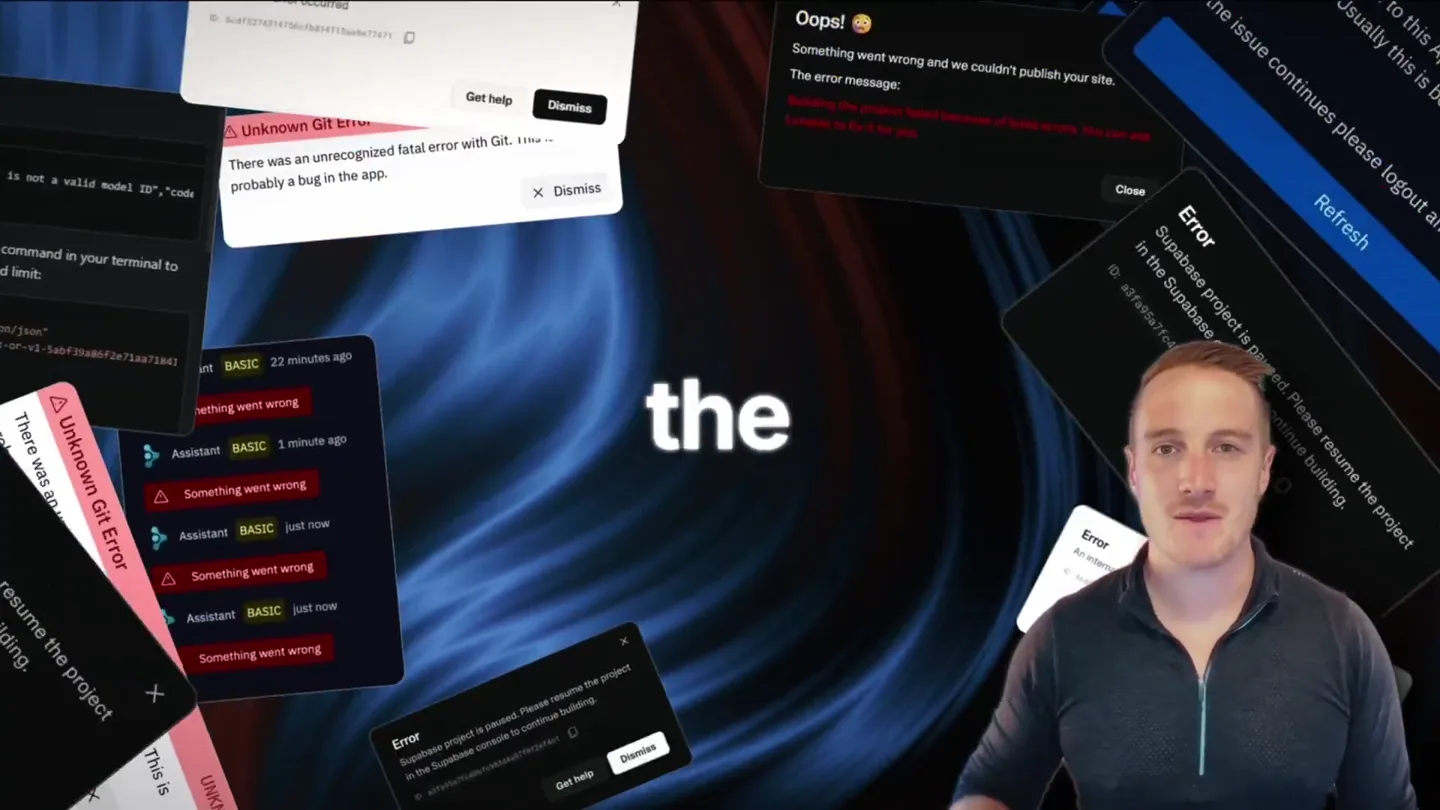
Bolt v2 pairs Claude Code and Codex agents with built-in hosting, database and storage so apps ship without setup.
Anthropic introduces Cowork, which brings the Claude Code way of delegating tasks to everyday, non-technical work.

Making life multiplanetary