
Xing Han Lu · Launch Video Breakdown: Hook, Pacing & Motion Design
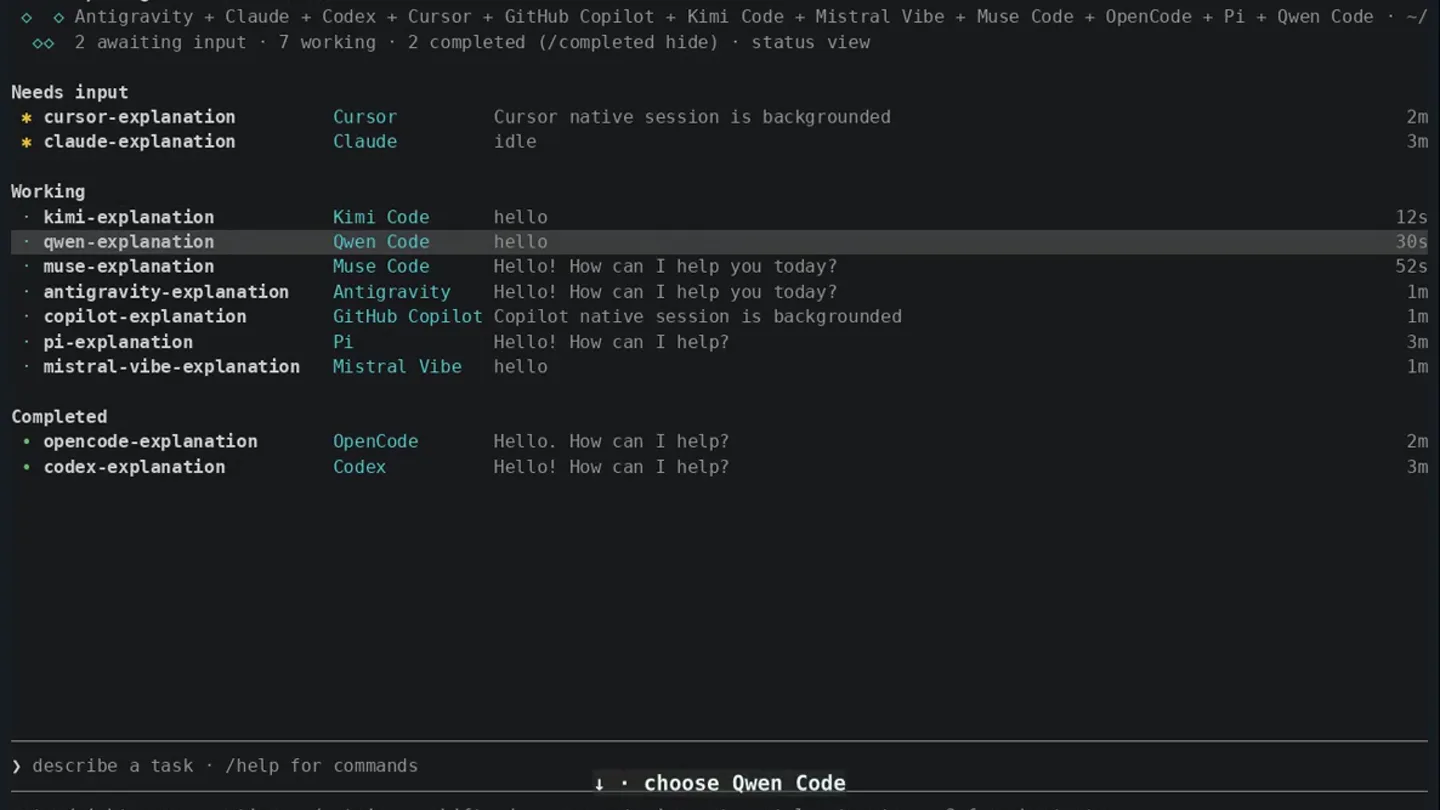
open-agent-view is an open dashboard, based on Claude Agent View, for managing Claude, Codex, Pi, OpenCode, and other coding agents.
Scene-by-scene timeline & spoken transcript
The Hook
Multi-Agent Dashboard Overview
“(No spoken dialogue — Silent video with ambient visual cues.)”
- On screen
- Open Agent View V0.1.41 Antigravity + Claude + Codex + Cursor + GitHub Copilot + Kimi Code + Mistral Vibe + Muse Code + OpenCode + Pi + Qwen Code 2 awaiting input · 7 working · 2 completed (/completed hide) · status view Needs input cursor-explanation Cursor Cursor native session is backgrounded 2m claude-explanation Claude idle 3m Working kimi-explanation Kimi Code hello 10s qwen-explanation Qwen Code hello 28s muse-explanation Muse Code Hello! How can I help you today? 50s antigravity-explanation Antigravity Hello! How can I help you today? 1m copilot-explanation GitHub Copilot Copilot native session is backgrounded 1m pi-explanation Pi Hello! How can I help? 3m mistral-vibe-explanation Mistral Vibe hello 1m Completed opencode-explanation OpenCode Hello. How can I help? 2m codex-explanation Codex Hello! How can I help? 3m describe a task /help for commands enter/right open · native: ~/- twice · shift+~ / space to inspect · ctrl+x to stop · ? for shortcuts Dashboard · 11 coding harnesses
- Camera
- Static, full-screen capture of a terminal interface.
- Motion
- Text highlighting and cursor movement to simulate user interaction, with subtle text updates.
Product Reveal
Diving into Qwen Code
“(No spoken dialogue — Silent video with ambient visual cues.)”
- On screen
- OWEN Qwen Code (v0.22.2) API Key | GPT-4.1 (/model to change) ~/work/acme-dashboard Tips: Add a QWEN.md file to give Qwen Code persistent project context. Auto mode enabled. An LLM classifier evaluates each tool call – safe actions auto-approve, risky ones are blocked. Exit: Shift+tab or /approval-mode default. Read context files: ../../../AGENTS.md, ~/.qwen/output-language.md hello Extensions changed on disk. Run /reload-plugins to apply updates. Hello. How can I assist you today? Type your message or @path/to/file acme-dashboard · GPT-4.1 · 131.1k Context 17.3% used Auto mode (shift + tab to cycle) Qwen Code · native session open Qwen Code Shift+~ · return to dashboard backgrounded Qwen Code session qwen-explanation; Enter/Right resumes it
- Camera
- Static, full-screen capture of a terminal interface.
- Motion
- Instantaneous scene cut, followed by simulated typing and text output, with a large, pixelated brand logo appearing.
Feature Teaser
Exploring Muse Code
“(No spoken dialogue — Silent video with ambient visual cues.)”
- On screen
- Muse Code 0.2.1 Model set to meta/muse-spark-1.2-contributor WARNING: Your prompts and outputs may be used to improve Meta's products. https://openrouter.ai/meta/muse-spark-1.2-contributor hello Hello! How can I help you today? meta/muse-spark-1.2-contributor · xhigh · ~/work/acme-dashboard Muse Code · native session open Muse Code Shift+~ · return to dashboard backgrounded Muse Code session; Enter/Right resumes it
- Camera
- Static, full-screen capture of a terminal interface.
- Motion
- Instantaneous scene cut, followed by simulated typing and text output, demonstrating a different agent's interface.
Call to Action
Kimi Code in Action: Web Lookup
“(No spoken dialogue — Silent video with ambient visual cues.)”
- On screen
- Welcome to Kimi Code! Send /help for help information. Directory: ~/work/acme-dashboard Session: session_0e7cbeff-04c2-4c4f-9c4a-540241a58d3f Model: GPT-5.4 Version: 0.39.0 Try Kimi Code Web UI - clearer task progress, visual sessions & settings management Run /web to continue your session in the browser No session yet - one will be created on your first message. tmux extended-keys is off. Modified Enter keys may not work. Add 'set -g extended-keys on' to ~/.tmux.conf and restart tmux. hello Hello. Look up https://open-agent-view.github.io/ and tell me what it is about. I'll check the site and summarize what it's about. Used FetchURL (https://open-agent-view.github.io/) 2.7 KB It's a tool called Open Agent View: a single dashboard for managing multiple coding-agent sessions across different "harnesses" like Claude Code, Codex, and Pi. From the site, the main idea is: run many agent sessions in one workspace see their status in one live dashboard jump into any session's native CLI return to the dashboard while that session keeps running So it's basically a multi-agent session manager / dashboard for developer-oriented AI CLIs, not a model itself. Source: Open Agent View (https://open-agent-view.github.io/). GPT-5.4 thinking ~/work/acme-dashboard shift-tab to Plan mode to review the approach before Kimi edits files context: 8% (20K/266K) Enter · send lookup prompt Type · Look up https://open-agent-view.github.io/ and tell me what it is about. working...! Tip: /sessions to browse and resume earlier sessions working...! Tip: /plugins: manage plugins - try the "Kimi Datasource" for reliable financial, economic, and academic data model · switch model Dashboard · Kimi Code keeps running backgrounded Kimi Code session; Enter/Right resumes it
- Camera
- Static, full-screen capture of a terminal interface.
- Motion
- Simulated typing, text output, and dynamic content generation, showcasing the agent's ability to fetch and summarize information.
Motion design primitives
Synthesizable in Remotion · key components of the terminal-ai-dashboard-showcase template.
TerminalTypewriterEffect
Text appears character by character, simulating real-time typing in a terminal, often with a blinking cursor. Lines of text then appear as 'output' from the system.
+ Code construction recipe
Use Remotion's `Sequence` and `spring` for cursor blink. For typing, `interpolate` the `text.length` property over time, rendering a substring. For output, use `delay` and `FadeIn` components.
DynamicHighlightRow
A specific row of text in a list or table is highlighted with a subtle background color change, indicating selection or focus.
+ Code construction recipe
Apply a `spring` animation to the `backgroundColor` property of a `div` element wrapping the target text. Use `AbsoluteFill` for precise positioning and `z-index` for layering.
PixelatedBrandReveal
A brand logo or key text appears with a pixelated, blocky animation, then resolves into a crisp, final form.
+ Code construction recipe
Utilize an SVG filter or a custom WebGL shader for the pixelation effect. Animate the `pixelSize` or `resolution` property from a large value to zero using `interpolate` or `spring`.
Style DNA & aesthetic system
Visual aesthetic
Typography
Motion
Special effects
Pacing & rhythm
Conceptual story rhythm
- 1
Dashboard Introduction
Purpose. Introduce the core concept of a multi-agent dashboard and its various integrated agents.
Execution. Full-screen terminal view showing a list of agents, with a cursor highlighting different options.
- 2
Agent Deep Dive
Purpose. Demonstrate the functionality and unique interface of individual coding agents.
Execution. Instant cut to a specific agent's terminal, showcasing its distinct branding and interaction patterns.
- 3
Interactive Task Execution
Purpose. Illustrate a practical use case by having an agent perform a task, such as web lookup and summarization.
Execution. Simulated typing of a command, followed by the agent's output, detailing its process and results.
- 4
Seamless Context Switching
Purpose. Highlight the ability to switch between agents and return to the dashboard without losing context.
Execution. Quick cuts back to the main dashboard, showing the status of previously active agents.
Remix in Animatiq Studio
Master remix prompt · agent-ready
Sample remix
Objective
Launch a new AI-powered code refactoring tool called 'RefactorGenie' that integrates with various IDEs and version control systems.How the recipe adapts
The 'RefactorGenie' video would open with a dashboard showing integrated IDEs and VCS. It would then cut to a 'RefactorGenie' terminal session, demonstrating a complex refactoring task with simulated typing and output. The 'PixelatedBrandReveal' primitive would be used for the 'RefactorGenie' logo. Dynamic highlighting would show the selection of different refactoring strategies. The video would conclude by returning to the dashboard, showing the completed refactoring task status.Remix blueprint · terminal-ai-dashboard-showcase
Scene durations (4 scenes, 29s)
Key Remotion components
Related Developer Tools Product Launches
Explore all Developer Tools launches →
xAI opens voice cloning on its API: build a custom voice in about two minutes or pick from 80+ voices in 28 languages.

Agentic CLI for coding, building apps, and automating workflows.
Sakana AI launches Fugu, a multi-agent orchestration system served through a single model API, led by its Fugu Ultra model.