
Scene-by-scene timeline & spoken transcript
The Hook
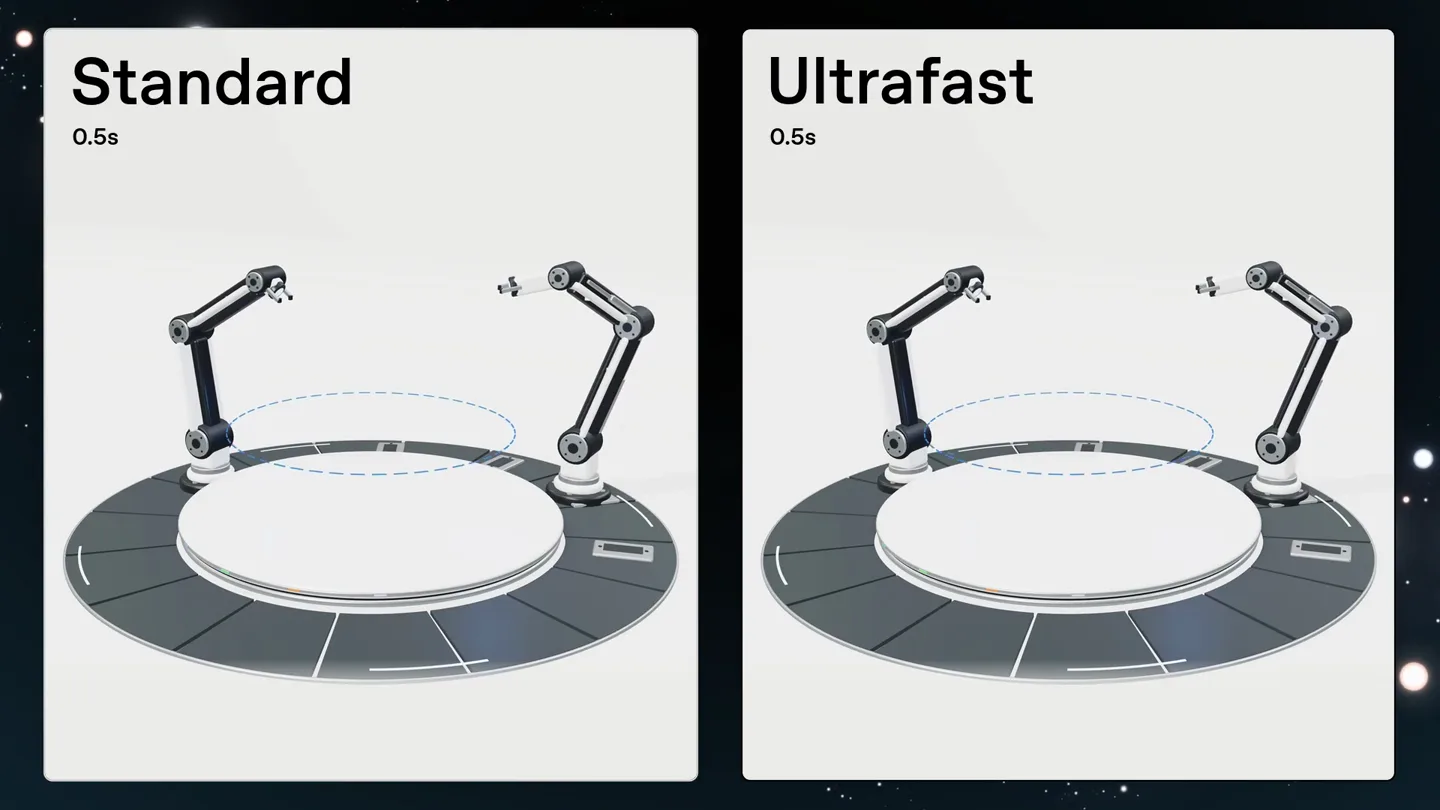
Side-by-Side Speed Comparison Intro
“(No spoken dialogue — Mellow electronic beat with sub-bass and pizzicato synth.)”
- On screen
- Standard Ultrafast
- Camera
- Static, high-angle isometric view of two identical 3D scenes, split vertically.
- Motion
- Split-screen comparison, subtle 3D model instantiation, and text overlay.
Problem Agitation
Rocket Assembly Time-Lapse
“(No spoken dialogue — Consistent mellow electronic beat continues, building subtle tension.)”
- On screen
- Standard 1.4s Ultrafast 1.4s Standard 3.6s Ultrafast 3.6s Standard 5.9s Ultrafast 5.9s Standard 8.2s Ultrafast 6.4s Standard 10.4s Ultrafast 6.4s Standard 12.7s Ultrafast 6.4s Standard 15.0s Ultrafast 6.4s
- Camera
- Static, high-angle isometric view. The 'Ultrafast' side transitions to a slightly lower angle with a background change.
- Motion
- Progressive 3D model assembly (rocket parts appearing), time counter animation, and scene background transition on the 'Ultrafast' side.
Product Reveal
Full Rocket Assembly & Launch Sequence
“(No spoken dialogue — Mellow electronic beat maintains its rhythm, subtle synth pad swells.)”
- On screen
- Standard 17.3s Ultrafast 6.4s Standard 19.5s Ultrafast 6.4s Standard 21.8s Ultrafast 6.4s Standard 24.1s Ultrafast 6.4s Standard 26.4s Ultrafast 6.4s Standard 28.6s Ultrafast 6.4s Standard 30.3s Ultrafast 6.4s
- Camera
- Static, high-angle isometric view for 'Standard'. 'Ultrafast' side maintains a slightly lower angle, then subtly zooms out and pans up as the rocket launches.
- Motion
- Continued 3D model assembly, smoke/exhaust particle effects for launch, and subtle camera movement to follow the 'Ultrafast' rocket's ascent.
Feature Teaser
Orbital Ascent & Speed Advantage
“(No spoken dialogue — Beat continues, with sustained synth pad creating an expansive feel.)”
- On screen
- Standard 30.3s Ultrafast 6.4s
- Camera
- The 'Standard' side remains static, showing the rocket on the launchpad. The 'Ultrafast' side transitions to an orbital view, following the rocket as it ascends into space.
- Motion
- Scene transition from launchpad to space, camera tracking the rocket, and subtle parallax scrolling of the Earth's surface to convey speed and altitude.
Motion design primitives
Synthesizable in Remotion · key components of the split-screen-speed-comparison template.
DualTerminalRaceSplit
A vertical split-screen layout comparing two processes side-by-side. Each side features a 3D environment where objects are progressively built or animated, with a time counter indicating duration.
+ Code construction recipe
Use a `Split` component for the layout. Render two separate `Sequence` components for 'Standard' and 'Ultrafast'. Animate 3D models using `ThreeCanvas` and `useCurrentFrame` for progressive visibility or transformation. Implement a `spring()` or `interpolate()` for smooth time counter updates.
Progressive3DAssembly
Complex 3D objects (like a rocket) are constructed piece by piece over time, with each component appearing or animating into place sequentially.
+ Code construction recipe
Utilize `ThreeCanvas` with `useCurrentFrame`. Each 3D part (e.g., rocket body, fins) is a separate mesh. Control the `opacity` or `position` of each part using `interpolate()` based on specific `from` and `to` frames, creating a staggered build-up effect.
OrbitalAscentTracker
A 3D camera follows a launching object (e.g., rocket) from a ground perspective to an orbital view, showcasing its ascent against a changing background (sky to space).
+ Code construction recipe
Within `ThreeCanvas`, animate the `camera.position` and `camera.lookAt` properties using `interpolate()` to simulate a tracking shot. Transition background textures or skyboxes from a terrestrial scene to a starry space scene. Implement `particle effects` for rocket exhaust and `parallax scrolling` for the Earth's surface.
Style DNA & aesthetic system
Visual aesthetic
Typography
Motion
Special effects
Pacing & rhythm
Conceptual story rhythm
- 1
The Setup
Purpose. Introduce the core comparison framework and the initial state of both 'Standard' and 'Ultrafast' scenarios.
Execution. Split-screen showing two identical empty platforms with robotic arms, clearly labeled 'Standard' and 'Ultrafast'.
- 2
The Build-Up
Purpose. Demonstrate the progressive assembly process, highlighting the time difference between the two tiers.
Execution. Rocket components appear sequentially on both sides, with the 'Ultrafast' side completing its assembly significantly faster, indicated by a time counter.
- 3
The Launch
Purpose. Showcase the culmination of the assembly and the immediate, dramatic speed advantage of the 'Ultrafast' tier.
Execution. The 'Ultrafast' rocket launches with smoke effects and ascends, while the 'Standard' rocket is still being assembled on the ground.
- 4
The Outcome
Purpose. Illustrate the ultimate benefit and superior performance of the 'Ultrafast' tier in a compelling visual.
Execution. The 'Ultrafast' rocket reaches orbit and flies through space, while the 'Standard' rocket remains on the launchpad, still in its assembly phase.
Remix in Animatiq Studio
Master remix prompt · agent-ready
Sample remix
Objective
Launch a new AI-powered code refactoring tool, 'CodeSculpt', demonstrating its speed against manual refactoring.How the recipe adapts
The DualTerminalRaceSplit primitive would compare 'Manual Refactor' and 'CodeSculpt'. Progressive3DAssembly would be adapted to show lines of code or abstract code blocks appearing and transforming. For 'CodeSculpt', the blocks would rapidly re-arrange and optimize, perhaps with glowing connections. The OrbitalAscentTracker would be replaced by a 'CodeCompletionTracker', where the 'CodeSculpt' side shows a fully refactored, optimized codebase flying through a digital landscape, while 'Manual Refactor' is still stuck on a single function. The time counters would highlight the dramatic speed difference in refactoring completion.Remix blueprint · split-screen-speed-comparison
Scene durations (4 scenes, 45s)
Key Remotion components
Related AI Agents Product Launches
Explore all AI Agents launches →
To ensure that artificial general intelligence benefits all of humanity

Introducing Claude Fable 5: a Mythos-class model that we’ve made safe for general use. Its capabilities exceed those of any model we’ve ever made generally available. https://t.co/2AvmEjHIX8

To understand the true nature of the universe.