
OpenCode · Launch Video Breakdown: Hook, Pacing & Motion Design
OpenCode 2 adds its own AI layer, mapping Anthropic, OpenAI, Gemini, Bedrock, and other providers onto one event stream.
Scene-by-scene timeline & spoken transcript
The Hook
Terminal Command & Code Snippets
“(No spoken dialogue — Dynamic electronic score with pizzicato synths and sub-bass drops)”
- On screen
- $ opencode Add dark mode Fix flaky auth test Migrate billing API Write release notes New session fix the flaky auth test Thought: Reproducing the failure - 2 steps - 3.1s Glob "*/**/*.test.ts" in - (38 matches) Read test/auth/session.test.ts $ bun test auth --rerun-each 20 3 of 20 runs failed It fails about one run in seven. Timing, not logic. Explored: 2 reads, 1 search Grep "refreshToken" in src (12 matches) Thought: Tracing the token refresh - 3 steps - 4.2s The refresh races the session check. I'll serialize them. Edit src/auth/session.ts 41 const session = await store.get(id) 42 - if (expired(session)) refresh(session) 42 + if (expired(session)) await refresh(session) tabs. horizontal : bun test auth also ad Build Pocket Goblin 14B Local max esc interrupt 42.1K (4%) $0.12 ctrl+p commands steer it now. or queue 1 queued update the changelog move it to another worktree. or fork it.
- Camera
- Static, then subtle zoom and pan across code editor, then wide shot revealing a network diagram.
- Motion
- Text typing animation, code diff highlighting, UI element reveals, data flow visualization with animated lines and nodes.
Product Reveal
Distributed Architecture & Plugin System
“(No spoken dialogue — Energetic electronic score with building risers and sub-bass drops)”
- On screen
- TUI DESKTOP Add dark mode Fix flaky auth test Migrate billing API Write release notes opencode run "summarize the diff" 1 opencode.log.create Billing now speaks the v2 API. Two endpoints left to migrate. CLI / SDK opencode service running 2.0.17 WEB one server. every client. close the terminal. it keeps working. Restarting service... Your session will resume automatically. hot reload. no restart. plugins everythin everything is a p even the TI
- Camera
- Zoom out to reveal a network diagram, then close-up on a terminal, then a subtle camera shake and zoom.
- Motion
- Node-link diagram animation, text reveals with glitch effects, UI pop-ups, and a 'hot reload' visual metaphor.
Feature Teaser
AI Layer & Cache Management
“(No spoken dialogue — Intensifying electronic score with impactful sound design)”
- On screen
- CACHE MISS naive rewrites the system prompt system* tools tool call assistant user cache miss 48,112 tokens at full price change the rules mid-session. CACHE HIT opencode 2 a w... an update github.checks todo t linear.issues ci.flaky_tests sys github.pulls ob p ci.flaky_tests tool call assistant user Instructions updated Instructions updated: core/instructions cache hit 48,112 bash s cached change the rules mid-session. keep the cache. execute code mode search({ query: "flaky tests" }) // -> tools.ci.flaky_tests const branches = ["main", "v2", "release"] const reports = await Promise.all( branches.map((branch) => tools.ci.flaky_tests({ branch })) ) execute ci.flaky_tests [branch=main] ci.flaky_tests [branch=v2] ci.flaky_tests [branch=release] filesystem network process only tools code mode: an interpreter, not a sandbox.
- Camera
- Static, then subtle zoom and pan across UI elements.
- Motion
- Text highlighting, button state changes, 'CACHE MISS' and 'CACHE HIT' animations with color shifts, code execution flow visualization.
Call to Action
Unified AI Stream & OpenCode 2 Reveal
“(No spoken dialogue — Climactic electronic score with a final impactful sub-bass drop)”
- On screen
- Anthropic Messages OpenAI Chat OpenAI Responses Gemini Bedrock Converse OpenAI-compatible LLMEvent stream step-start reasoning-delta planning... text-delta auth.test.ts is flaky tool-call ci_flaky_tests @opencode/ai Effect-native schema-first our own AI layer. every provider, one stream. 3,332 commits 40 contributors V2 only 3,165 pull requests rebuilt from scratch on Effect. opencode opencode 2 $ curl -fsSL https://opencode.ai/v2/install | bash or npm i -g @opencode/cli
- Camera
- Static, then a quick zoom out to reveal the logo and installation commands.
- Motion
- Data flow animation, numerical counters, logo reveal with glitch and typing effects, command line interface (CLI) instructions.
Motion design primitives
Synthesizable in Remotion · key components of the opencode-developer-launch template.
TerminalTypewriter
Text appears character by character as if being typed in a terminal, often with a blinking cursor. Code blocks highlight and diffs animate in.
+ Code construction recipe
Use `Sequence` and `spring` for character reveal, `interpolate` for cursor blink opacity. Implement `CodeSurfer` or custom `Highlight` components for syntax highlighting and diff animations.
NetworkFlowDiagram
Nodes representing systems or concepts are connected by animated lines, indicating data or process flow. Elements pop in and out, and text labels appear.
+ Code construction recipe
Utilize `SVG` paths with `stroke-dasharray` and `stroke-dashoffset` for line animations. Nodes can use `spring` for scale and opacity. Text can be revealed with `Sequence` and `Fade`.
GlitchTextReveal
Text or UI elements appear with a digital glitch effect, often accompanied by color shifts or pixelation, before settling into a clean state.
+ Code construction recipe
Apply `CSS filters` (e.g., `hue-rotate`, `saturate`) and `transform` properties with `interpolate` for glitching. Combine with `Text` components and `spring` for final position/opacity.
Style DNA & aesthetic system
Visual aesthetic
Typography
Motion
Special effects
Pacing & rhythm
Conceptual story rhythm
- 1
The Developer's Challenge
Purpose. Introduce the pain points and complexities faced by developers in managing code, tests, and distributed systems.
Execution. Rapid-fire display of code editor interactions, terminal commands, and debugging scenarios, highlighting common developer frustrations.
- 2
OpenCode's Unified Solution
Purpose. Present OpenCode as the elegant solution that simplifies complex workflows and integrates disparate systems.
Execution. Visual metaphors like network diagrams showing 'one server, every client' and seamless 'hot reload' demonstrations.
- 3
AI-Powered Efficiency
Purpose. Showcase OpenCode's unique AI layer and its ability to optimize performance and adapt to changing rules.
Execution. Animations of 'CACHE MISS' turning into 'CACHE HIT', and a clear diagram illustrating multiple AI providers feeding into one event stream.
- 4
The Future of Development
Purpose. Conclude by emphasizing OpenCode's foundational strength and inviting developers to experience the new paradigm.
Execution. A powerful logo reveal, key statistics (commits, contributors), and clear installation instructions, reinforcing the product's readiness and impact.
Remix in Animatiq Studio
Master remix prompt · agent-ready
Sample remix
Objective
Launch a new API gateway product called 'NexusFlow' that unifies microservices.How the recipe adapts
The NexusFlow video would open with a terminal command '$ nexusflow init' using the TerminalTypewriter primitive. It would then transition to a NetworkFlowDiagram showing various microservices connecting through a central 'NexusFlow' node, with animated data packets flowing. GlitchTextReveal would be used for feature headlines like 'Unified Auth' or 'Real-time Analytics'. The overall dark theme, high-contrast text, and fast cuts would be maintained, with sound design emphasizing data flow and secure connections.Remix blueprint · opencode-developer-launch
Scene durations (9 scenes, 43s)
Key Remotion components
Related Developer Tools Product Launches
Explore all Developer Tools launches →
Agentic CLI for coding, building apps, and automating workflows.
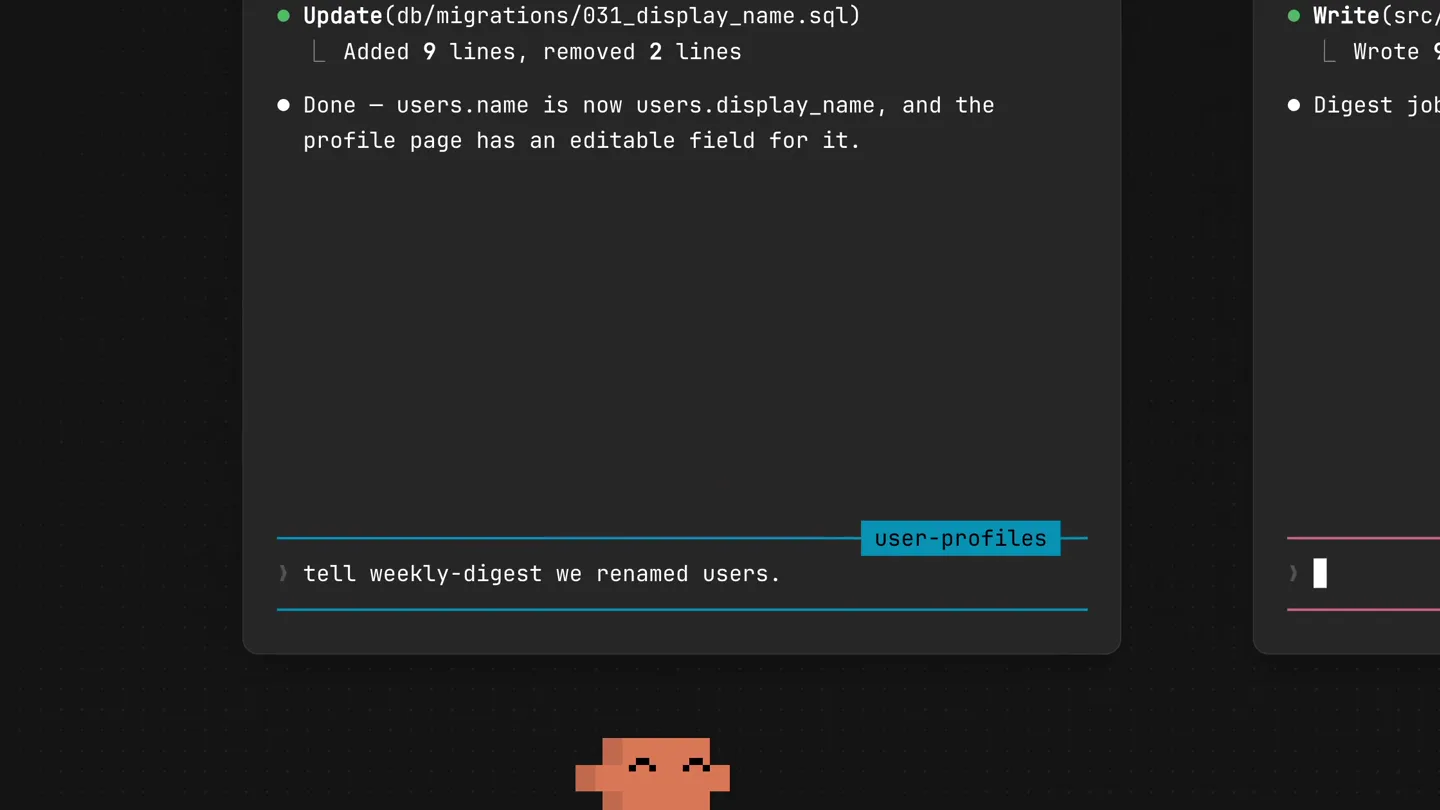
New in Claude Code: your sessions can now message each other. Tell Claude to send a summary (not your history or files), and the other session picks it up mid-task.

Meet Qwen3.8-Max: A New Bar for Coding and Cowork. https://t.co/mJaA8vr6xT