
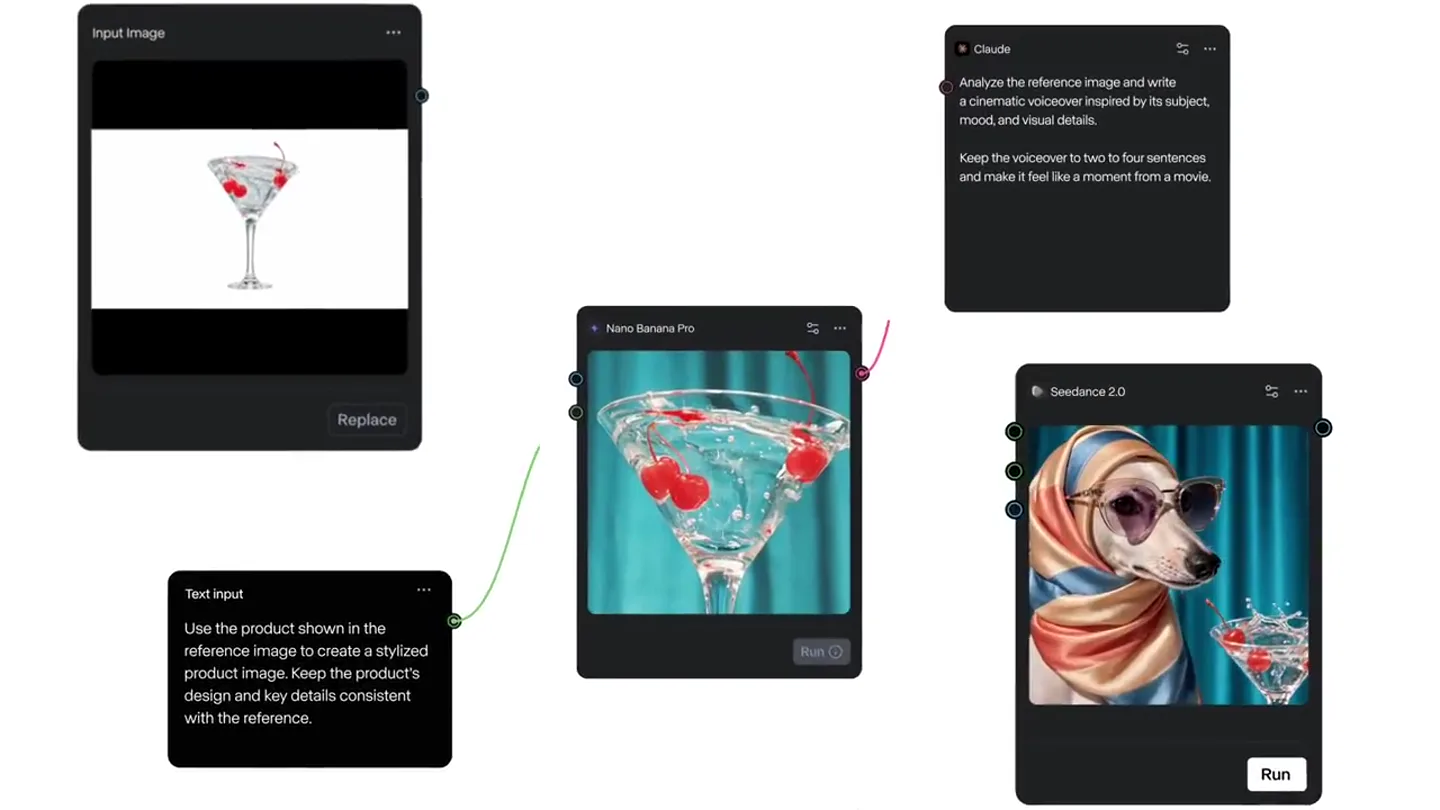
Scene-by-scene timeline & spoken transcript
The Hook
Introducing Runway Agent: Node-Based AI Workflows
“(No spoken dialogue — Glitchy, percussive electronic beat with pizzicato synths and driving sub-bass. High-energy riser builds to sub-bass drop/impact at 0:08.)”
- On screen
- Introducing Agent Workflow
- Camera
- Static wide shot of text, then a dynamic zoom into a node-based UI, followed by a close-up on a text input field.
- Motion
- Text reveal with subtle scale animation, rapid UI element pop-ins, and a smooth camera push into interactive elements.
Product Reveal
Natural Language Workflow Creation & Customization
“(No spoken dialogue — Ambient electronic score with orchestral synth pads and arpeggiated synth melodies. Riser builds from 0:19 to 0:21, leading to sub-bass drop/impact.)”
- On screen
- What changes between runs of this workflow? 1 Product image only Swap the product photo each run 2 Product image + ad copy New photo and new messaging each run 3 Product image + style/mood Same copy, different visual direction Type your own answer need to lock down a few details. Three quick questions above — answers will me design the right pipeline before building anything. 3 of 3 Skip & send What format/platform are these ads Output will appear here Input Image Extract Frame Connect a video to extract a frame Edit frame Run Text Analyze the reference image, identify its key product, visual style, mood, and potential audience, then develop a conversational media campaign concept with KEY ad copy, suggested social messaging, and suggested content. Include ad copy beside the product in the output, with concise copy tailored to the product. Show the bottle in a variety of settings and scenarios while keeping it as the main focus. Change the background entirely, while keeping the product in the exact same position within the frame. Run all
- Camera
- Close-up on interactive UI elements, then a wide shot revealing a complex node graph, followed by a zoom into a specific output node.
- Motion
- Interactive UI elements animate with quick, responsive feedback. Node connections draw dynamically, and the camera smoothly pans and zooms to highlight workflow progression.
Feature Teaser
Scalable Output & Multi-Aspect Ratio Generation
“(No spoken dialogue — Driving electronic beat continues, incorporating percussive effects. High-energy sweep and sub-bass impact at 0:35.)”
- On screen
- Type your thoughts... Workflow Ad Campaign convert my videos to all aspect ratios| Building workflow Source Video 16:9 Output 1:1 Output 3:4 Output 9:16 Output 4:3 Output 21:9 Output Text Prompt Type a prompt 0 characters
- Camera
- Close-up on a text input field with typing animation, then a wide shot of a multi-output node graph, followed by a quick zoom to a specific output.
- Motion
- Text typing animation with a blinking cursor. Node graph expands and populates with multiple output aspect ratios, demonstrating scalability through parallel processing visualization.
Call to Action
Runway Agent: Create Any Workflow on Command
“(No spoken dialogue — Final high-energy sweep and sub-bass impact.)”
- On screen
- Create any workflow Create any workflow on command. Available Now in Agent Runway
- Camera
- Static wide shot of text, then a fade to the company logo.
- Motion
- Bold text reveals with a subtle bounce, followed by a clean fade to the brand logo.
Motion design primitives
Synthesizable in Remotion · key components of the runway-agent-workflow-builder template.
NodeGraphConnect
Nodes appear and connect dynamically with bezier curves, illustrating data flow. Connections highlight briefly upon activation or data transfer.
+ Code construction recipe
Use `spring` for node pop-in and `interpolate` for bezier curve drawing. SVG paths for connections, with `stroke-dasharray` and `stroke-dashoffset` for drawing animation. Highlight with `scale` and `opacity` on connection lines.
DynamicTextInput
Text appears as if being typed, with a realistic blinking cursor. Input fields expand or contract based on content or user interaction.
+ Code construction recipe
Implement `typewriter` effect using `interpolate` on string slices. Use a `blink` animation for the cursor. Input field resizing with `spring` for width/height transitions.
MultiOutputGrid
A grid of output nodes populates rapidly, each displaying a different aspect ratio or processed result, emphasizing parallel processing.
+ Code construction recipe
Staggered `spring` animations for each grid item's `opacity` and `scale`. Use `Grid` component for layout. Content within each output node can use `fade` or `zoom` transitions.
Style DNA & aesthetic system
Visual aesthetic
Typography
Motion
Special effects
Pacing & rhythm
Conceptual story rhythm
- 1
The Agent's Promise
Purpose. Introduce the core concept of AI agents and their ability to build workflows.
Execution. Starts with a bold text reveal, quickly transitioning to a visual representation of nodes and connections, hinting at the underlying system.
- 2
Intuitive Creation
Purpose. Demonstrate the ease of creating complex workflows using natural language.
Execution. Focuses on text input fields, interactive prompts, and the dynamic generation of workflow nodes based on user input.
- 3
Scalable Output
Purpose. Highlight the product's capability to generate diverse outputs at scale, across various formats.
Execution. Showcases a complex node graph with multiple output nodes, each displaying different aspect ratios or content variations, emphasizing efficiency.
- 4
The Runway Advantage
Purpose. Reinforce the brand and the product's unique value proposition.
Execution. Concludes with a clear, concise call to action and the brand logo, leaving a lasting impression of power and accessibility.
Remix in Animatiq Studio
Master remix prompt · agent-ready
Sample remix
Objective
Launch a new AI-powered code generation platform called 'SyntaxFlow' that allows developers to describe desired functionality in natural language and automatically generates code snippets in multiple languages and frameworks.How the recipe adapts
The NodeGraphConnect primitive will visualize the flow from natural language input to generated code modules. DynamicTextInput will show developers typing their requirements. MultiOutputGrid will display generated code in different languages (Python, JavaScript, Go) and frameworks (React, Vue, Angular) side-by-side, emphasizing SyntaxFlow's versatility and speed. The overall dark theme and fast pacing will convey a powerful, efficient developer tool.Remix blueprint · runway-agent-workflow-builder
Scene durations (4 scenes, 37.4s)
Key Remotion components
Related AI Agents Product Launches
Explore all AI Agents launches →
To ensure that artificial general intelligence benefits all of humanity
Gopuff introduces Go, an AI shopping assistant built with SpaceXAI: say what you need and the order is placed.

Iliad (Troy) trailer made by Grok Imagine 1.5, which was just released