
QuiverAI · Launch Video Breakdown: Hook, Pacing & Motion Design
Visual AI is shifting from pixels to code. With Arrow 1.1, every illustration is generated as editable SVG source code, creating outputs that can be refined, adapted, and integrated into real workf…
Scene-by-scene timeline & spoken transcript
The Hook
SVG Illustration Generation
“(No spoken dialogue — ambient visual with subtle UI sounds implied by cursor movement and text generation.)”
- On screen
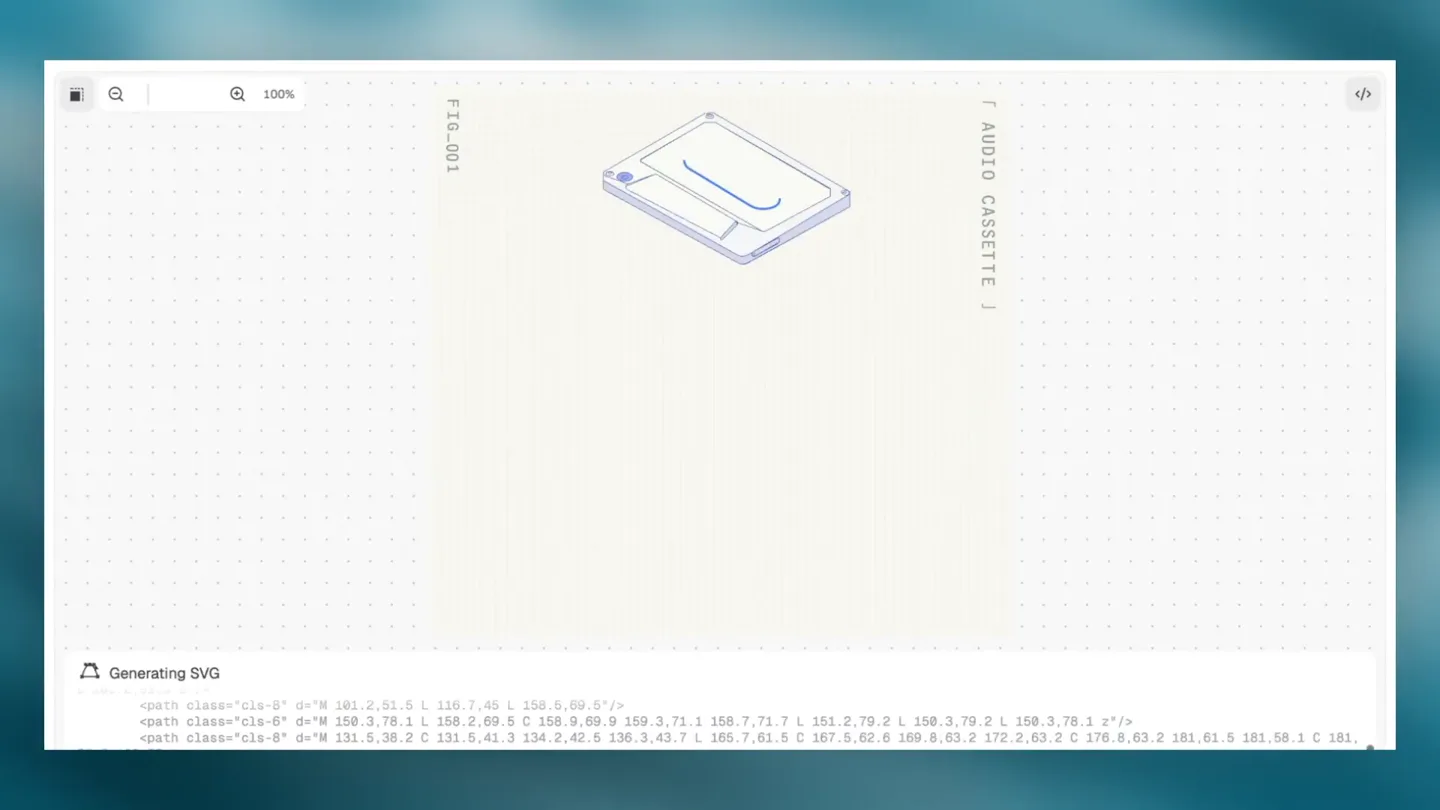
- FIG. 001 AUDIO CASSETTE Generating SVG <path class="cls-3" d="M 285.0,8.99 H 292.3 V 182.8 H 291.5 V 180 H 289.5 V 182.1 H 288.8 V 100 H 286.6 V 102.9 H 285.6 V 99 Z"/> </g> <p>
- Camera
- Static, wide shot of a UI window with a dotted grid background. The camera is fixed on the central canvas area.
- Motion
- Progressive SVG path drawing, simulating real-time code generation and rendering of an isometric illustration.
Product Reveal
Detailed Component Assembly
“(No spoken dialogue — ambient visual with subtle UI sounds implied by cursor movement and text generation.)”
- On screen
- FIG. 001 AUDIO CASSETTE Generating SVG <path class="cls-8" d="M 146,14.9 C 140,15.1 145.5,15.4 144.8,15.4 C 144.2,15.4 143.6,15.1 143.6,14.9 C 143.6,14.6 144.2,14.4 144.8,14.4 S 146,14.6 146,14.9 Z"/> <path class="cls-8" d="M 216.6,55.6 C 216.6,56.1 215.8,56.1 215.8,56.1 C 215.8,55.9 213.5,53.7 214.3,53.4 C 216.2,53.2 217.5,54.2 216.6,55.6 Z"/>
- Camera
- Static, wide shot. The illustration within the UI window dynamically assembles, revealing more complex parts of the audio cassette.
- Motion
- Sequential reveal of SVG elements, creating an exploded isometric view of the cassette components. Elements appear with a subtle fade-in and position shift.
Feature Teaser
Annotated Exploded View
“(No spoken dialogue — ambient visual with subtle UI sounds implied by cursor movement and text generation.)”
- On screen
- FIG. 001 AUDIO CASSETTE TOP SHELL TAPE WINDOW HUB HOLE (LEFT) HUB HOLE (RIGHT) SUPPLY REEL (LEFT SPOOL) MAGNETIC TAPE (FILL COLOR) LEADER TAPE (FILL COLOR) TAKE-UP REEL (RIGHT SPOOL) GUIDE ROLLER (LEFT) GUIDE ROLLER (RIGHT) CAPSTAN HOLE PRESSURE PAD ASSEMBLY (FELT & SHIELD) BOTTOM SHELL METAL SHIELD SCREW POST WRITE PROTECT TAB SCREW POST (BOTTOM) Generating SVG
- Camera
- Static, wide shot. The illustration is fully rendered and annotated with labels, showcasing the detailed output.
- Motion
- Text labels and connecting lines animate in, precisely pointing to each component of the exploded cassette diagram. This highlights the granular detail of the generated SVG.
Call to Action
Editable SVG Source Code
“(No spoken dialogue — ambient visual with subtle UI sounds implied by cursor movement and text generation.)”
- On screen
- <svg xmlns="http://www.w3.org/2000/svg" viewBox="0 0 300 285"> <!-- SVG created with Arrow, by QuiverAI (https://quiver.ai) --> <style type="text/css"> .cls-0 { fill: #F8F7F0; stroke: none; } .cls-1 { fill: none; stroke: #C0C0C0; stroke-width: 0.25; stroke-dasharray: 0.5,1; } .cls-2 { fill: none; stroke: #999999; stroke-miterlimit: 10; } .cls-3 { fill: #999999; } .cls-4 { fill: none; stroke: #283687; stroke-width: 0.4; stroke-linecap: round; stroke-linejoin: round; stroke-miterlimit: 10; } .cls-5 { fill: #F5F6F7; stroke: #283687; stroke-width: 0.4;
- Camera
- Slow, controlled pan and zoom into the right-hand code editor panel, revealing the generated SVG source code.
- Motion
- Smooth camera pan and zoom, combined with a scrolling text animation in the code editor, emphasizing the 'code' aspect of the visual AI.
Motion design primitives
Synthesizable in Remotion · key components of the code-generated-isometric-reveal template.
SVGPathDraw
An SVG illustration progressively renders as if being drawn stroke by stroke, simulating real-time vector graphic creation from code.
+ Code construction recipe
Utilize Remotion's `interpolate` function with `stroke-dasharray` and `stroke-dashoffset` properties on SVG paths. Calculate total path length and animate `stroke-dashoffset` from full length to zero over time, using `easeOutCubic` for a natural drawing effect.
ExplodedIsometricReveal
Individual components of an isometric illustration appear and subtly shift into their final exploded positions, often accompanied by text labels.
+ Code construction recipe
Each SVG component should be a separate Remotion `<AbsoluteFill>` or `<Sequence>` element. Animate `transform: translateY` and `opacity` using `spring` for a bouncy, staggered reveal. Text labels can fade in with a slight delay after their corresponding component.
CodeEditorScrollZoom
A code editor panel smoothly scrolls its content while the camera simultaneously zooms into a specific section of the code.
+ Code construction recipe
Implement a `scroll-y` animation on the code editor container using `interpolate` for smooth scrolling. Simultaneously, animate the camera's `scale` and `translate` properties using `spring` or `easeOutQuad` to achieve the zoom and pan effect, focusing on relevant code snippets.
Style DNA & aesthetic system
Visual aesthetic
Typography
Motion
Special effects
Pacing & rhythm
Conceptual story rhythm
- 1
The Genesis
Purpose. Introduce the core concept: visual AI generating code.
Execution. Initial blank canvas, then the first strokes of an SVG illustration appear, accompanied by 'Generating SVG' text and scrolling code.
- 2
The Unveiling
Purpose. Showcase the product's capability to create complex, editable illustrations.
Execution. The illustration rapidly assembles into a complete, detailed object (audio cassette), demonstrating the AI's output quality.
- 3
The Dissection
Purpose. Highlight the granular, editable nature of the generated output.
Execution. The illustration explodes into its constituent parts, with precise labels appearing, emphasizing the 'code' aspect that allows for such detailed deconstruction.
- 4
The Code Revealed
Purpose. Reinforce the core value proposition: illustrations as editable source code.
Execution. A smooth zoom into the actual SVG source code, showing the clean, well-structured output that developers can directly use and modify.
Remix in Animatiq Studio
Master remix prompt · agent-ready
Sample remix
Objective
Launch a new AI tool, 'MeshGen', that converts text prompts into editable 3D GLTF models.How the recipe adapts
The video would start with a blank 3D viewport in a minimalist UI. As 'Generating GLTF' appears, a complex 3D drone model would progressively render, wireframe by wireframe, then with textures. It would then explode into its individual components (propellers, chassis, camera), each labeled with a clean sans-serif font. The final scene would smoothly pan and zoom into a code editor displaying the generated GLTF JSON, highlighting its editable structure. The camera movements would be slow and precise, emphasizing the technical detail.Remix blueprint · code-generated-isometric-reveal
Scene durations (4 scenes, 19s)
Key Remotion components
Related Developer Tools Product Launches
Explore all Developer Tools launches →
xAI opens voice cloning on its API: build a custom voice in about two minutes or pick from 80+ voices in 28 languages.

Claude can now operate your Mac, opening apps, browsing and filling spreadsheets, as a research preview in Cowork and Claude Code.

Agentic CLI for coding, building apps, and automating workflows.