
Databricks · Launch Video Breakdown: Hook, Pacing & Motion Design
Omnigent is an open source AI meta-harness that gives teams one place to compose, control, and collaborate across agent workflows — bringing together coding agents including Codex, Claude, Cursor, Pi, Antigravity, and custom agents, with dynamic guardrails.
Scene-by-scene timeline & spoken transcript
The Hook
Introducing Omnigent: The AI Meta-Harness
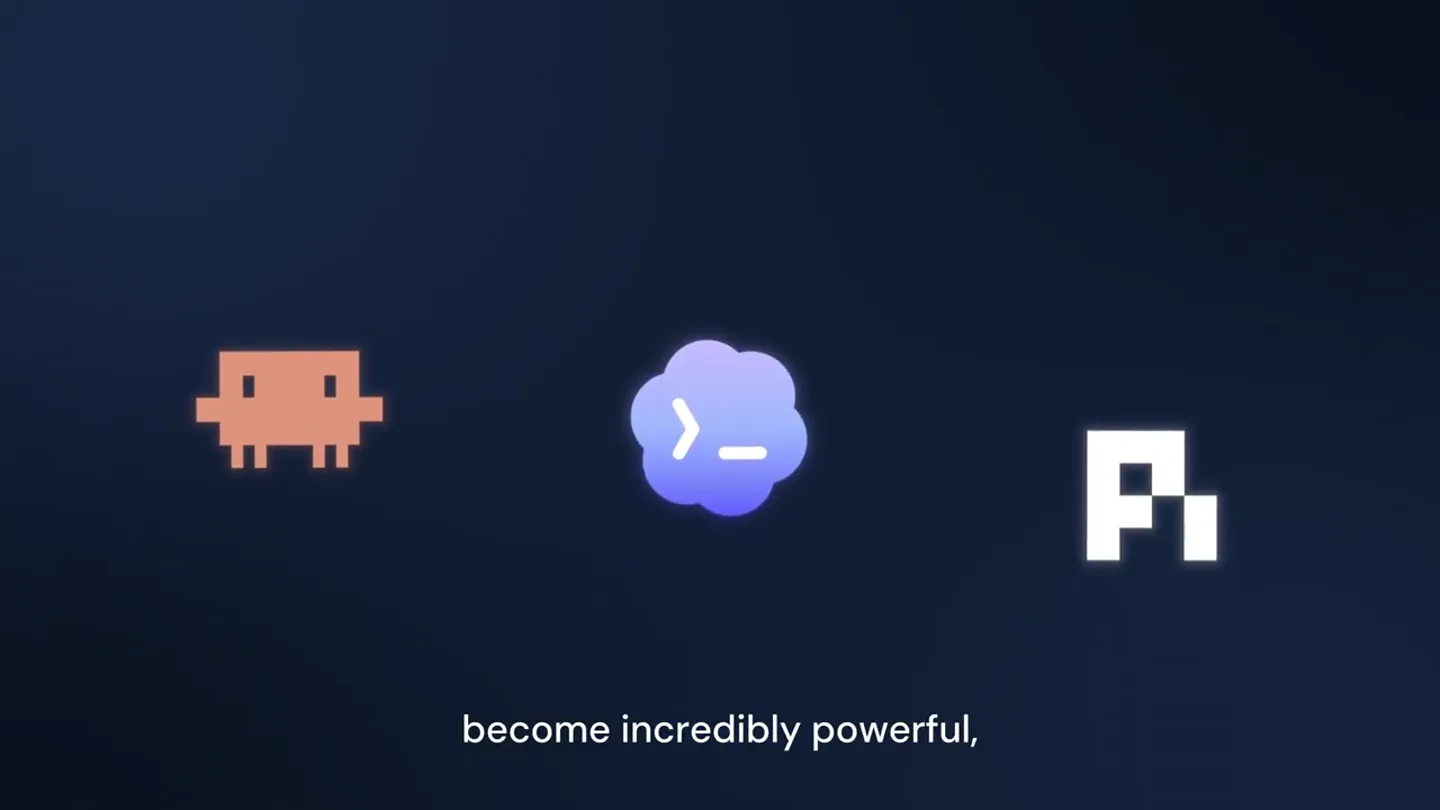
“become incredibly powerful, and as projects scale, across the same workflow. Omnigent is a meta harness that sits above all of your agents, giving teams one place to compose, control, and collaborate across agent workflows. Bringing together coding agents including Codex, Claude, Cursor, Pi, Antigravity, and custom agents, with dynamic guardrails.”
- On screen
- Omnigent
- Camera
- Static camera with subtle zoom on icons, then a reveal of the Omnigent logo. Followed by a quick pan and zoom into a UI screen.
- Motion
- Iconography morphing, text reveal, UI zoom-in, subtle glow effects on icons.
Product Reveal
Unified Interface & Agent Switching
“This gives you one unified interface for building robust agent workflows. And with Omnigent, you can seamlessly switch between different models and techniques, like Claude Code, with just one line change. Or even switch to OpenAI agents, with just one line change. This allows you to experiment with different models and techniques, without having to rewrite your entire workflow.”
- On screen
- /investigate Please investigate this repo and give me an overview. Files Agents 2/3 Shells polly explore-content-structure Plan: -[] Map top-level content areas -[] Inspect src libraries/components -[] Inspe... explore-architecture-tooling Now let me look at the API/functions layer, scripts, CI/hooks, and remaining structure. my_agent agent.yaml name: my_agent prompt: You are a helpful data analyst. executor: harness: claude-sdk tools: word_count: type: function callable: mypackage.mymodule.word_count researcher: type: agent prompt: Search for relevant information and summarize it. tools: word_count: inherit harness: openai-agents
- Camera
- Close-up on UI elements, then a smooth transition between code editor views. The camera follows the cursor and highlights text.
- Motion
- UI element highlighting, text typing animation, smooth code editor transitions, cursor animation.
Feature Teaser
Dynamic Guardrails & Secure Sandboxing
“Omnigent also provides stateful data-centric policies that track things like cost budgets, or even require approval for file and shell operations. And because Omnigent runs in a secure sandbox, you can be confident that your agents are operating safely. And when it comes to collaboration, Omnigent makes it easy to share live agent sessions via a URL, so you can collaborate and steer your agent together, in real time, from your desktop or even your phone.”
- On screen
- Add Policy Choose a policy to apply to this session. Filter policies... Limit Tool Calls Per Session Limits the total number of tool calls across the entire session using session_state to persist the counter Require Approval for File & Shell Operations Asks for user approval before any file or shell tool call — covers Omnigent sys_os_* tools, Claude Code native tools (Bash, Read, Write, Edit, Glob... Block Specific Skills Prevents the agent from loading specific skills. Intercepts Session Cost Budget Change Gates a session on cumulative LLM spend (USD); once a hard limit is reached DENY (the whole turn at the request phase, or tool call) while still on an expensive model (prompting a model downgrade), and ASK for approval at each soft warning checkpoint (tool-call phase only). Reads event.context.usage.total_cost_usd and event.context.model. max_cost_usd (number) Hard limit in USD; once cumulative session cost reaches it, tool calls are blocked while the session is on an expensive model. ask_thresholds_usd (comma-separated) Optional soft warning checkpoints in USD; the session asks for approval the first time spend crosses each (every value must be < max_cost_usd). comma-separated values expensive_models (comma-separated) Optional case-insensitive substring tokens for the model tiers blocked once over budget (default: Fable and GPT-4, excluding the cheap -mini-nano variants). An empty list disables the hard limit, leaving only the soft thresholds. comma-separated values Add Share this session Invite others to view or collaborate on this session. Public access Anyone can view this session NAME t.dang@databricks.com anthony.giuliano@databricks.com User ID alice@example.com Copied! Done PERMISSION Owner Edit Read Grant sessionUtils.ts Comments Address All Open 1 Addressed computeSessionUsage can we refactor this? anthony.giuliano@databricks.com 12:22 PM Today Omnigent New session Inbox Q Search sessions No active sessions What should we do? Describe a task to start a new session... Claude Co... Development No workflow Advanced K49W3G0Z7R What should we do? Describe a task to start a new session... Claude Co... Development No workflow Advanced
- Camera
- Zoom into policy modals, then a stylized animation of a sandbox. Followed by UI interactions for sharing and collaboration, and a multi-device view.
- Motion
- Modal pop-up, illustrative animation, UI element interaction, multi-device screen presentation, subtle parallax scrolling.
Call to Action
Omnigent: Open Source & Available Now
“but the layer you want to build on. Omnigent is open source and available today at omnigent.ai.”
- On screen
- but the layer you w Omnigent start today Omnigent is open source omnigent.ai at omnigent.ai.
- Camera
- Dynamic text animation, then a full-screen reveal of the Omnigent logo and call to action.
- Motion
- Kinetic typography, logo reveal, button animation, URL reveal.
Motion design primitives
Synthesizable in Remotion · key components of the databricks-omnigent-style template.
IconGlowReveal
Icons appear with a subtle glow and a soft, expanding circular outline, then transition into a unified cluster. This signifies integration and connection.
+ Code construction recipe
Use `spring` for scale and opacity of the icon and its glow. Animate an SVG circle's stroke-dasharray and stroke-dashoffset for the expanding outline. Interpolate positions for the clustering effect.
CodeEditorTypewriter
Text appears as if being typed in a code editor, with a blinking cursor, followed by a smooth highlight and replacement of specific code lines.
+ Code construction recipe
Implement a `Sequence` of `Text` components with `delay` and `duration` for typing. Use `interpolate` for cursor opacity. Animate `background-color` for line highlighting and `opacity` for text replacement.
MultiDeviceShowcase
Multiple device screens (desktop, mobile) slide into view, displaying synchronized UI content, emphasizing cross-platform functionality.
+ Code construction recipe
Utilize `spring` for the `translateX` and `rotateY` properties of each device frame. Ensure `z-index` is managed for layering. Use `AbsoluteFill` for screen content and `interpolate` for content opacity.
Style DNA & aesthetic system
Visual aesthetic
Typography
Motion
Special effects
Pacing & rhythm
Conceptual story rhythm
- 1
The Integration Promise
Purpose. Introduce the core problem of managing multiple AI agents and hint at a unified solution.
Execution. Individual agent icons appear, then coalesce into a single, glowing entity, symbolizing integration.
- 2
Seamless Workflow Demonstration
Purpose. Showcase the product's ability to simplify complex agent switching and configuration.
Execution. A code editor UI animates, demonstrating a single line change to switch agent harnesses, highlighting ease of use.
- 3
Security & Collaboration Assurance
Purpose. Address concerns about control, security, and team collaboration in agent workflows.
Execution. Visual metaphors like a sandbox for security, and UI flows for policy setting and session sharing across devices.
- 4
Call to Action & Empowerment
Purpose. Encourage users to adopt the open-source solution and become part of the community.
Execution. Kinetic typography emphasizing 'open source' and 'start today', culminating in the product logo and URL.
Remix in Animatiq Studio
Master remix prompt · agent-ready
Sample remix
Objective
Launch a new open-source API gateway called 'Nexus' that simplifies microservice orchestration and provides real-time analytics.How the recipe adapts
The 'IconGlowReveal' primitive would be adapted to show various microservice icons (e.g., database, message queue, serverless function) converging into the Nexus logo. The 'CodeEditorTypewriter' would demonstrate configuring a new API route in Nexus with a few lines of YAML, highlighting auto-completion and validation. The 'MultiDeviceShowcase' would display the Nexus dashboard on a desktop and a mobile app showing real-time analytics, emphasizing monitoring and control from anywhere.Remix blueprint · databricks-omnigent-style
Scene durations (4 scenes, 78s)
Key Remotion components
Related Developer Tools Product Launches
Explore all Developer Tools launches →
xAI opens voice cloning on its API: build a custom voice in about two minutes or pick from 80+ voices in 28 languages.

Claude can now operate your Mac, opening apps, browsing and filling spreadsheets, as a research preview in Cowork and Claude Code.

Agentic CLI for coding, building apps, and automating workflows.