

Figma · Launch Video Breakdown: Hook, Pacing & Motion Design
Figma Motion is here — announced live from Config 2026.
Scene-by-scene timeline & spoken transcript
The Hook
Figma Motion Reveal
“(No spoken dialogue — A high-energy audio transition with a sub-bass drop at 0:02, followed by a driving electronic beat and pizzicato synth melodies.)”
- On screen
- Figma Motion
- Camera
- Rapid cuts between UI elements and abstract motion graphics. Close-up on Figma's timeline and easing curve editor. Wide shot of a complex UI layout with multiple cards.
- Motion
- Fast-paced cuts, UI element reveals, cursor interactions, abstract shape animations, text reveals with a glitch effect.
Feature Teaser
Advanced Animation Controls & Collaboration
“(No spoken dialogue — The driving electronic beat continues, punctuated by high-energy audio transitions at 0:07, 0:12, 0:17, and 0:22, often with sub-bass drops.)”
- On screen
- Create a glitchy CANYON CREW HECTOP 3D transform Hyein Gilles Looking good! Easing Brand Motion Motion Tokens Brand: Linear Brand: Snappy Brand: Playful
- Camera
- Focus on specific UI panels: timeline, 3D transform tool, and easing presets. Dynamic camera moves across a grid of icons and a profile screen.
- Motion
- Keyframe manipulation, 3D rotation, collaborative cursor animations, preset easing selection, grid layout transitions, data visualization animations.
Product Reveal
Seamless UI Animation & Prototyping
“(No spoken dialogue — The energetic electronic beat maintains its pace, with audio transitions at 0:27 and 0:32, featuring risers and sub-bass impacts.)”
- On screen
- Set your ideas in motion 166°
- Camera
- Zoom into a UI element, then a wide shot showcasing a complex app interface with animated components. Close-up on a rotation dial.
- Motion
- Interactive UI elements, data-driven animations, confetti burst, rotation controls, smooth transitions between different app screens.
Feature Teaser
Expressive Motion Design
“(No spoken dialogue — The driving electronic beat continues, with high-energy audio transitions at 0:37, 0:42, and 0:47, including sweeps and sub-bass drops.)”
- On screen
- (No on-screen text)
- Camera
- Dynamic camera movements across various UI elements, showcasing different animation styles and interactions. Close-ups on specific animated components.
- Motion
- Complex UI interactions, physics-based animations, custom easing curves, interactive data visualizations, and dynamic content loading.
Call to Action
Figma Motion: Bring Your Designs to Life
“(No spoken dialogue — The electronic beat builds in intensity towards the end, with prominent audio transitions at 0:52, 0:57, 1:02, and 1:07, culminating in a final impactful sub-bass drop.)”
- On screen
- Figma Motion is here. Config 2026
- Camera
- Rapid cuts between abstract motion graphics and UI elements, culminating in a full-screen reveal of the Figma Motion logo and tagline.
- Motion
- Abstract shape morphing, text reveals with dynamic effects, logo animation, and a final impactful title card.
Motion design primitives
Synthesizable in Remotion · key components of the dynamic-ui-motion-launch template.
InteractiveTimelineKeyframe
A horizontal timeline with draggable keyframes and an interactive playhead. Users can adjust keyframe positions and select easing curves from a dropdown.
+ Code construction recipe
Utilize Remotion's <Sequence> and <AbsoluteFill> for layout. Implement draggable elements with `useCurrentFrame` and `interpolate` for keyframe positions. Use SVG paths for the timeline line and circles. Implement a dropdown for easing curve selection with conditional rendering based on user interaction.
DynamicUIGridTransition
A grid of UI elements (icons, cards) that animate into view with staggered delays and different easing types. Elements can scale, rotate, and translate.
+ Code construction recipe
Create a grid layout using CSS Grid or Flexbox within Remotion components. Apply `spring` or `interpolate` with `stagger` for staggered entry animations. Use `transform` properties (scale, rotate, translate) for individual element motion. Allow for different easing presets to be applied via props.
CollaborativeCursorPath
Multiple cursors moving across the screen, leaving a trail or interacting with UI elements. Text bubbles appear next to cursors, simulating real-time collaboration.
+ Code construction recipe
Track cursor positions over time using `useCurrentFrame` and `interpolate` along predefined or dynamically generated paths. Render SVG paths for trails. Use <AbsoluteFill> for text bubbles, animating their opacity and position with `spring` or `interpolate` based on cursor proximity or event triggers.
Style DNA & aesthetic system
Visual aesthetic
Typography
Motion
Special effects
Pacing & rhythm
Conceptual story rhythm
- 1
The Interactive Canvas
Purpose. Introduce the core concept of motion design within Figma's familiar interface, highlighting ease of use.
Execution. Rapid cuts showcasing Figma's UI with new motion features, emphasizing direct manipulation of animation properties on the canvas.
- 2
Precision & Expressiveness
Purpose. Demonstrate the depth of control and creative possibilities offered by the new motion tools.
Execution. Detailed views of timeline keyframes, easing curves, 3D transforms, and collaborative features, showing both granular control and expressive outcomes.
- 3
Real-World Application
Purpose. Showcase how Figma Motion can be used to create compelling, interactive experiences for various products.
Execution. Examples of animated app interfaces, data visualizations, and interactive prototypes, illustrating practical use cases.
- 4
The Future of Design
Purpose. Conclude with a powerful statement about Figma's vision for integrated design and motion.
Execution. Abstract motion graphics blending with UI elements, culminating in the 'Figma Motion is here' title card and logo reveal.
Remix in Animatiq Studio
Master remix prompt · agent-ready
Sample remix
Objective
Launch a new AI-powered music composition tool called SynthFlow AI.How the recipe adapts
The video would open with a rapid montage of SynthFlow's clean UI, showing AI-generated melodies and rhythmic patterns forming on a timeline. Instead of Figma's easing curves, we'd see interactive waveform editors and spectral analysis visualizations. Collaborative cursors would highlight real-time co-creation of tracks. The vibrant color palette would be adapted to reflect SynthFlow's branding, perhaps with more blues and purples alongside the existing energetic tones. Abstract motion graphics would visualize sound propagation and AI processing, culminating in a 'SynthFlow AI: Compose the Future' title card.Remix blueprint · dynamic-ui-motion-launch
Scene durations (5 scenes, 68s)
Key Remotion components
Related Creative Tools Product Launches
Explore all Creative Tools launches →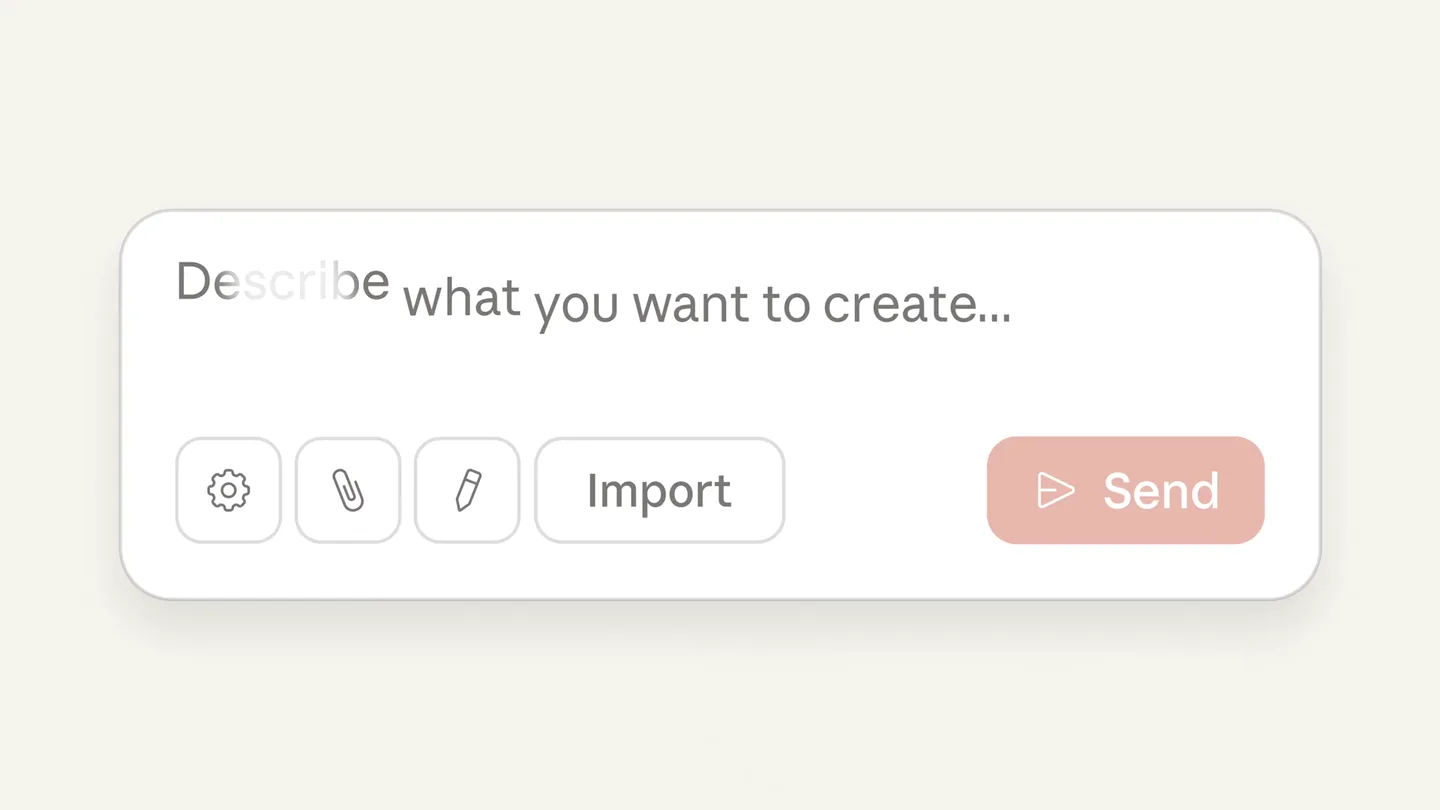
Anthropic Labs launches Claude Design, which turns conversation into prototypes, slides and one-pagers, powered by Claude Opus 4.7.
A vibe design partner with an AI-native canvas for turning ideas into UI.

Your work tools in Claude are now available on mobile. Explore Figma designs, create Canva slides, check Amplitude dashboards, all from your phone. Give it a try: