
Poimandres · Launch Video Breakdown: Hook, Pacing & Motion Design
Glyph v0.1.0 is a GPU-first typography engine for the web: batched drawing, incremental updates, and multilingual text that looks like a native app.
Scene-by-scene timeline & spoken transcript
The Hook
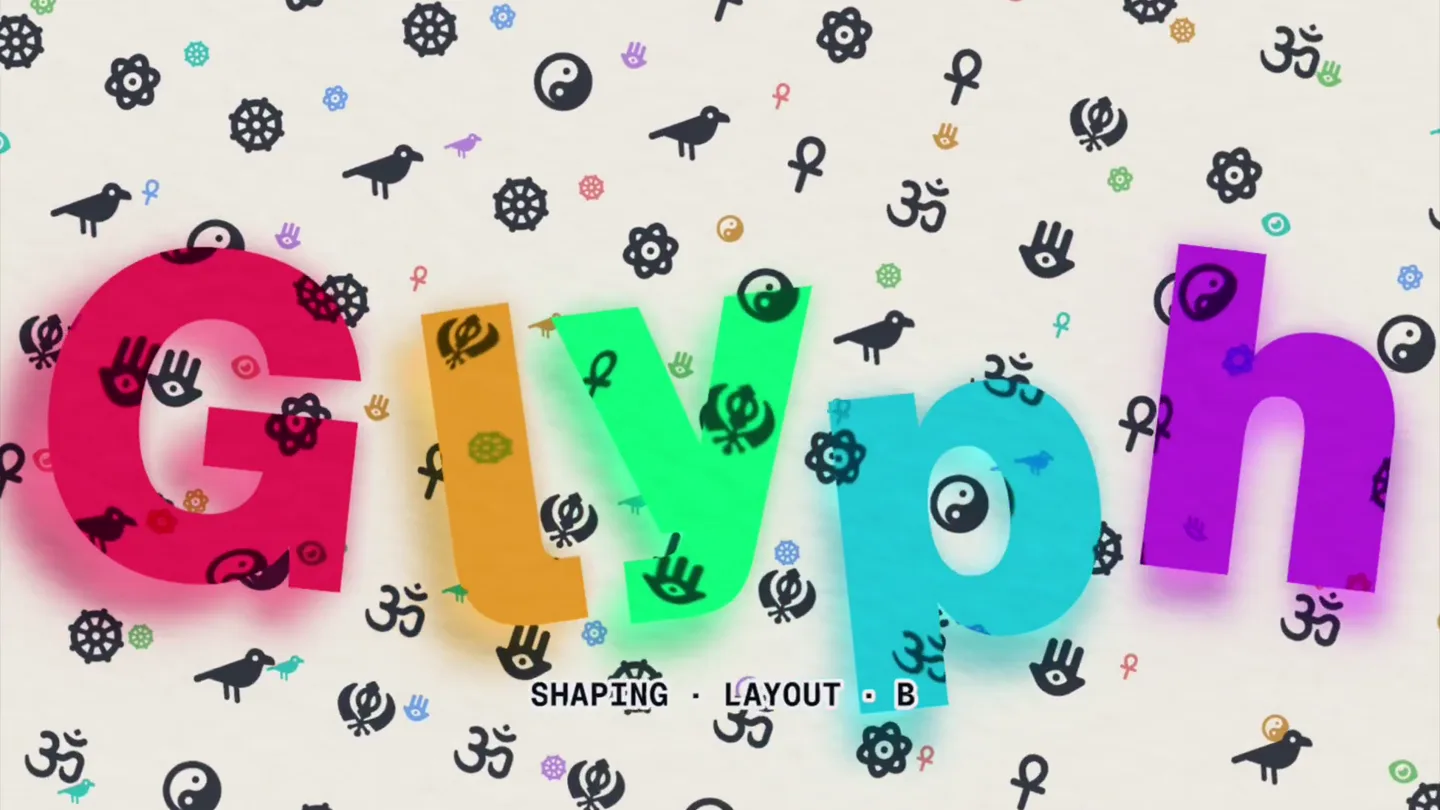
Glyph Title Reveal with Dynamic Iconography
“(No spoken dialogue — upbeat, rhythmic, silent video with a 110 BPM implied tempo)”
- On screen
- Glyph
- Camera
- Static overhead shot, slight zoom out as letters form.
- Motion
- Masking reveal, character-by-character text animation, dynamic background icon fill.
Feature Teaser
Technical Feature List Expansion with 3D Element
“(No spoken dialogue — rhythmic, silent video with a 110 BPM implied tempo)”
- On screen
- SHAPING · LAYOUT · BAKING · SHADERS · SLUG · MSDF · BITMAP · WEBGPU
- Camera
- Static overhead shot, slight camera shake and tilt as the 3D element appears.
- Motion
- Text reveal with dot separators, 3D object animation (rotation, scaling), particle effects, background icon changes.
Product Reveal
Glyph Letters Disintegration and Black Hole Transition
“(No spoken dialogue — rhythmic, silent video with a 110 BPM implied tempo)”
- On screen
- SHAPING · LAYOUT · BAKING · SHADERS · SLUG · MSDF · BITMAP · WEBGPU
- Camera
- Slight pan and zoom towards the center, then a rapid pull-back and warp.
- Motion
- Text disintegration, particle system, black hole/vortex effect, screen warp/distortion.
Call to Action
Cosmic Starfield and Fade to Black
“(No spoken dialogue — rhythmic, silent video with a 110 BPM implied tempo)”
- On screen
- (No on-screen text)
- Camera
- Rapid zoom out from the vortex, then static on a starfield, fading to black.
- Motion
- Warp transition, starfield particle generation, fade out.
Motion design primitives
Synthesizable in Remotion · key components of the dynamic-glyph-launch template.
DynamicIconFillText
Large, colorful text characters are filled and animated with a pattern of small, diverse icons that dynamically change and move within the letterforms and the background.
+ Code construction recipe
Use Remotion's <Text> component with a custom SVG mask or shader to reveal a background of animated <Icon> components. Interpolate icon positions, scale, and opacity. Implement a `useVideoConfig` hook to synchronize icon changes with specific beats.
FeatureListTypewriter
A list of technical terms appears sequentially with a subtle dot separator, accompanied by a 3D object that rotates and emits particles, emphasizing each new term.
+ Code construction recipe
Animate text opacity and position using `spring` for a typewriter effect. Use `Sequence` to time each word's appearance. Integrate a 3D model (e.g., using `three-remotion`) with `interpolate` for rotation and `ParticleSystem` for emission synchronized with text reveals.
VortexDisintegration
Text and background elements are drawn into a central black hole-like vortex, distorting and disintegrating into particles before transitioning to a new scene.
+ Code construction recipe
Apply a `Shader` or `SVGFilter` (e.g., `feDisplacementMap`) to create the vortex distortion. Animate the `transform` properties of text and background elements to simulate being pulled in. Use a `ParticleSystem` for the disintegration effect, with particles moving towards the vortex center.
Style DNA & aesthetic system
Visual aesthetic
Typography
Motion
Special effects
Pacing & rhythm
Conceptual story rhythm
- 1
Product Introduction
Purpose. Immediately grab attention and introduce the product name with a visually rich, memorable animation.
Execution. The 'Glyph' title emerges with vibrant colors and dynamic icon fills, setting an energetic tone.
- 2
Feature Showcase
Purpose. Highlight key technical capabilities and the underlying technology in a concise, engaging manner.
Execution. A list of features appears sequentially, accompanied by a rotating 3D element and particle effects, reinforcing the 'engine' concept.
- 3
Technological Power
Purpose. Visually represent the transformative power and depth of the technology.
Execution. The 'Glyph' letters and background elements are dramatically pulled into a central vortex, symbolizing a powerful, all-encompassing force.
- 4
Future Vision
Purpose. Conclude with a sense of wonder and potential, leaving a lasting impression.
Execution. The vortex transitions into a cosmic starfield, suggesting vast possibilities and a new frontier.
Remix in Animatiq Studio
Master remix prompt · agent-ready
Sample remix
Objective
Launch video for 'Aether', a new AI-powered music composition tool.How the recipe adapts
The 'Aether' title would appear with musical note and waveform icons filling its letters. The feature list would highlight 'Generative Melodies', 'Adaptive Harmony', 'Real-time Orchestration', with a 3D abstract sound wave object rotating and emitting particles. The vortex transition would pull in musical elements, leading to a cosmic soundscape of glowing, pulsating notes.Remix blueprint · dynamic-glyph-launch
Scene durations (4 scenes, 15s)
Key Remotion components
Related Creative Tools Product Launches
Explore all Creative Tools launches →
A vibe design partner with an AI-native canvas for turning ideas into UI.

We heard you wanted to use Codex rate limit resets on your own time. Starting today, we’re rolling out the ability to save rate limit resets to use later. We’re starting Go, Plus, Pro, and Business
Introducing Framer 3.0 with Agents, Branching, Community, and an all-new design.