
Anton Osika · Launch Video Breakdown: Hook, Pacing & Motion Design
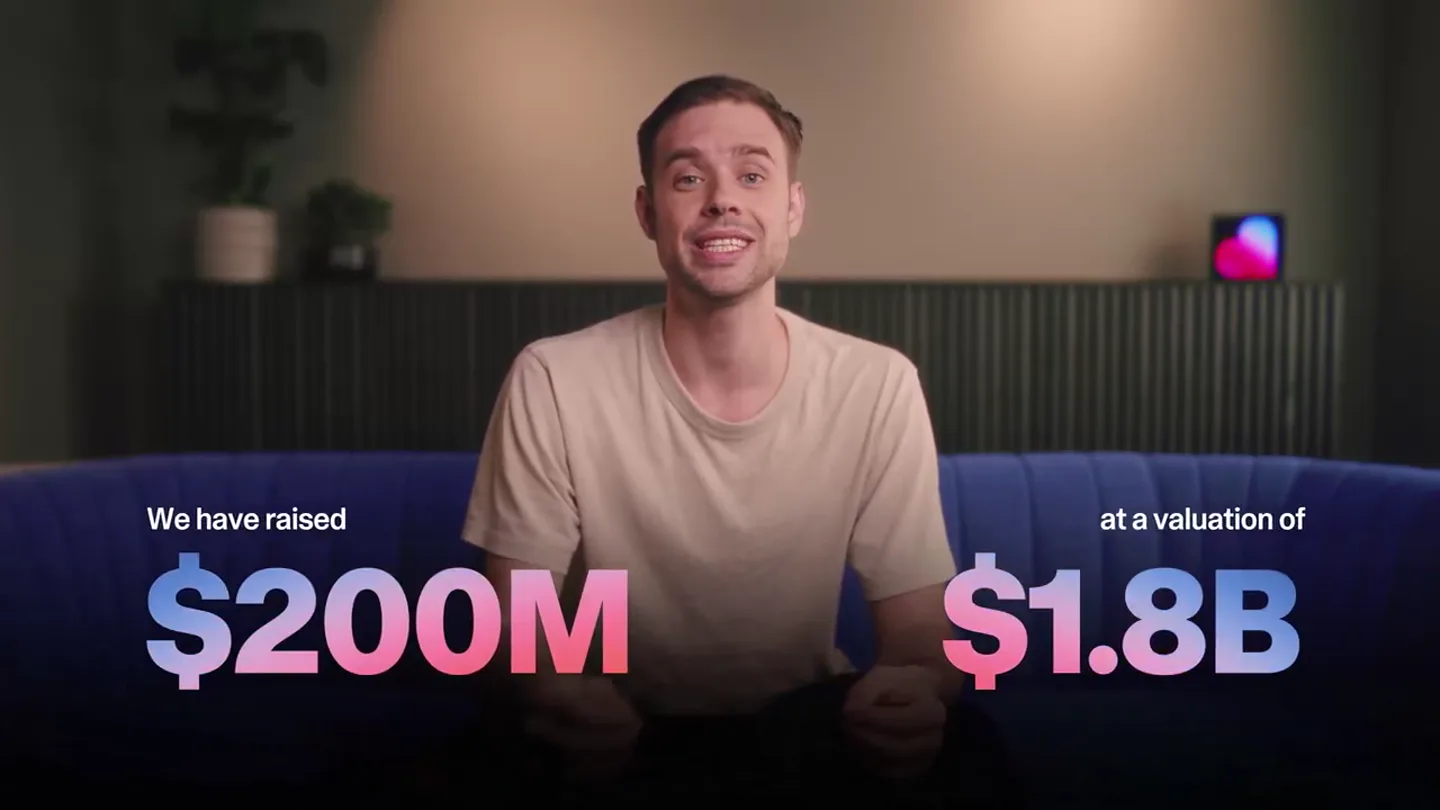
Lovable just crossed $100M ARR in 8 months. Today we're launching a game-changing update, it reduces the error rates by 91%. Introducing Lovable Agent.
Scene-by-scene timeline & spoken transcript
The Hook
Lovable Agent Introduction & Value Proposition
“Lovable just crossed $100M ARR in 8 months. Today we're launching a game-changing update, it reduces the error rates by 91%. Introducing Lovable Agent.”
- On screen
- We have raised $200M at a valuation of $1.8B Introducing Agent DocuSign Build me Attach Public DocuSign App Build me a document signing app like DocuSign Lovable I'll create a DocuSign alternative. A digital document sig application with document upload, signature pl Creating... "Build me a document signing app like DocuSign" Gather write code files Gather relevant knowledge Search abo
- Camera
- Alternates between a medium shot of the founder speaking directly to the camera and close-up screen recordings of the product UI.
- Motion
- Rapid cuts between founder and product UI, with UI elements animating in response to spoken commands. Text overlays highlight key metrics.
Product Reveal
Demonstrating Lovable Agent's Capabilities
“So what did I do with my free side project with a legal budget of $0? Continued building of course. Shipped new features. Made the free product even better. It's crazy how I now have thousands of users on Inkless wo love the product.”
- On screen
- Gather write code files Gather relevant knowledge Search about DocuSign Create Core components Read code for signing capability Search for signing libraries Integrating Signature Function Read code files for sending emails Search up Resend API documentation Email Implementation Read code files for where to add payments Search for Stripe API Documentation Integrate Stripe Billing https://docs.stripe.com/api Error detected Finished Fixed const renderContent = () => { switch (activeTab) { case "documents": return <DocumentList onDocumentOpen={handleDocumentOpen} />; case "templates": return ( <div className="text-center py-12"> <h1 className="h-16 mx-auto text-muted-foreground mb-4">Document Templates</h1> <p className="text-muted-foreground mb-6">Create reusable templates for faster document creation</p> <Button>Create Template</Button> </div> ); case "payment": DocuSign App Sign Documents Upload Your Document Select a PDF document to prepare for signing Upload Document Drag and drop your PDF here Browse files PDF files only, max 10MB Lovable I'll create a DocuSign alternative. A digital document signing application with document upload, signature placement, and signing capabilities. Plan Core Plan setup: Step 1: PDF viewer setup Step 2: Signature field placement Step 3: Drawing signatures Step 4: Stripe integration Step 5: Email notifications Step 6: Storage Ready! The app now offers a full signing workflow with a clean, professional interface, like DocuSign Create document signing app Preview Restore Code Ask Lovable... Chat Agent Until DocuSign sent me an email. That I'm "in violation of DocuSign's intellectual property". For "disseminating false and misleading statements regarding DocuSign". What? I never stole anything from DocuSign or made misleading statements about DocuSign. They basically got scared that I created a free e-sign tool. DocuSign - maybe next time it's better to listen to your customers rather than sending cease and desists?
- Camera
- Focuses on screen recordings, demonstrating the product's workflow from command input to task completion, including error handling and UI generation. Occasional cuts back to the founder.
- Motion
- Animated flowcharts illustrate internal processes. UI elements dynamically appear and populate. Smooth transitions between different application views. Text scrolls and highlights key information.
Feature Teaser
Impact & Call to Action
“And we just made our biggest product update yet, reducing errors in Lovable by 91%. Introducing Lovable Agent.”
- On screen
- ProUniversitario Quer estudar? O ProUniversitário te ajuda! Disciplinas Direito Administração Tecnologia da Informação Engenharia Common Errors Old Lovable New Lovable Capability Old Lovable You've got $100 in credits! Lovable nico @lovableuser_nico I love using your products @lovable_dev Anton Osika @antonosika Lovable just hit $100M ARR faster than any tech company in history. And we just made our biggest product update yet, reducing errors in Lovable by 91%. Introducing Lovable Agent.
- Camera
- Mix of founder speaking, showcasing user testimonials (tweets), and animated data visualizations. Ends with a product shot of a gift card.
- Motion
- Animated bar charts demonstrate performance improvements. Social media posts animate onto the screen. Product elements (gift cards) slide and stack, creating depth. Gradient backgrounds are used for visual interest.
Motion design primitives
Synthesizable in Remotion · key components of the founder-ai-product-launch template.
DynamicUIGeneration
Text input fields populate, and UI elements like buttons, checkboxes, and flowcharts dynamically appear and animate into their final positions, simulating real-time application building.
+ Code construction recipe
Utilize `spring()` for bouncy, natural element entrances. Animate `opacity`, `scale`, and `translateY` properties. Use `Sequence` and `AbsoluteFill` for orchestrating complex UI builds. SVG paths can be animated for flowchart lines.
MetricHighlightGradient
Large numerical metrics and key phrases are displayed with a vibrant, shifting gradient fill, often accompanied by a subtle glow or shadow effect.
+ Code construction recipe
Apply a `linear-gradient` CSS property to text elements, animating the `background-position` or `hue-rotate` filter over time. Use `drop-shadow` for depth. `interpolateColors` can create smooth gradient transitions.
StackedCardReveal
Multiple card-like elements (e.g., gift cards, social media posts) slide in from off-screen, stacking or fanning out with a slight parallax effect, revealing the primary card in the foreground.
+ Code construction recipe
Animate `translateX`, `translateY`, and `rotateZ` for each card using `spring()` or `easing` functions. Apply `z-index` to control stacking order. Use `map` to render multiple instances with staggered delays.
Style DNA & aesthetic system
Visual aesthetic
Typography
Motion
Special effects
Pacing & rhythm
Conceptual story rhythm
- 1
The Bold Claim
Purpose. Immediately establishes the product's success and the significance of the new launch, hooking the viewer.
Execution. Founder speaking directly, overlaid with large, gradient-filled text highlighting impressive financial metrics.
- 2
Problem & Solution Demo
Purpose. Illustrates the core problem the product solves and visually demonstrates its intuitive, powerful solution.
Execution. Screen recordings showing a user inputting a command, followed by animated flowcharts and UI generation, culminating in a functional application.
- 3
Overcoming Adversity & Validation
Purpose. Builds credibility and trust by sharing a founder's journey and showcasing real-world user success.
Execution. Founder's personal anecdote about legal challenges, followed by animated social media testimonials and a demonstration of error reduction metrics.
- 4
Future & Incentive
Purpose. Reinforces the product's impact and provides a clear call to action with an enticing offer.
Execution. Animated bar charts showing performance gains, a final founder address, and a visually appealing reveal of a promotional gift card.
Remix in Animatiq Studio
Master remix prompt · agent-ready
Sample remix
Objective
Launch an AI-powered design tool called 'CanvasFlow' that automates UI component generation from natural language prompts.How the recipe adapts
The 'DynamicUIGeneration' primitive would be used to show CanvasFlow building complex UI layouts from a simple text prompt. 'MetricHighlightGradient' would display '90% faster design cycles' and '500+ components generated'. The 'StackedCardReveal' would showcase user testimonials of designers praising CanvasFlow's speed. The founder would explain the AI's underlying logic using animated flowcharts, similar to the code generation process in the original video.Remix blueprint · founder-ai-product-launch
Scene durations (5 scenes, 108s)
Key Remotion components
Related Developer Tools Product Launches
Explore all Developer Tools launches →
xAI opens voice cloning on its API: build a custom voice in about two minutes or pick from 80+ voices in 28 languages.
Claude can now operate your Mac, opening apps, browsing and filling spreadsheets, as a research preview in Cowork and Claude Code.

Agentic CLI for coding, building apps, and automating workflows.