
Malfors · Launch Video Breakdown: Hook, Pacing & Motion Design
Today, we're launching Malfors. A collaborative, graph-based investigation platform, made for analysts. - Excellent UX✨ - Built-in enrichments from major vendors - Custom enrichments via simple API - Case management & real-time collaboration and much more! https://t.co/HljdAEWoJv
Scene-by-scene timeline & spoken transcript
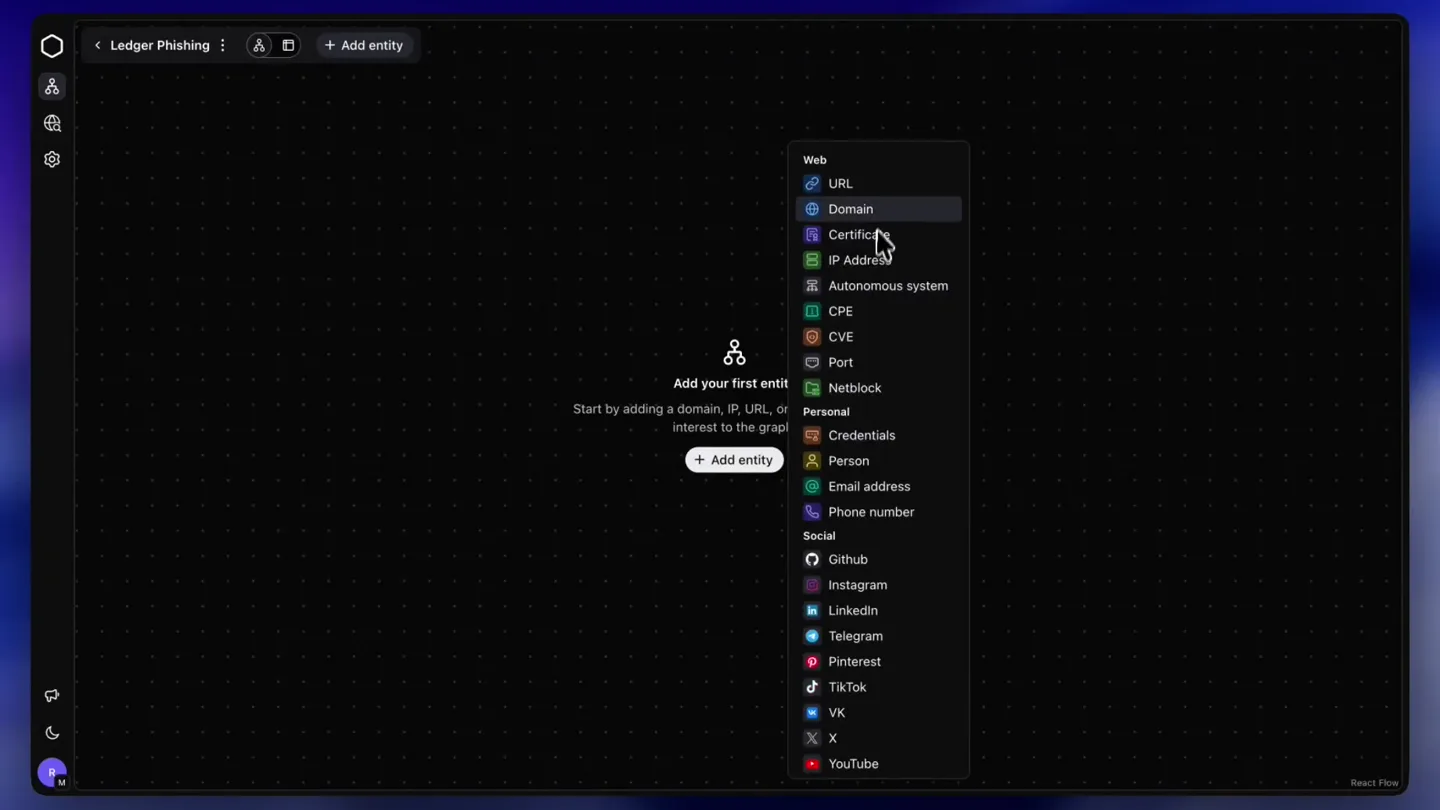
The Hook
Initial Entity Creation & Enrichment
“(No spoken dialogue — Silent video with ambient UI clicks and subtle background hum.)”
- On screen
- Ledger Phishing Add entity Add your first entity Start by adding a domain, IP, URL, or any other point of interest to the graph. Add entity Web URL Domain Certificate IP Address Autonomous system CPE CVE Port Netblock Personal Credentials Person Email address Phone number Social Github Instagram LinkedIn Telegram Pinterest TikTok VK X YouTube ledgerapp.shop Domain ledgerapp.shop Added at Oct 21, 2025, 5:26 PM Added by R Redacted Details Additional details about the entity Incoming links (0) No entities Outgoing links (0) No entities Enrich Malfors DNSDumpster URLscan - Search WhoisXMLAPI VirusTotal - Domain report HudsonRock - Lookup dom... SilentPush
- Camera
- Static screen capture with precise mouse movements highlighting UI elements. Zoom-in on specific panels.
- Motion
- Direct screen recording with cursor interaction, showcasing real-time UI responsiveness and dropdown menu animations.
Product Reveal
Graph Expansion & Data Correlation
“(No spoken dialogue — Silent video with ambient UI clicks and subtle background hum.)”
- On screen
- ledgerapp.shop DNS AAAA records No data CNAME records Records No data MX records Exchange Priority No data NS records Nameserver a.share-dns.com. b.share-dns.net. SOA records Nameserver Hostmaster Serial Refresh Retry Expire a.share-dns.com. master.share-dns.com 1743597957 3600 1200 86400 TXT records No data Details Malfors - DNS Executed at Oct 21, 2025, 5:26 PM A records IP Address 101.32.51.16 Add entity Copy Copy (defanged) Open in Search in ledgerapp.shop DNS 101.32.51.16 Enrich IP Address 101.32.51.16 Added at Oct 21, 2025, 5:26 PM Added by R Redacted Details IPInfo - IP Details Executed at Oct 21, 2025, 5:26 PM Summary IP 101.32.51.16 ASN AS132203 Organization Tencent Building, Keijizhongyi Avenue Geolocation Location 22.2783,114.1747 City Hong Kong Region Hong Kong
- Camera
- Dynamic pan and zoom to follow the data flow and graph expansion. Focus shifts between the graph and detail panels.
- Motion
- Smooth camera pans and zooms, combined with animated node creation and connection lines, illustrating data relationships.
Feature Teaser
Multi-Source Enrichment & Graph Visualization
“(No spoken dialogue — Silent video with ambient UI clicks and subtle background hum.)”
- On screen
- ledgerapp.shop DNS 101.32.51.16 Enrich IP Address 101.32.51.16 Added at Oct 21, 2025, 5:26 PM Added by R Redacted Details IPInfo - IP Details Shodan - InternetDB Executed at Oct 21, 2025, 5:26 PM Hostnames Hostname appdl.vip appdl.store appmart.cfd CPEs CPE cpe:/a:openbsd:openssh:7.4 SecurityTrails - Reverse IP Executed at Oct 21, 2025, 5:26 PM Domains Domain ledger.com.ledgerapp.vip ledgerapp.icu ledgerapp.shop com.ledgerapp.vip ledgerapp.cc ledgerapp.vip www.ledgerapp.vip ledger.com.start-process.com ledgeronline.im ledgerapp.shop DNS 101.32.51.16 Reverse IP Reverse IP Reverse IP Reverse IP Reverse IP Reverse IP Reverse IP ledger.com.ledgerapp.vip ledgerapp.icu ledgerapp.shop com.ledgerapp.vip ledgerapp.cc ledgerapp.vip www.ledgerapp.vip ledger.com.start-proces... ledgeronline.im
- Camera
- Continuous camera movement, panning across the expanding graph, highlighting new nodes and connections. Slight zoom out to show overall structure.
- Motion
- Animated graph layout transitions, node creation with subtle pop-in effects, and smooth line drawing to represent relationships.
Call to Action
Advanced Graph Manipulation & Collaboration
“(No spoken dialogue — Silent video with ambient UI clicks and subtle background hum.)”
- On screen
- Ledger Phishing Add entity ledgerapp.shop DNS 101.32.51.16 Reverse IP Reverse IP Reverse IP Reverse IP Reverse IP Reverse IP Reverse IP ledger.com.ledgerapp.vip ledgerapp.icu ledgerapp.shop com.ledgerapp.vip ledgerapp.cc ledgerapp.vip www.ledgerapp.vip ledger.com.start-proces... ledgeronline.im Port Netblock Personal Credentials Person Email address Phone number Social Github Instagram LinkedIn Telegram Pinterest TikTok VK X YouTube Change type Delete Add entity Zoom to fit Auto-layout Layered Tree ledgerapp.shop DNS 101.32.51.16 Reverse IP Reverse IP Reverse IP Reverse IP Reverse IP Reverse IP Reverse IP ledger.com.ledgerapp.vip ledgerapp.icu ledgerapp.shop com.ledgerapp.vip ledgerapp.cc ledgerapp.vip www.ledgerapp.vip ledger.com.start-proces... ledgeronline.im React Flow
- Camera
- Interactive camera movements, including selection box, context menu interactions, and auto-layout demonstration. Final zoom out to reveal the full graph.
- Motion
- Interactive UI elements with hover states, context menu animations, and a dynamic graph layout algorithm visualization. Smooth camera transitions.
Motion design primitives
Synthesizable in Remotion · key components of the dynamic-graph-investigation template.
GraphNodePopIn
New graph nodes appear with a subtle scale-up and fade-in effect, accompanied by connecting lines drawing from existing nodes. This signifies new data points being added to the investigation.
+ Code construction recipe
Use Remotion's 'spring' function for scale and opacity, with a slight delay for each new node. SVG path animations for the connecting lines, using 'stroke-dasharray' and 'stroke-dashoffset' interpolation.
PanelSlideIn
Detail panels slide in from the right side of the screen, revealing additional information about selected graph entities. Content within the panel fades in sequentially.
+ Code construction recipe
Implement 'interpolate' for X-position translation and opacity for the panel container. Child elements (text, data fields) can use staggered 'spring' animations for their individual fade-in.
DynamicGraphLayout
The entire graph re-arranges itself smoothly when new nodes are added or an auto-layout function is triggered, maintaining clear connections and optimal spacing.
+ Code construction recipe
Utilize a force-directed graph layout algorithm (e.g., d3-force) to calculate new node positions. Animate node and line positions using 'spring' or 'interpolate' for smooth transitions between layout states.
Style DNA & aesthetic system
Visual aesthetic
Typography
Motion
Special effects
Pacing & rhythm
Conceptual story rhythm
- 1
Initial Interaction
Purpose. Introduce the core interaction of adding an entity and initiating an investigation.
Execution. Mouse cursor clicks 'Add entity', a dropdown appears, and a domain is selected, followed by a detail panel sliding in.
- 2
Data Enrichment
Purpose. Demonstrate the platform's ability to enrich data from various sources.
Execution. The 'Enrich' menu is opened, a vendor is selected, and the detail panel populates with new information, expanding the investigation.
- 3
Graph Expansion
Purpose. Showcase the graph's dynamic growth as new related entities are discovered.
Execution. New nodes (IP addresses, other domains) are added to the graph, connected by lines, visually representing the expanded investigation scope.
- 4
Advanced Analysis & Collaboration
Purpose. Highlight advanced features like layout management and entity type changes.
Execution. The user selects multiple nodes, changes their type, and triggers an auto-layout, demonstrating control and flexibility within the graph.
Remix in Animatiq Studio
Master remix prompt · agent-ready
Sample remix
Objective
A cybersecurity threat intelligence platform that visualizes attack paths.How the recipe adapts
The Malfors recipe adapts by replacing 'entities' with 'threat actors' and 'indicators of compromise'. The graph nodes would represent different attack stages or compromised assets, with connecting lines showing the flow of an attack. Panel slide-ins would display detailed threat intelligence reports. The dynamic graph layout would re-arrange to show evolving attack chains, maintaining the dark-mode UI and precise interaction style for a professional, analytical feel.Remix blueprint · dynamic-graph-investigation
Scene durations (4 scenes, 39s)
Key Remotion components
Related Developer Tools Product Launches
Explore all Developer Tools launches →
xAI opens voice cloning on its API: build a custom voice in about two minutes or pick from 80+ voices in 28 languages.

Claude can now operate your Mac, opening apps, browsing and filling spreadsheets, as a research preview in Cowork and Claude Code.

Agentic CLI for coding, building apps, and automating workflows.