
cole · Launch Video Breakdown: Hook, Pacing & Motion Design
One prepaid balance and one key for every API agents and products need — models, search, scrape, or data — billed and metered in one layer.
Scene-by-scene timeline & spoken transcript
The Hook
The API Reseller Problem
“(No spoken dialogue — Driving electronic beat with pizzicato synths and sub-bass. High-energy risers and sweeps.)”
- On screen
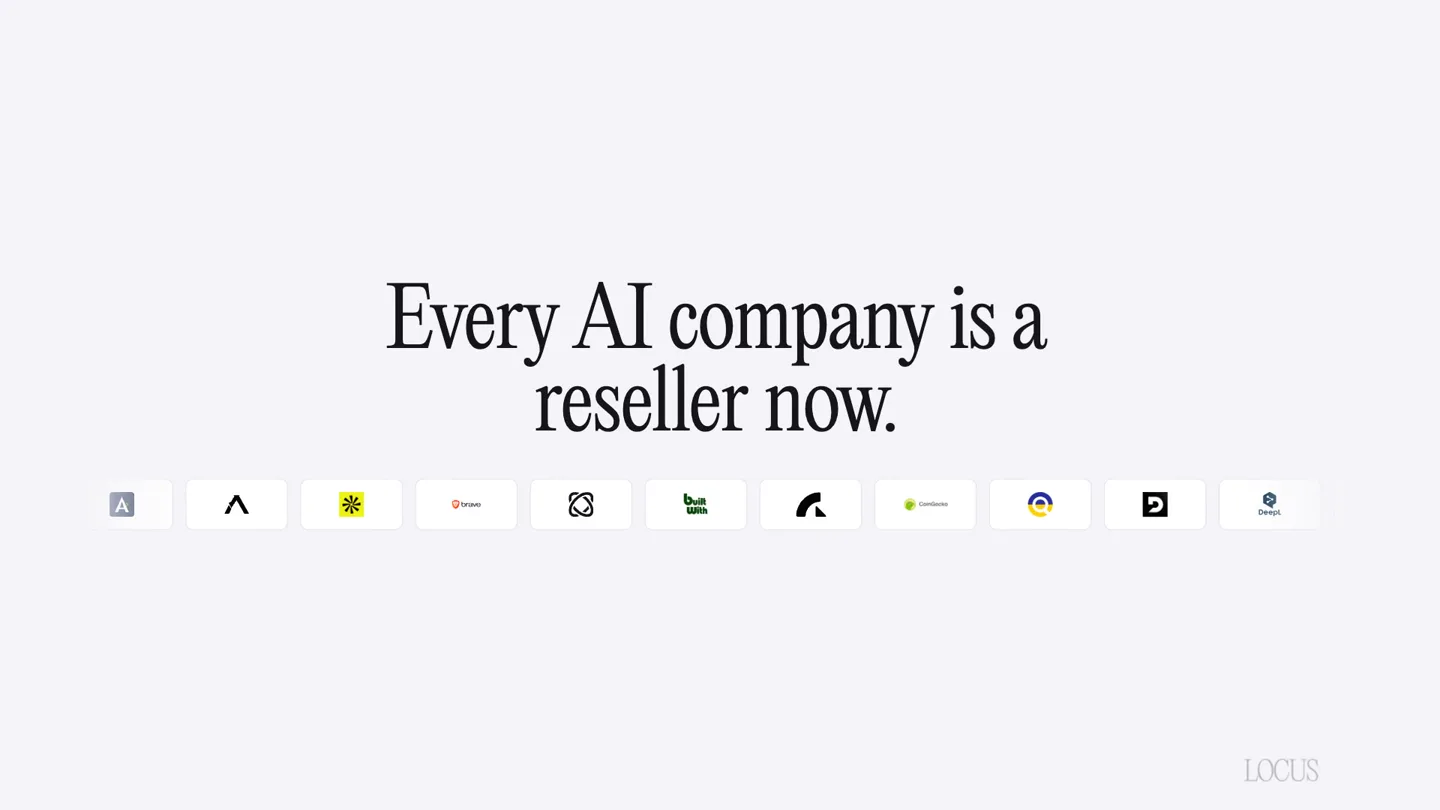
- Every AI company is a reseller now. tokens GPU time third party APIs Software was pure margin. Agents broke that. Every run has a bill. tavily/search firecrawl/scrape apollo/enrichment anthropic/messages ONE RESEARCH TASK $0.0900 $0.0115 $0.1140 $0.0849 One task. Nine cents is yours. 30¢ of costs. You charge 39. You charge $0.3905 Your costs -$0.3004 Yours to keep $0.0901 ×250 TASKS A DAY ACCOUNT REQUIRED Every vendor, another account. Signups. Cards. Invoices. 275 tool vendors your agent might call. You cannot open 286 accounts.
- Camera
- Static, centered framing on UI elements and text. Occasional subtle zooms and pans to highlight specific data points.
- Motion
- Rapid text reveals, data visualization animations (progress bars, expanding cards), icon grid animations with 'account required' pop-ups, numerical counters.
Problem Agitation
The Need for a Unified Layer
“(No spoken dialogue — Beat intensifies with more prominent 808 percussion and sub-bass drops. Tension builds.)”
- On screen
- A supply layer And a meter tavily/search 117.000 cr base cost $0.3004 your price $0.2690 You need two things. Wholesale supply, and a meter. YOUR PRODUCT LOCUS PRO PROVIDERS Your agent, unchanged One prepaid balance Your markup We pay the providers Your margin, to Stripe Your users and balances Locus is both. One balance. Your prices. One bill.
- Camera
- Static framing, with elements sliding in from the sides to form a cohesive diagram.
- Motion
- Split-screen reveals, diagrammatic animations with connecting lines and numbered steps, smooth transitions between conceptual blocks.
Product Reveal
Locus: The Unified API Platform
“(No spoken dialogue — The electronic beat maintains its driving rhythm, with subtle variations and sound effects accompanying UI interactions.)”
- On screen
- LOCUS PRO Balances & Ledger Analytics Billing Catalog & Pricing API Keys Integrate platform.paywithlocus.com/catalog + Top up Catalog & Pricing 286 services - 2,404 endpoints - enable them per user, priced in credits. Unique providers 286 Directory listings 180 MRP listings 121 x402 listings 58 Anthropic anthropic.com Verified Apollo apollo.io Verified Brave Search brave.com Verified 2 endpoints Enabled 16 endpoints Enabled 12 endpoints Enabled Exa exa.ai 6 endpoints Enabled Pick your providers. 286 of them, already wired in. Request POST /api/wrapped/credits/tavily/s Authoriza One line of routing. Cost comes back in the headers. Your ledger, live. Every burn is a row, margin included. Balances & Ledger Every burn, top-up and allocation across your users, with your margin broken out. Earnings, this task $0.0901 Margin rate 23.1% Balance, user_8213 $9.6095 endpoint calls charged margin tavily/search 1 117.000 cr $0.0270 firecrawl/scrape 3 14.937 cr $0.0034 apollo/people-enrichment 3 148.200 cr $0.0342 anthropic/messages 1 110.331 cr $0.0255 Analytics Usage, base cost and margin across your users, by day. Usage, 30 days $0.0000 Your margin $0.0000 Calls 0 Active users 0 Aug 6 Aug 18 Your margin, on every task. Usage and margin, broken out daily. Aug 10 - $1.58 burned - $0.208 yours
- Camera
- Simulated screen recordings with smooth UI navigation, highlighting specific features. Subtle camera pushes into the UI.
- Motion
- Interactive UI animations, data population (numbers increasing, bar charts growing), sidebar navigation highlights, tooltip reveals, code snippet reveals.
Call to Action
Join the Locus Ecosystem
“(No spoken dialogue — The electronic beat reaches a crescendo, with a final impactful sub-bass drop and a fading ambient synth.)”
- On screen
- 193 providers 1,620 endpoints 1 key, one bill An OpenRouter for any API. 286 providers. 2,404 endpoints. One key. LOCUS Design partners, this month. One agent. 90 days. We do the integration with you. Docs docs.paywithlocus.com Email cole@paywithlocus.com x @coledermo LOCUS docs.paywithlocus.com
- Camera
- Wide shot of a grid of logos, then a static shot of the call to action screen, fading to a dark background with the logo and URL.
- Motion
- Grid expansion of logos, numerical count-ups, text reveals with subtle fades, final brand logo reveal with a dark mode transition.
Motion design primitives
Synthesizable in Remotion · key components of the locus-api-orchestrator-launch template.
DataCardReveal
A rectangular card element slides into view, often from the bottom or side, and its internal text or data fields animate in sequentially or with a subtle fade-in effect. Numbers within the card may count up.
+ Code construction recipe
Use `spring()` for card entry animation (translateY/X, opacity). Animate text/numbers with `interpolate()` for opacity and `useCurrentFrame()` for number counting, ensuring a staggered reveal for internal elements.
IconGridPop
A grid of small, square icons appears, often expanding from a central point or fading in in a staggered pattern. Individual icons may have subtle bounce or scale animations upon appearance.
+ Code construction recipe
Implement a `map()` function over an array of icon data. Use `spring()` for `scale` and `opacity` on each icon, with a `delay` based on its index in the grid for a staggered effect. SVG filters can add subtle glow or shadow.
DynamicUIPopulation
Simulated user interface elements, such as input fields, charts, or ledger entries, dynamically populate with data. This includes text appearing, numbers incrementing, or bar chart segments growing.
+ Code construction recipe
Utilize `interpolate()` for animating `width` (for progress bars/charts), `opacity` for text reveals, and `useCurrentFrame()` for numerical count-ups. Combine with `sequence()` to orchestrate complex multi-element UI animations.
Style DNA & aesthetic system
Visual aesthetic
Typography
Motion
Special effects
Pacing & rhythm
Conceptual story rhythm
- 1
The Problem Landscape
Purpose. Establish the current challenges faced by AI companies and developers regarding API management and billing.
Execution. Rapid-fire text reveals, icon grids, and data visualizations illustrating the complexity and cost of current solutions.
- 2
The Core Solution
Purpose. Introduce Locus as the fundamental answer to the identified problems, simplifying the ecosystem.
Execution. Diagrammatic animations showing Locus as a central hub, connecting various components with clear, numbered steps.
- 3
Product in Action
Purpose. Demonstrate the practical application and benefits of Locus through simulated UI interactions.
Execution. Smooth screen recordings showcasing features like provider selection, API routing, and live ledger/analytics.
- 4
Call to Partnership
Purpose. Encourage potential users to engage with Locus, highlighting ease of integration and support.
Execution. Expanding grid of integrated partners, numerical summaries, and a clear call-to-action screen with contact details.
Remix in Animatiq Studio
Master remix prompt · agent-ready
Sample remix
Objective
Launch a new cloud-based data analytics platform called 'InsightFlow' that unifies disparate data sources and provides real-time insights.How the recipe adapts
The 'InsightFlow' video would open with a rapid sequence of data source logos (IconGridPop) and text highlighting the 'data silo' problem. A DataCardReveal would show a complex, fragmented data pipeline. The solution would be introduced with a diagram (similar to Locus's 'is both' scene) showing InsightFlow as the central hub. DynamicUIPopulation would then animate a dashboard with real-time data streams, growing bar charts, and live metric updates, demonstrating the platform's capabilities. The call to action would feature a grid of supported integrations and a prompt to 'Start your unified data journey'.Remix blueprint · locus-api-orchestrator-launch
Scene durations (4 scenes, 94s)
Key Remotion components
Related Developer Tools Product Launches
Explore all Developer Tools launches →
xAI opens voice cloning on its API: build a custom voice in about two minutes or pick from 80+ voices in 28 languages.

Claude can now operate your Mac, opening apps, browsing and filling spreadsheets, as a research preview in Cowork and Claude Code.

Agentic CLI for coding, building apps, and automating workflows.