
Rive · Launch Video Breakdown: Hook, Pacing & Motion Design
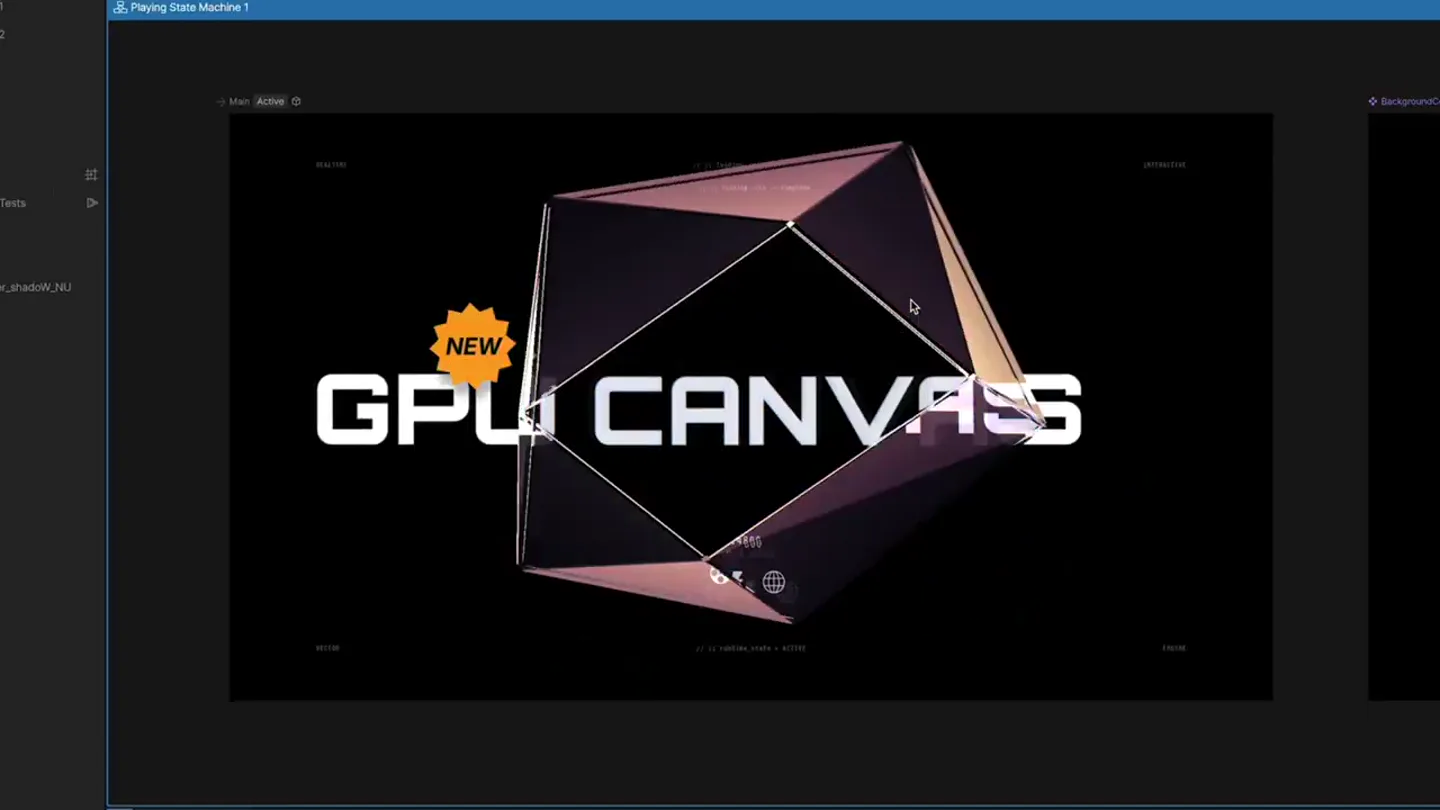
Rive's low-level GPU layer for 3D, shaders, and custom effects is out of Early Access. Write shaders once in WGSL; Rive compiles them for Metal, Vulkan, Direct3D, WebGPU, and WebGL.
Scene-by-scene timeline & spoken transcript
The Hook
GPU Canvas Reveal & Creative Potential
“Rive's low-level GPU layer for 3D, shaders, and custom effects is out of Early Access. Write shaders once in WGSL; Rive compiles them for Metal, Vulkan, Direct3D, WebGPU, and WebGL.”
- On screen
- NEW GPU CANVAS
- Camera
- Static wide shot of a rotating 3D geometric prism, then quick cuts to various UI elements and 3D scenes within the Rive editor.
- Motion
- Rapid scene cuts, 3D object rotation, UI element reveals, and dynamic text animations with a subtle glow effect.
Product Reveal
Diverse Application Showcase
“The GPU Canvas is a developer-first design, giving you low-level access to the GPU. This means you can create advanced use cases like custom 3D renderers, real-time physics simulations, and complex visual effects. You can also use it to optimize your graphics for performance and create stunning visuals.”
- On screen
- 3D SHADERS, MERMAID, LONG RANGE MISSILE, Player 2, Player 5, CALLOUT 3, SYSTEM DIAGNOSTICS 0.0.2345, Aurel One, make me a chromatic aberration shader, BOONE TOREADORS, GILBERT TIGERS
- Camera
- A series of quick, dynamic cuts showcasing various 3D scenes, UI elements, and interactive applications within the Rive editor. The camera often zooms or pans slightly to highlight specific features.
- Motion
- Fast-paced montage of diverse 3D renders, UI interactions, and shader effects. Includes object transformations, text reveals, and simulated real-time data updates. The transitions are sharp and energetic.
Feature Teaser
Shader Development & Cross-Platform Power
“With GPU Canvas, you can write shaders once in WGSL, and Rive compiles them for Metal, Vulkan, Direct3D, WebGPU, and WebGL. This allows you to target a wide range of platforms with a single codebase. The editor provides a powerful environment for shader development, with real-time feedback and debugging tools.”
- On screen
- (No on-screen text)
- Camera
- Focus on code editor interfaces, shader graphs, and abstract visual representations of GPU processes. The camera often highlights specific lines of code or nodes in a graph.
- Motion
- Abstract visualizers, code editor animations, and data flow representations. Features glowing lines, subtle particle effects, and dynamic grid patterns to convey technical complexity and power.
Call to Action
Unleash Your Creativity
“Unleash your creativity with GPU Canvas. The possibilities are endless. Get started today and bring your wildest ideas to life. Visit rive.app/gpu-canvas to learn more.”
- On screen
- (No on-screen text)
- Camera
- A final sequence of highly stylized and abstract 3D animations, showcasing fluid motion and complex shader effects. The camera moves through these abstract spaces, building to a final impactful shot.
- Motion
- Fluid abstract animations, complex particle systems, and volumetric lighting effects. The pacing becomes slightly more deliberate, emphasizing the visual impact before a final, strong audio-visual punctuation.
Motion design primitives
Synthesizable in Remotion · key components of the syntaxflow-ai-code-launch template.
GeometricPrismReveal
A faceted 3D geometric prism rotates and subtly changes its internal lighting and reflections, revealing text behind or within it. The prism has a wireframe overlay that glows.
+ Code construction recipe
Use a `ThreeCanvas` component with a custom `ShaderMaterial` for the prism's surface, interpolating `rotation` and `lightIntensity`. Implement a `WireframeGeometry` overlay with a `GlowEffect` shader. Text can be rendered as `HTML` or `ThreeText` with `opacity` and `scale` animations.
DynamicUIMontage
Rapid cuts between various UI elements within a creative tool, showcasing interactive components, code editors, and real-time 3D previews. Elements often slide, fade, or scale into view with a subtle bounce.
+ Code construction recipe
Utilize `Sequence` and `AbsoluteFill` for quick scene transitions. Animate `opacity`, `x`/`y` translations, and `scale` using `spring` or `cubic-bezier` interpolations for UI elements. Employ `CodeSurfer` for code snippets and `Canvas` for embedded 3D previews, updating props dynamically.
AbstractShaderFlow
Abstract visual representations of data flow or shader compilation, featuring glowing lines, particle systems, and dynamic grid patterns that react to audio cues or internal logic.
+ Code construction recipe
Implement a `Canvas` component with a custom WebGL shader for generative patterns. Use `interpolate` to drive shader uniforms (e.g., `time`, `resolution`, `color`) based on audio analysis or `frame` number. Particle systems can be achieved with `react-three-fiber` and `useFrame` hooks.
Style DNA & aesthetic system
Visual aesthetic
Typography
Motion
Special effects
Pacing & rhythm
Conceptual story rhythm
- 1
The Grand Introduction
Purpose. Immediately grab attention and introduce the core product (GPU Canvas) and its groundbreaking capability.
Execution. A dramatic reveal of the product name with a rotating 3D geometric object, followed by rapid cuts showcasing diverse high-fidelity 3D applications.
- 2
The Power & Versatility
Purpose. Demonstrate the breadth of applications and advanced use cases enabled by the GPU Canvas.
Execution. A montage of various interactive 3D scenes, game elements, product configurators, and complex visual effects, all rendered within the Rive editor.
- 3
The Technical Edge
Purpose. Highlight the developer-first features, cross-platform compatibility, and shader development workflow.
Execution. Visualizations of code editors, shader graphs, and abstract representations of WGSL compilation to multiple GPU APIs, emphasizing efficiency and control.
- 4
The Creative Unleashing
Purpose. Inspire users to explore the endless creative possibilities and provide a clear call to action.
Execution. A final sequence of highly artistic and fluid abstract 3D animations, culminating in a powerful visual and audio impact, followed by a call to visit the product page.
Remix in Animatiq Studio
Master remix prompt · agent-ready
Sample remix
Objective
Launch a new AI-powered code generation tool called 'SyntaxFlow'.How the recipe adapts
The GeometricPrismReveal primitive will be adapted to a 'DataCrystalReveal' for SyntaxFlow, showcasing an abstract, rotating 3D data structure that morphs and glows, revealing the product name. The DynamicUIMontage will feature rapid cuts between a simulated IDE, showing AI-generated code snippets, real-time error highlighting, and automated refactoring suggestions. The AbstractShaderFlow will be reinterpreted as 'CodeStreamVisualization', depicting glowing lines of code flowing and transforming, symbolizing cross-language compilation and optimization. The color palette will shift to cool blues and greens with electric accents, maintaining the high-tech feel. The voiceover will detail SyntaxFlow's capabilities, and the sound design will mirror the original's energy with risers and sub-bass drops.Remix blueprint · syntaxflow-ai-code-launch
Scene durations (4 scenes, 52s)
Key Remotion components
Related Creative Tools Product Launches
Explore all Creative Tools launches →
A vibe design partner with an AI-native canvas for turning ideas into UI.

We heard you wanted to use Codex rate limit resets on your own time. Starting today, we’re rolling out the ability to save rate limit resets to use later. We’re starting Go, Plus, Pro, and Business
There's a hidden tax on every knowledge worker in the world, and nobody talks about it: The design tax. You're a strategist, a sales lead, a marketer. You were hired for what you know. But every me…