
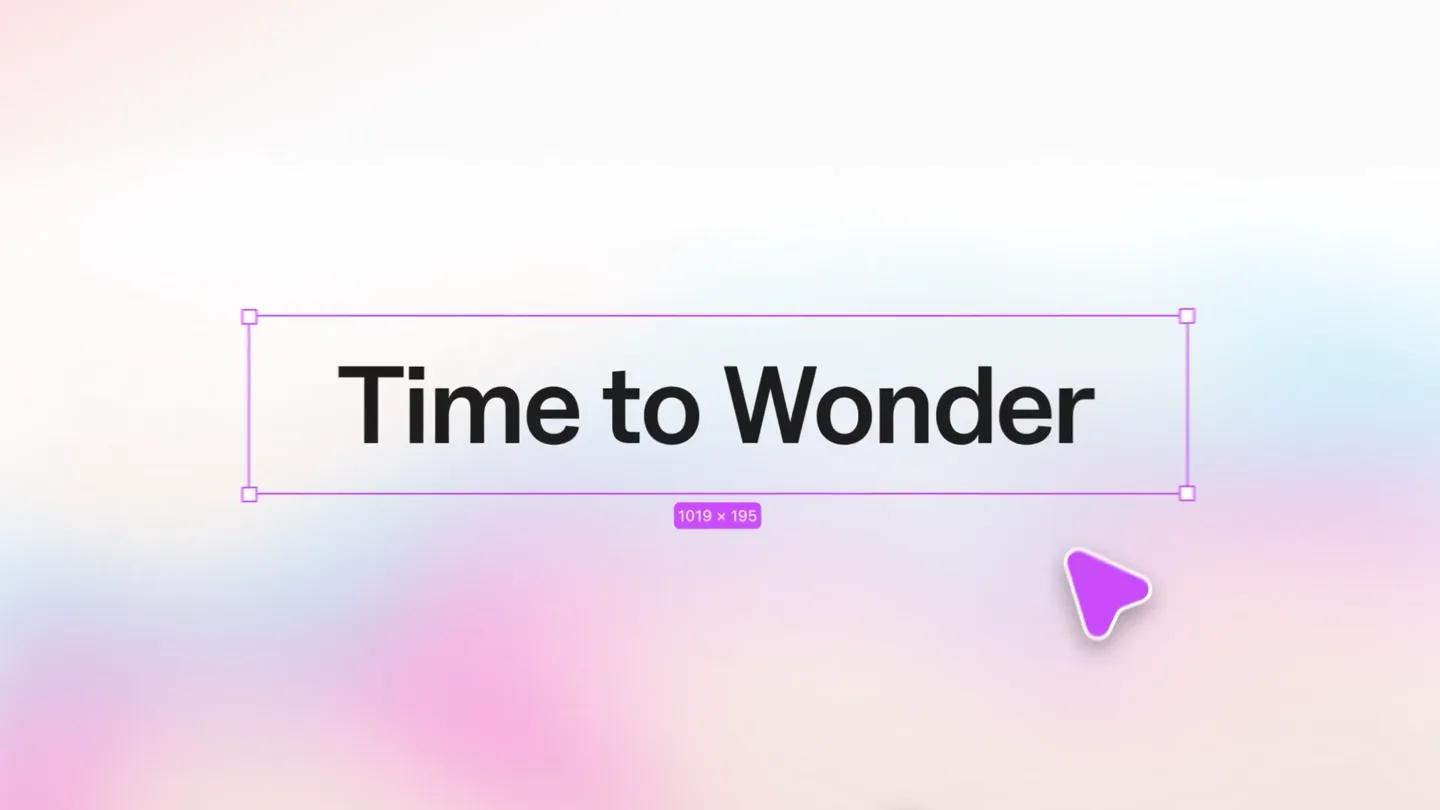
Wonder · Launch Video Breakdown: Hook, Pacing & Motion Design
A design tool where everything you create is backed by real code — closing the gap between what you design and what ships.
Scene-by-scene timeline & spoken transcript
The Hook
AI-Powered Design Generation
“(No spoken dialogue — High-energy audio transition with pizzicato synths and sub-bass drop at 0:00, building anticipation.)”
- On screen
- Create a brand identity moodboard for my g
- Camera
- Close-up on a text input field, then a rapid zoom out to reveal a full design interface.
- Motion
- Typing animation, cursor interaction, rapid UI reveal with a 'pop' effect.
Product Reveal
Seamless Design & Code Integration
“(No spoken dialogue — Orchestral synth pads and pizzicato synths create a grand, evolving soundscape. Sub-bass drop at 0:03.)”
- On screen
- Landing Page v.1.0, Copy from Figma, National Art Museum Zurich, BRAND IDENTITY MOOD BOARD, ZURICH / ART / IDENTITY, WOOD / PALETTE / TYPE / TEXTURE / DIGITAL EXPRESSION, PALETTE, MUSEUM RED #D70000, INK #17171B, PAPER #F8F8F8, STONE #D9D9D9, GOLD #9A8A3A, SIGNAL / PAPER / PIGMENT / STONE, TYPOGRAPHY, ARCHIVE / COLLECTION / EXHIBITION, A typographic system rooted in Swiss clarity, using assertive sans-serif hierarchy with generous spacing and lean, institutional confidence., EDITORIAL / GROTESQUE SANS / MONO, BODY TEXT, HEADLINE, UTILITY LABELS, BUTTONS, Uncoated paper, stone surfaces, bronze details, and archival labels., Sharp framing, generous spacing, and disciplined spacing., Describe what you'd like to design..., Auto, 2 frames added as context, Design a modern, responsive landing page using our brand identity and the, Wondering..., WHERE GLOBAL ARTISTS MEET SWISS CIVIC CLARITY., A new national platform for international gathering, exhibition, moving image and public dialogue, rooted with the quiet authority of Zurich., INTERNATIONAL ARTS, EXHIBITIONS / COLLECTION / ARTISTS, EVENTS, THREE, Paint as Public Memory, FEATURING Wolfgang Tillmans, Julie Mehretu, and William Kentridge, 18 MARCH - 14 JULY 2028, New Monumentalism, LARGE-SCALE art sculpture and installation across the lakefront, 02 APRIL - 23 AUGUST 2028, Add context, Change Theme, Create Variants, File name, Position, X 375, Y 375, L 1, W 200, H 80, Layout, Flex, 24, Padding, Margin, Appearance, 100 %, Clip content, Typography, Inter, Regular, A 24, 20, 0 %, Off, All, Word, Border, 000000, 10 %, Bottom, D262FF, 100 %
- Camera
- Dynamic camera pans and zooms across a complex UI, highlighting different elements and interactions. Focus shifts between input fields, generated content, and contextual menus.
- Motion
- Fast-paced UI animation, content generation reveal, drag-and-drop simulation, context menu pop-ups, and seamless transitions between different design states. The purple cursor acts as a guide.
Feature Teaser
Bridging Design and Code
“(No spoken dialogue — High-energy audio transition with riser and sweep at 0:17-0:18, followed by a sub-bass drop at 0:18. The music maintains an anticipatory, grand mood.)”
- On screen
- Connect MCP
- Camera
- Close-up on UI elements, then a rapid transition to abstract iconography representing design and code.
- Motion
- Iconography animation, symbolic representation of connection, rapid visual metaphor transition.
Product Reveal
Wonder: Design Backed by Code
“(No spoken dialogue — High-energy audio transition with riser and sweep at 0:28-0:29, followed by a sub-bass drop at 0:29. The music builds to a climax.)”
- On screen
- Wonder, Now in Public Alpha, wonder.design
- Camera
- Full screen reveal of the Wonder logo and tagline, with a subtle camera push-in.
- Motion
- Logo reveal, text animation with a handwritten style flourish, subtle camera movement for emphasis.
Call to Action
Experience Wonder Now
“(No spoken dialogue — High-energy audio transition with riser and sweep at 0:36-0:37, followed by a sub-bass drop at 0:37. The music resolves with a final impact.)”
- On screen
- Wonder, Now in Public Alpha, wonder.design
- Camera
- Static shot of the Wonder logo and website, allowing the call to action to resonate.
- Motion
- Subtle glow and pulse effect on the logo, reinforcing brand presence.
Motion design primitives
Synthesizable in Remotion · key components of the ai-design-to-code-launch template.
AICursorTypeReveal
A stylized purple cursor interacts with a text input field, simulating typing and then triggering a rapid UI expansion or content generation. The cursor has a subtle glow and shadow.
+ Code construction recipe
Use `interpolate` for cursor position and opacity. Implement a `spring` animation for the UI expansion. Text typing can be achieved with a character-by-character reveal. Apply SVG filters for glow and shadow effects on the cursor.
DynamicUIDrilldown
Complex UI elements, such as design panels, generated content, and contextual menus, are revealed and animated with fast pans, zooms, and pop-up effects, maintaining a sense of responsiveness.
+ Code construction recipe
Utilize `interpolate` for camera position (pan/zoom) and element opacity/scale. Employ `spring` animations for pop-up menus and content reveals. Manage z-index for layering UI elements. Consider `canvas` for complex background gradients or subtle texture overlays.
IconicConceptMerge
Abstract icons representing different concepts (e.g., design, code) animate into view, interact, and then transform or combine to symbolize a core product benefit or integration.
+ Code construction recipe
Animate SVG paths or shapes using `interpolate` for position, scale, and color. Use `spring` for impact and bounce effects during interaction. Implement `keyframe` animations for complex transformations or morphing between icons.
Style DNA & aesthetic system
Visual aesthetic
Typography
Motion
Special effects
Pacing & rhythm
Conceptual story rhythm
- 1
The AI Spark
Purpose. Immediately hook the viewer by demonstrating the product's core AI-powered generation capability.
Execution. Typing animation in an input field, followed by an instant, magical reveal of a complex design output.
- 2
Design in Flow
Purpose. Showcase the product's intuitive UI and seamless workflow for design creation and iteration.
Execution. Dynamic camera movements across the UI, highlighting features like context addition, theme changes, and responsive design generation.
- 3
Code Unlocked
Purpose. Illustrate the unique value proposition of bridging the design-to-code gap.
Execution. Abstract iconography representing design and code, animating to show their connection and the product's role in unifying them.
- 4
Wonder Revealed
Purpose. Conclude with a strong brand statement and a clear call to action.
Execution. Full-screen logo reveal with a tagline, followed by website information, reinforced by subtle animation.
Remix in Animatiq Studio
Master remix prompt · agent-ready
Sample remix
Objective
A new AI-powered data visualization platform called 'InsightFlow' that turns complex datasets into interactive dashboards instantly.How the recipe adapts
The AICursorTypeReveal primitive would show a user typing a natural language query like 'Visualize Q3 sales performance by region' into InsightFlow. The DynamicUIDrilldown primitive would then rapidly animate the generation of a multi-panel dashboard, with charts and graphs populating dynamically. The IconicConceptMerge primitive could represent raw data transforming into structured, insightful visualizations, perhaps with a 'data cloud' icon merging into a 'chart' icon. The vibrant purple accent would be replaced with a cool blue or green to signify data and clarity, maintaining the fast-paced, responsive motion language.Remix blueprint · ai-design-to-code-launch
Scene durations (5 scenes, 43s)
Key Remotion components
Related Creative Tools Product Launches
Explore all Creative Tools launches →
Anthropic Labs launches Claude Design, which turns conversation into prototypes, slides and one-pagers, powered by Claude Opus 4.7.
A vibe design partner with an AI-native canvas for turning ideas into UI.
Your work tools in Claude are now available on mobile. Explore Figma designs, create Canva slides, check Amplitude dashboards, all from your phone. Give it a try: