Glm 5v Turbo (by Z.ai) · Launch Video Breakdown: Hook, Pacing & Motion Design
Native multimodal coding from images, videos, design drafts and document layouts. Leading vision coding, tool use, and GUI agent performance. From 智谱 / Z.ai.
Scene-by-scene timeline & spoken transcript
The Hook
Multimodal UI Generation from Sketch & Prompt
“(No spoken dialogue — Driving electronic score with pizzicato synths and rhythmic percussion. High-energy audio transitions with risers and sub-bass drops.)”
- On screen
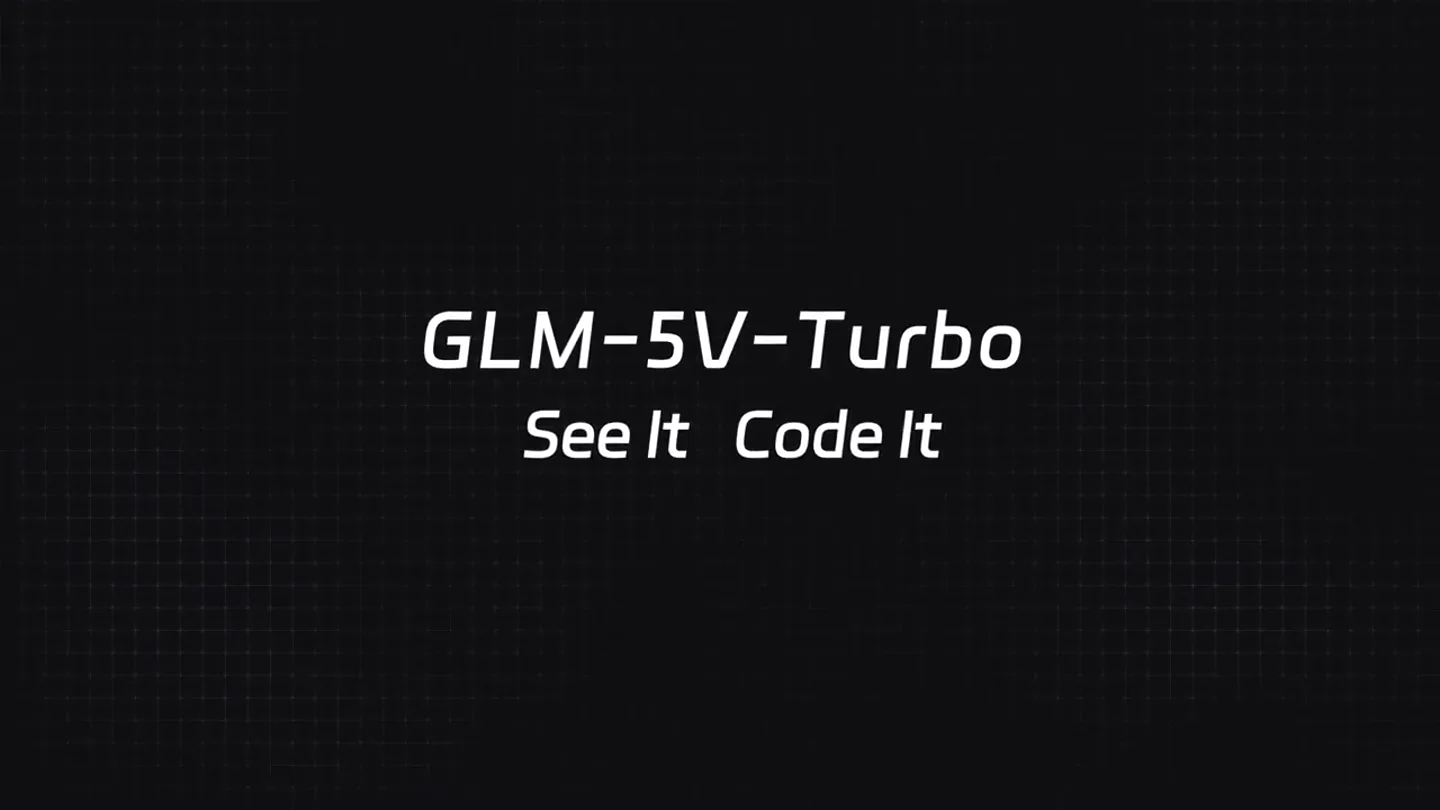
- GLM-5V-Turbo See It Code It GLM-5V PLAYGROUND Click and drag, release when you're finished SENDING FULL CANVAS Everything on the canvas will be captured. Add a frame to send only a specific area. Webframe -> App Landing Page Dashboard Describe what you want to build... GENERATE make a concept music app that plays https://lab.design/music.mp3 by def STREAMING INITIATION Resonance Queue Midnight Echoes Aurora Collective Nocturnal Sessions Vol. II COPY OPEN Resonance is a concept music player interface. Audio streams from an external source. All controls are fully functional with keyboard support.
- Camera
- Static wide shot of a UI canvas, then a slow zoom into the text input and generated UI. Subsequent shots are close-ups of UI elements and code.
- Motion
- UI element reveals, text typing animation, code generation, and smooth transitions between UI states. The initial text 'See It Code It' animates in with a subtle bounce.
Product Reveal
Generative Art & Design from Image References
“(No spoken dialogue — Electronic score continues with increased intensity, featuring melodic synth lines and rhythmic percussion. Sound effects include UI clicks and subtle whooshes.)”
- On screen
- Reference = Code Full canvas will be sent As a master of creative programming, create an interactive generative art piece with given reference image as direction / inspiration. You may use canvas2d, shader, p5.js or similar. PLAN GENERATE Full canvas will be sent [Plan] As a master of cr... OK: plan complete Describe changes, or leave empty and hit Refine. STREAMING SYSTEM STATUS FLUID QUANTIZATION FREQUENCY NODES LATENCY DEEP_BLUE.SUB GENERATIVE ART SYSTEM V2.4 X_COORD Y_COORD DEPTH SCROLL TO QUANTIZE SCROLL OR DRAG TO TRANSFORM INTENSITY CALM COPY OPEN FRAMES TO SEND 2/2 FRAME 1 FRAME 2 GLOBAL ROAD RUNNING FINISHERS UP IN 2024 COMPARED TO 2023 14.6% 20.9% 17% concept music player app with style of given reference design GENERATE Page 1 GLOBAL ROAD RUNNING FINISHERS UP IN 2024 - ALBUM UP NEXT Half Marathon Finisher Ultra Distance Events WEEKLY GROWTH COPY OPEN
- Camera
- Dynamic camera movements, including quick zooms and pans across the UI, and a subtle 3D rotation of the generated app interface. The camera often focuses on the input and output areas.
- Motion
- Rapid UI transformations, text generation, and a 'morphing' effect as one UI design transitions into another. The 'Reference = Code' text animates in with a quick, impactful reveal.
Feature Teaser
Advanced Multimodal Design & Code Generation
“(No spoken dialogue — The electronic score maintains its driving rhythm, with more complex synth melodies and a 'scratching' sound effect. Energetic transitions punctuate scene changes.)”
- On screen
- SOURCES TO SEND 1/1 create an iPhone app OK: generated Describe changes, or leave empty and hit Refine for auto-improvement. COPY OPEN 9:41 Syarn Home Search Bag Profile Drag to rotate the device Refer to the webpage screen recording 1745px x 850px Featured Works, Archives, About Corvetto Benedetto Freelance Developer Issue N°003 / Coll. 2026 Ref. E23-032026-R02 FW Clone the webpage FW Images → Code → Music Image → Strudel Music Recents images Name Date Modified Size Kind images.jpg Today at 21:09 9 KB JPEG image 000125603_0.jpg Today at 18:21 115 KB JPEG image 12081348.webp Today at 18:21 186 KB WebP image The_Beatles_Ab_album_cover.jpg Today at 18:21 587 KB JPEG image Duffy-The-Origi...Aladdin-Sane.jpg Today at 18:21 164 KB JPEG image Upload a photo Show Options Cancel Open
- Camera
- Smooth, controlled camera movements, including a subtle orbit around a 3D phone model and a dynamic pan across a webpage clone. The camera often highlights the transformation from input to output.
- Motion
- 3D object manipulation (phone rotation, cube rotation), screen recording integration, and a 'flow' animation for the 'Images → Code → Music' text. UI elements animate with a soft, elastic feel.
Call to Action
Live Coding Music & Vision Coding Model Reveal
“(No spoken dialogue — The electronic score reaches its peak intensity, with a strong four-on-the-floor beat and powerful synth melodies. Impactful sound effects, including a final sub-bass drop, conclude the video.)”
- On screen
- STRUDEL LIVE CODING REPL Strudel REPL stack( sound "bd ~ bd ~ bd ~ sd ~~"), sound "hh16").gain(0.2), sound "~ cp ~ ~ cp ~ ~~").gain(0.35).room(0.4), note "c2 ~ eb2 ~ f2 ~ bb1 ~").sound "sawtooth").lpf(300 .gain 1.0), note "[c4,eb4,g4,b4] [f4,ab4,c5,eb5] [bb3,d4,f4,ab4] [eb4,g4,bb4,d5]>").sound "p note "c5 ~ eb5 f5 ~ bb4 ~").sound "triangle").delay(0.38).room(0.5).gain(0.3 ).cpm 60 play GLM-5V-Turbo Vision Coding Model
- Camera
- Close-up on the live coding environment, with the camera subtly tracking the cursor and highlighting generated code. The final shot is a static, centered display of the product name and tagline.
- Motion
- Live code typing animation, syntax highlighting, and a 'play' button interaction. The final text reveal is clean and impactful, with a subtle glow effect. The overall pacing is fast and energetic.
Motion design primitives
Synthesizable in Remotion · key components of the ai-multimodal-transform template.
CodeStreamReveal
Text appears as if being typed in a code editor, with syntax highlighting and a blinking cursor. Lines of code can expand or collapse, and specific elements can be highlighted.
+ Code construction recipe
Use Remotion's <Sequence> and <AbsoluteFill> for layout. Implement typing effect with `interpolate` on `text.length` and `substring`. Apply syntax highlighting via `styled-components` or `className` props. Use a `spring` animation for cursor blink and line expansion/collapse.
MultimodalCanvasMorph
A UI canvas dynamically transforms from a simple sketch or image input into a fully rendered, interactive application interface, often with 3D elements or subtle rotations.
+ Code construction recipe
Utilize Remotion's `interpolate` for smooth transitions between different UI states. Employ `react-three-fiber` for 3D elements like rotating phones or cubes. Use SVG filters or Canvas API for generative art effects and image processing. Coordinate timing with `useCurrentFrame` and `spring` for elastic UI element reveals.
DynamicTextFlow
Key phrases or concepts animate across the screen, often with a 'flow' or 'stream' effect, emphasizing the transformation of one input type to another (e.g., 'Images → Code → Music').
+ Code construction recipe
Create text elements using `AbsoluteFill` and `Text`. Animate position and opacity using `interpolate` with custom easing functions (e.g., `easeOutCubic`). Use SVG paths or `clipPath` for directional flow effects. Synchronize text animations with audio beats for rhythmic impact.
Style DNA & aesthetic system
Visual aesthetic
Typography
Motion
Special effects
Pacing & rhythm
Conceptual story rhythm
- 1
The Vision
Purpose. Introduce the core concept of multimodal coding and the product's ability to translate visual input into functional code.
Execution. Opening title card 'See It Code It' followed by a rapid demonstration of sketching a UI and generating a music player app.
- 2
The Transformation
Purpose. Showcase the product's versatility by demonstrating its application in generative art and data visualization, emphasizing 'Reference = Code'.
Execution. Transition from a text prompt to a generative art piece, then to a data-driven music player UI, all from visual references.
- 3
The Expansion
Purpose. Highlight advanced capabilities like cloning complex web pages and generating music from images, broadening the scope of 'Images → Code → Music'.
Execution. Demonstration of creating an iPhone app from an image, cloning a webpage, and then live coding music from an image input.
- 4
The Breakthrough
Purpose. Conclude with the product's identity as a leading vision coding model, reinforcing its innovative nature.
Execution. Final reveal of 'GLM-5V-Turbo Vision Coding Model' with a powerful audio and visual crescendo.